
Calidi Biotherapeutics Advances Clinical Pipeline with Focus on Oncolytic Virus Therapies
Calidi Biotherapeutics’ latest quarterly filings demonstrate continued clinical progression in oncolytic virus therapies amid ongoing financial losses and capital raising efforts.
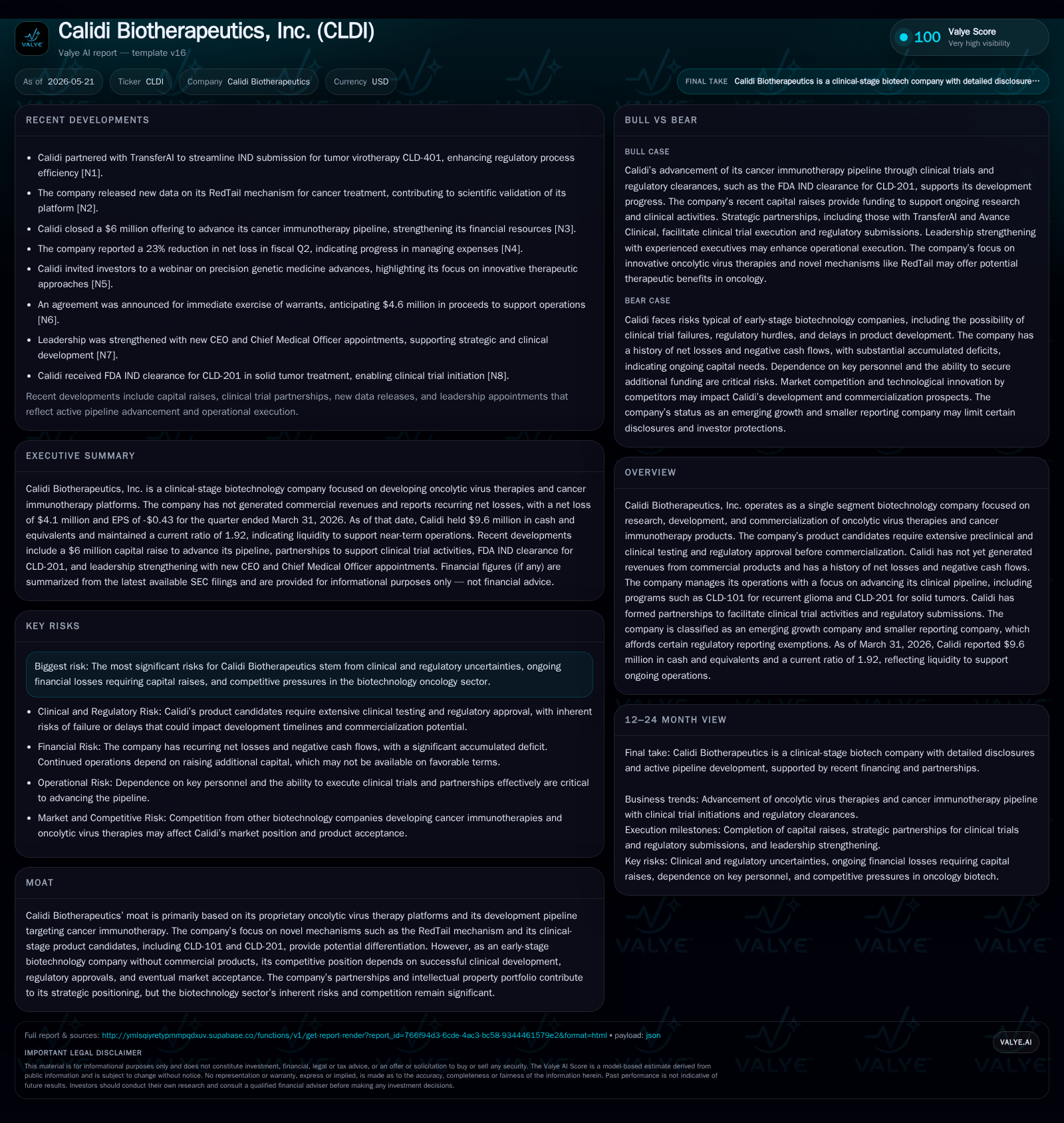
In its May 14, 2026 10-Q and related filings, Calidi Biotherapeutics detailed steady advancement of its cancer immunotherapy pipeline centered on proprietary RedTail platform enveloped oncolytic viruses. The company reported no material changes in risk factors but highlighted its ongoing net operating losses and dependence on capital markets. Calidi’s business model remains focused on early-stage R&D, with future revenue contingent on clinical milestones, regulatory approvals, and commercialization of breakthrough virus-based therapies targeting solid tumors and gliomas. Key growth drivers include clinical trial progress, streamlined IND submissions aided by a recent partnership with TransferAI, and potential licensing streams tied to the divestiture of Nova Cell assets. Nevertheless, regulatory complexity and the inherent uncertainties of early oncology biotech investing present notable risks. Financially, the company’s liquidity position is modest but supported by low debt levels and a current ratio near two.
Latest Quarterly Operational Update and Implications
Calidi Biotherapeutics’ most recent quarterly filing (Form 10-Q dated May 14, 2026) provides an operational snapshot reinforcing the continued momentum in advancing its cancer immunotherapy pipeline [S2]. While there were no material changes reported in risk factors compared to prior disclosures [S2], the company highlights persistent operating losses aligned with expectations for a pre-revenue biotechnology entity engaged deeply in R&D. Concurrent event reporting details first quarter financial results alongside corporate developments that underscore strategic priorities [S3].
Notably, recent news highlights Calidi’s collaboration with TransferAI to streamline investigational new drug (IND) submissions for their tumor virotherapy program CLD-401 [N1], suggesting active efforts to reduce regulatory bottlenecks—a crucial factor given the lengthy timelines that often hinder biotech innovation flow. These operating disclosures together signal Calidi’s strategy of pairing technology advancement with efficient trial execution frameworks.
Business Model Centered on Proprietary Oncolytic Virus Platforms
Calidi operates as a single-segment biotechnology company focusing exclusively on the research, development, and eventual commercialization of novel cancer immunotherapies based on engineered enveloped oncolytic viruses [S1]. Revenue generation prospects hinge on multiple contingent pathways: upfront license fees from collaborative partnerships, milestone payments linked to clinical progress or regulatory approvals, royalty streams from asset licenses or divested pipelines (e.g., Nova Cell), government grants and third-party funding, plus eventual product sales upon commercial launch [S1].
The core technology foundation is Calidi’s proprietary RedTail platform—an engineered enveloped virus designed to evade immune system clearance during systemic delivery. This allows targeted delivery of therapeutic genetic payloads to metastatic tumor sites otherwise difficult to access using conventional virotherapy vectors [S1][N2]. The company manages extensive preclinical development activities alongside clinical trials mainly addressing solid tumors and recurrent gliomas.
As typical in early-stage oncology biotechs, Calidi incurs substantial R&D expenditure without current product revenues. Market success depends heavily on obtaining approvals via complex regulatory pathways and achieving market acceptance post-launch. Intellectual property rights and partnerships underpin competitive advantages but also require sustained capital investment over protracted timelines.
Industry Context: Competitive Sets and Regulatory Hurdles in Oncology Biotech
The broader oncology biotechnology landscape is crowded with competitors exploring viral vector-based therapies including other oncolytic virus platforms and immune checkpoint agents. Success hinges not only on demonstrating superior efficacy or safety in clinical trials but also navigating stringent regulatory frameworks governing gene therapy products—including IND approvals that require extensive safety testing before patient enrollment can proceed.
Specialized capacity constraints exist as trials for novel biologics demand experienced clinical sites capable of handling complex protocols under Good Clinical Practice (GCP) standards. Moreover, payor reimbursement policies for breakthrough biologic therapies shape pricing power post-commercial launch. Adoption dynamics often reflect high switching costs if approved therapies yield durable responses compared with standard chemotherapy or radiation approaches.
Calidi contends within these structural conditions by developing differentiated viral platforms intended for systemic metastatic targeting—a capability few competitors currently possess at advanced stages.
RedTail Mechanism and Clinical Programs: Differentiation Through Innovation
Central to Calidi’s strategic moat is the unique RedTail mechanism leveraging an enveloped virus engineered to resist immune neutralization during bloodstream transit [S1][N2]. This property theoretically enables effective systemic distribution targeting metastatic lesions distant from primary tumors—a critical unmet need as metastasis drives most cancer mortality.
Lead clinical candidates CLD-101 (for recurrent glioma) and CLD-201 (for solid tumors) embody this approach. While still in mid-stage development requiring further validation through pivotal trials and regulatory approvals ahead of commercialization, these programs represent promising differentiation versus conventional non-enveloped viral therapies prone to rapid immune clearance.
The RedTail platform's potential to deliver potent genetic medicines directly into difficult-to-access metastatic microenvironments could elevate Calidi’s positioning if proven clinically effective [N2]. However, given early-stage status, substantial developmental risk remains.
Growth Drivers: Clinical Milestones, IND Submissions, and Partnership Expansion
Growth prospects are closely tied to achieving critical inflection points including successful IND submissions—recently facilitated by the TransferAI partnership aimed at streamlining regulatory filings for CLD-401—and subsequent clinical milestones such as patient enrollment completion or initial efficacy/safety readouts [N1][S4]
Additional growth vectors arise from milestone payments embedded within strategic alliances or licensing deals reflective of pipeline de-risking events. For example, after divesting majority ownership interests in Nova Cell along with associated intellectual property assets for an upfront payment plus deferred consideration subject to future royalties [S9], Calidi benefits from non-dilutive cash inflows supplementing its funding base.
Government grants and third-party funded research agreements further diversify funding sources. Overall growth remains capped by the timing of regulatory clearances shaping transition toward commercialization revenue streams.
Risks and Constraints: Capital Requirements, Regulatory Uncertainties, and Competitive Pressures
The company continues facing significant liquidity pressures requiring ongoing capital raises due to high burn rates approximating $20 million operating loss in the prior fiscal year [F1][S5]. Management explicitly acknowledges “substantial doubt” about short-term going concern absent successful financing efforts [S5].
Clinical development failures remain a perennial threat given high attrition rates in oncology biotechnology pipelines coupled with complex FDA approval processes requiring robust safety/efficacy data documentation [S26]. Commercial adoption uncertainty looms until definitive proof emerges demonstrating superiority or complementary benefits relative to existing therapeutic modalities.
Competitive rivalry intensifies as multiple entities vie for market share within novel virotherapy niches—necessitating continuous innovation investments alongside attentive patent protection enforcement.
Near-Term Catalysts and What Investors Should Monitor Ahead
Investors should focus attention on several upcoming catalysts signaling potential progression de-risking:
- Timing and results of pivotal trial phases for CLD-101 and CLD-201,
- Status updates regarding IND submission uptake facilitated by TransferAI collaboration,
- Announcement of any new partnership deals involving upfront or milestone payments,
- Recognition or collection of deferred consideration from Nova Cell divestiture arrangements,
- Cash runway indicators disclosed in quarterly updates reflecting funding sufficiency amid cash burn pressures. Monitoring these metrics will provide clearer signals around execution capability underpinning valuation adjustments ahead.
Financial Overview: Capital Position and Funding Pathways
By the end of calendar year 2024, Calidi held approximately $9.6 million in cash equivalents complemented by low total debt estimated at $623 thousand as of Q1 2026 [F1][S2]
Nonetheless, consistent net losses exceeding $20 million indicate reliance upon fresh equity/debt infusions or partnering revenue streams remain integral to sustaining operations beyond immediate quarters [F1][S5]. Recent capital raises via registered direct offerings and common stock placements have been material contributors but do not eliminate refinancing risk entirely due to ongoing R&D intensity [S15][S19].
Management continues emphasizing proactive financing strategies alongside operational discipline critical given the inherently long investment horizon typical for oncology-focused biotechs approaching commercialization inflection points.
This analysis is based strictly on publicly available SEC filings through May 2026 combined with recent news insights; it does not include forward-looking investment advice or speculative projections beyond documented disclosures.
Disclaimer: This is research-only, informational analysis and not investment advice. It may include AI-generated interpretation and general industry context. Always verify important details using primary sources.

Comments