
Cirrus Logic Strengthens Credit Profile While Diversifying Beyond iPhone Audio
Recent quarterly disclosures highlight Cirrus Logic’s continued reliance on Apple alongside strategic moves into new markets, bolstered by enhanced financial flexibility through an amended credit facility.
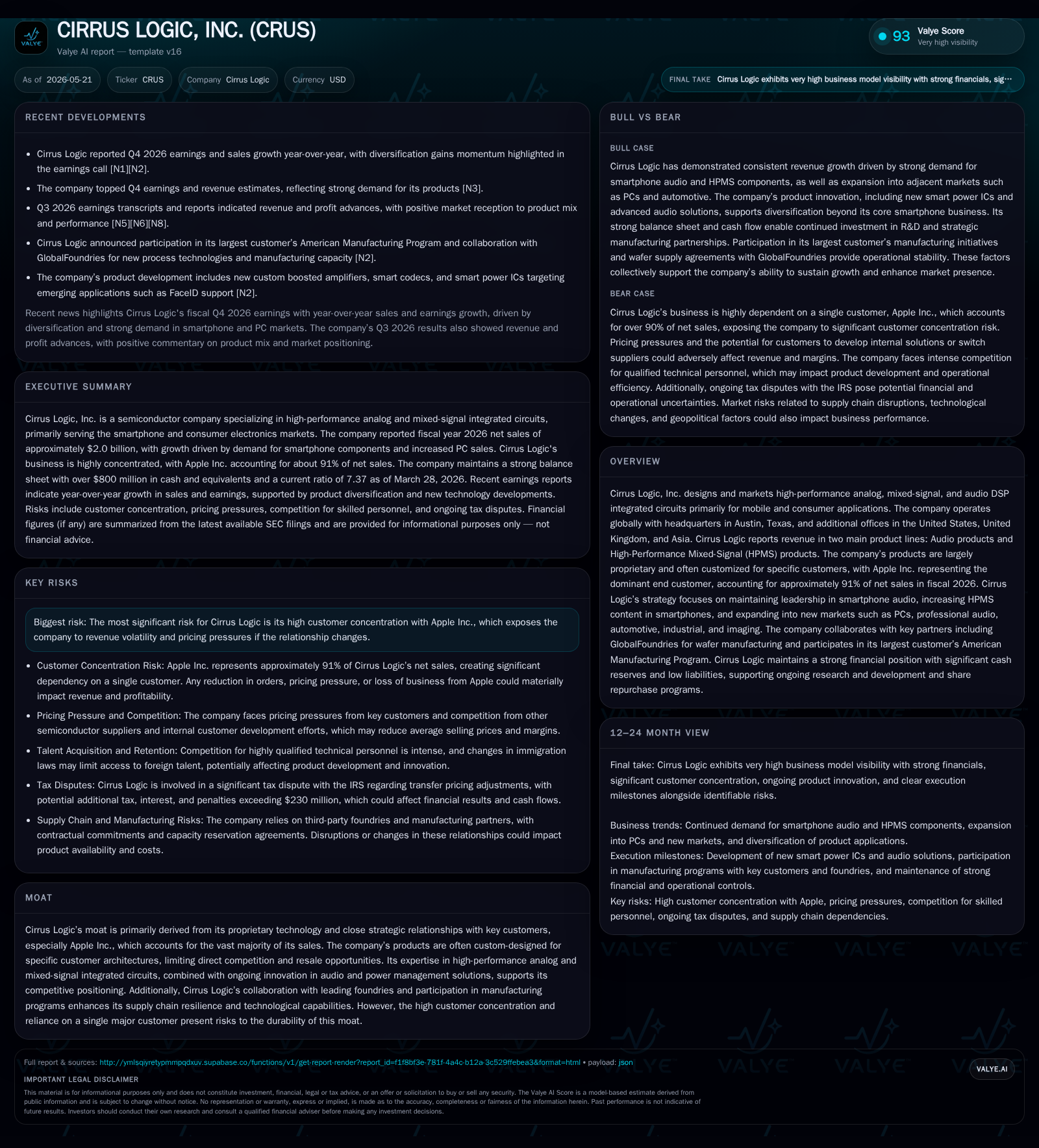
In its latest quarterly filing ending February 2026, Cirrus Logic sustained revenue growth driven by its core audio and high-performance mixed-signal (HPMS) product lines, underscoring strong demand within the smartphone space, particularly from Apple which remains its dominant customer. The company reinforced its financial foundation by entering into a third amended revolving credit agreement in May 2026, providing $350 million of secured liquidity through 2031. Strategic diversification efforts are progressing with noticeable revenue gains outside the mobile segment, aimed at PCs, automotive, and industrial markets. However, high customer concentration risks persist, necessitating careful monitoring of product mix evolution and supply chain resilience.
Latest Quarterly Operating Developments and Their Immediate Impact
Cirrus Logic's fiscal fourth quarter ending February 3, 2026 [S2] showcased continuing momentum with net sales increasing approximately 5% year-over-year to near $2 billion. This reflects solid demand across the two reported product lines—Audio products and High-Performance Mixed-Signal (HPMS) products—with HPMS revenues growing faster at around 10% driven predominantly by smartphone applications. Audio product sales saw a more moderate increase of about 2%, reflecting persistent strength in smartphone-related components as well as emerging PC segment gains [S14], [N3].
A key aspect underscored in the quarterly disclosure is the company's ongoing dependency on Apple Inc., which represented an outsized ~91% of total net sales during fiscal 2026 [S2]. Management acknowledges this concentration explicitly, noting that while expansion outside Apple is progressing incrementally, any significant change in Apple's engagement or sourcing could create variability in Cirrus Logic's top-line performance.
Business Model Overview: Proprietary Audio and HPMS ICs with Custom Integration
Cirrus Logic designs specialized analog, mixed-signal, and audio digital signal processing integrated circuits tailored primarily for mobile and consumer electronics [S1]. Revenue is concentrated in two main categories:
Audio Products: These encompass proprietary audio DACs (digital-to-analog converters), ADCs (analog-to-digital converters), amplifiers, and codec solutions customized for flagship smartphones. Their deep integration into customer hardware platforms creates substantial switching costs.
HPMS Products: This category includes high-performance mixed-signal ICs extending beyond mobile handset applications into PCs, professional audio equipment, automotive systems, industrial controls, and imaging devices.
The business model heavily emphasizes custom design wins with major OEMs. Cirrus Logic's ICs are engineered specifically for customers’ architectures rather than generic off-the-shelf chips; this restricts direct competition but also ties revenue closely to customer product cycles and design choices [S1]
Customer Concentration and Competitive Position within the Semiconductor Value Chain
The company operates under significant concentration risk due to Apple’s dominance as an end customer—purchasing through multiple contract manufacturers equating to roughly 91% of net sales for fiscal year 2026 [S2], [S12]. Such reliance poses exposure to abrupt order fluctuations or pricing pressures resulting from negotiations or changes in Apple's supplier strategy.
However, Cirrus Logic’s moat emanates from its proprietary technologies and bespoke solutions that are difficult to replicate or replace promptly. These factors contribute to high switching costs for customers considering alternative suppliers or internal component development. The company also benefits from close collaboration with leading foundries ensuring supply chain stability critical to meeting sophisticated product requirements.
Despite these advantages, competitors potentially include broad-based analog/mixed-signal semiconductor firms capable of contesting emerging segments such as PC audio or automotive electronics if Cirrus Logic cannot expand sufficiently beyond the iPhone ecosystem.
Market Structure and Peer Context: Smartphone Audio Leadership vs. Emerging Segments
Within smartphone audio chipsets specifically optimized for premium devices like iPhones, Cirrus Logic maintains a strong leadership position supported by longstanding design wins. This privileged status enables favorable margin profiles owing to high technical barriers to entry.
Yet globally broader semiconductor markets such as PCs (especially AI-enhanced audio codecs), professional audio gear, automotive infotainment systems, industrial sensors/control systems, and imaging components offer larger addressable spaces where Cirrus Logic aims incremental share gains [S1], [N2]. Strategically partnering with tier-one OEMs across these verticals allows diversification away from single-customer concentration while leveraging core strengths in mixed-signal integration.
Supply chain partnerships with foundries such as TSMC underpin product availability but require rigorous management amidst ongoing global semiconductor capacity constraints impacting timing of ramp-ups.
Growth Drivers: Expanding Product Footprint Across PCs, Automotive, and Industrial Markets
Fiscal year 2026 marked tangible progress along Cirrus Logic's multi-pronged growth strategy emphasizing three key vectors:
- Smartphone Audio Penetration: Continued evolution in smartphone features including spatial audio solutions sustains baseline demand.
- HPMS Expansion Across Platforms: Cirrus has achieved solid year-over-year increases (~10%) in HPMS revenues largely fueled by AI-enabled amplifiers/codecs gaining traction in PCs [S1].
- Diversification Into New End-Markets: Development of new product families tailored for professional audio equipment, automotive infotainment/ADAS applications, industrial sensor interfaces and imaging components broadens exposure beyond consumer devices [N11].
These growth drivers align with measurable KPIs such as incremental net sales outside Apple (~9%) and broader geographic footprint including China, India, Vietnam augmenting overall revenue resilience.
Risks and Constraints: Customer Dependency and Supply Chain Considerations
Foremost among operational risks is the extreme dependence on Apple Inc., which accounts for nine-tenths-plus of aggregate sales despite diversification measures underway [S25]. Pricing leverage tends to favor the large OEM customer who can apply pressure during contract negotiations or shift sourcing strategically.
Additional constraints reside in supply chain dynamics: wafer foundry capacity limitations may impede timely fulfillment especially for newer product ramps; currency fluctuations represent limited but present translation risks given global operational scope. Legal exposures exist but management notes no material threatened adverse impact currently expected [S1], [S25].
Potential internal technology development by customers themselves could erode Cirrus Logic’s market position over time if barriers decline.
Execution Watchpoints: Financial Agreements, New Product Releases, and Revenue Mix Progress
Investors should monitor several near-term execution milestones:
- Progress Against Revenue Diversification Targets: Tracking shifts in percent revenue attributable outside Apple will indicate success or limitation of broadening strategy.
- Deployment of AI-Enabled Product Families: Adoption rates of new HPMS audio amplifiers/codecs aligned with AI workloads in next-gen PCs represent key growth indicators.
- Credit Agreement Implementation: The Third Amended Credit Agreement signed May 4th providing $350 million revolving credit capacity through May 2031 affords enhanced balance sheet flexibility allowing funding for R&D or opportunistic M&A without immediate refinancing risk [S3].
- Capital Allocation Plans: Ongoing share repurchases under Board approvals totaling hundreds of millions support shareholder value alongside discretionary investment spending [S4], [N7].
Current Financial Foundation: Liquidity, Capital Access, and Investment Priorities
At fiscal year-end March 28, 2026, Cirrus Logic exhibited robust liquidity positions including cash and equivalents totaling approximately $801 million on balance sheet complemented by low outstanding debt levels nearing zero under existing credit facilities [F1], [S2]. The company entered into an amended secured revolving credit facility valued at $350 million maturing in May 2031 — enhancing financial flexibility for capital expenditures or strategic initiatives [S3].
Management continues disciplined share repurchases funded entirely from cash reserves indicating confidence tempered with cautious capital stewardship aligned with long-term growth aspirations.
This analysis synthesizes publicly filed SEC disclosures up through May 2026 combined with recent company news releases without providing investment advice. All financial data is cited directly from corresponding authoritative filings as noted within brackets throughout the narrative.
Disclaimer: This is research-only, informational analysis and not investment advice. It may include AI-generated interpretation and general industry context. Always verify important details using primary sources.

Comments