
Advanced Drainage Systems Expands Market Reach Amid Cost Pressures and Debt Refinancing
Advanced Drainage Systems reported growth in fiscal 2026 driven by acquisitions and operational realignments, while navigating raw material cost volatility and significant indebtedness.
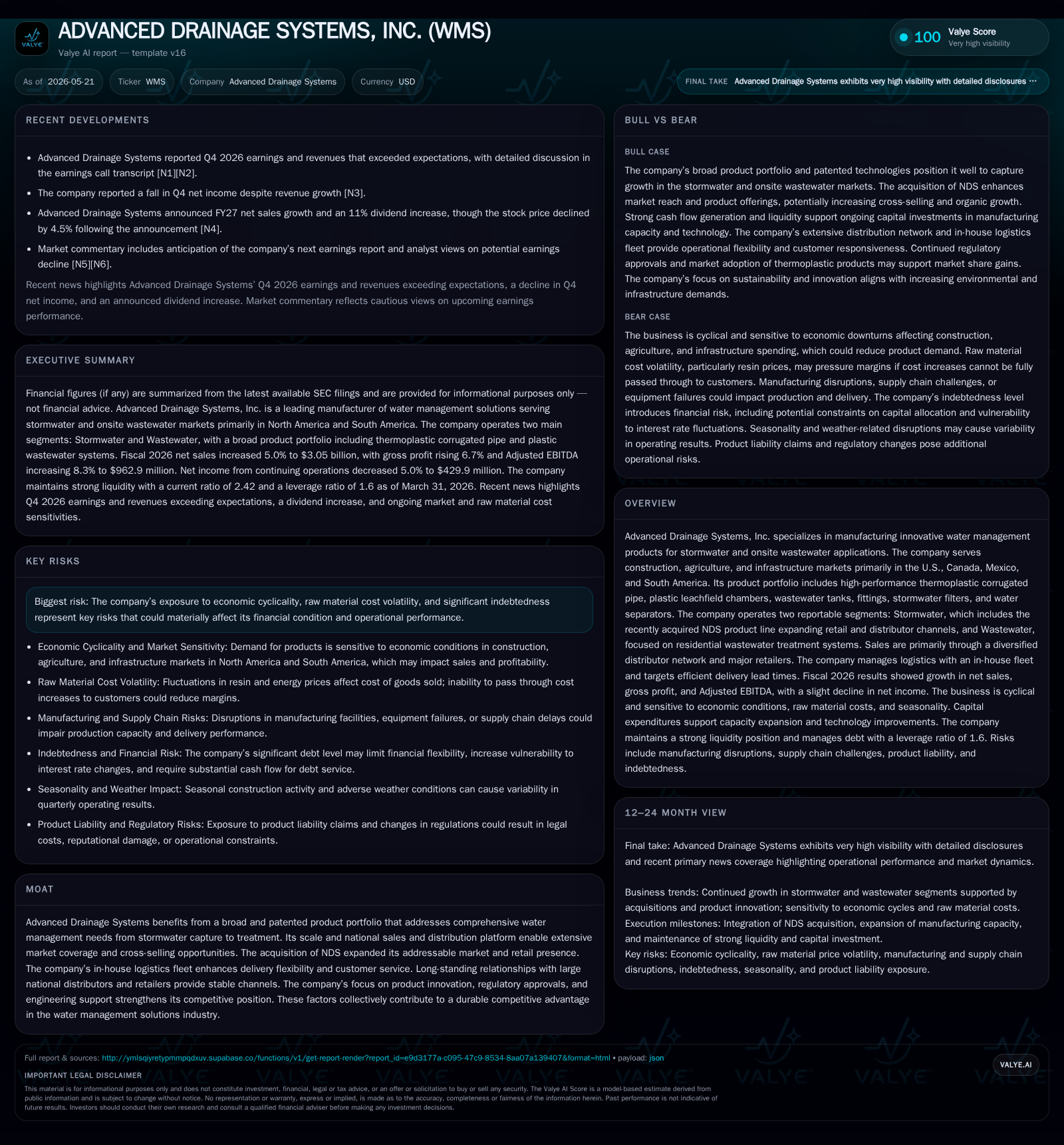
In its latest quarterly filing for fiscal 2026, Advanced Drainage Systems (ADS) highlighted ongoing integration of the NDS acquisition, delivering revenue growth through expanded product coverage and distribution channels. The company’s focus on its stormwater and wastewater segments, coupled with a broad thermoplastic product portfolio and in-house logistics, underpins its competitive moat. Structural demand drivers include residential, non-residential construction, infrastructure spending, and agriculture markets across North and South America. However, raw material cost inflation, cyclical end markets, and leverage from recent refinancing remain key risks. Monitoring execution on network optimization, pricing strategies, and debt management will be critical for ADS’s growth trajectory.
Recent Operating Update
Advanced Drainage Systems (ADS) released its latest quarterly report for fiscal Q3 ending December 31, 2025 ([S2]). This filing reflects ongoing efforts to integrate the National Diversified Sales (NDS) acquisition completed in the prior year. The company has realigned its reportable segments — primarily into Stormwater and Wastewater divisions — to mirror how performance is assessed by management following the NDS integration ([S3]).
The recent quarter demonstrated modest net sales growth supported by expanded distribution channels especially through retail and distributor networks enhanced by NDS. While raw material costs (resins used in thermoplastics) remain elevated causing pressure on cost of goods sold, ADS has been implementing price increases where competitively feasible. A 2026 Restructuring Plan initiated during the fiscal year has optimized production facilities and distribution networks to better manage these headwinds ([S18]).
Business Model
ADS manufactures innovative water management products tailored to stormwater capture/treatment as well as onsite wastewater applications. Its offering includes patented thermoplastic corrugated pipes known for their durability, light weight versus traditional concrete or steel alternatives, plastic leachfield chambers, wastewater tanks, fittings, stormwater filters, and separators ([S1]).
Revenue is predominantly generated by selling these products through a diversified network of distributors and key national retailers operating primarily in the U.S., Canada, Mexico, and select South American markets. Customers span residential construction projects to large infrastructure developments and agricultural applications.
Pricing dynamics are influenced by raw material costs—especially polyethylene (HDPE) and polypropylene (PP) resins—which compose a significant portion of production expenses. The company strives to offset such cost pressures via price adjustments but faces competition-driven limits on pricing power ([S1]). Product mix also affects margins since allied products like chambers and filters have a lower resin content.
Vertical integration includes ADS’s own logistics fleet managing delivery schedules to optimize service levels—an important differentiator in timely fulfillment within construction supply chains where delays can be costly ([S1]). Engineering support services further strengthen customer relationships by assisting specifications that align with regulatory requirements.
Industry Structure & Competitive Position
The water management product industry served by ADS is fragmented but highly competitive. The market is characterized by low-to-moderate barriers to entry at the local level but consolidation trends favor larger players with national reach like ADS.
ADS maintains a leadership position due to:
- Broad patented product portfolio covering stormwater/wastewater solutions,
- Extensive scale allowing cross-selling opportunities across product lines,
- A national sales and distributor platform complemented by the recent NDS acquisition expanding retail penetration,
- Superior logistics capabilities via an owned fleet enabling efficient delivery,
- Strong engineering capabilities facilitating regulatory approvals across varied jurisdictions.
Competitors include manufacturers of alternative materials (concrete/steel/PVC), regional pipe producers, and allied product companies. ADS’s thermoplastic technology advantage provides lighter weight, durability benefits making it increasingly preferred in many applications ([S1],[S26]).
However, competitor pricing policies constrain price escalation efforts. Additionally, ongoing raw material cost volatility creates margin variability industry-wide.
Growth Drivers
Structural Demand Drivers:
- Residential Construction: Growth linked to homebuilding rates impacted by demographic trends such as population growth and household formation.
- Non-Residential & Infrastructure: Commercial development activity and government-funded infrastructure projects drive demand for drainage solutions.
- Agricultural Markets: Farm income levels influence irrigation and drainage needs.
- Geographic Expansion: Increasing adoption of thermoplastic pipe products supported by evolving regulatory approvals enabling entry into new markets.
Product Portfolio Expansion:
The addition of NDS expanded ADS’s addressable market by adding complementary allied products including stormwater chambers and filtration systems which facilitate bundled sales opportunities. Organic growth in these Allied Products alongside cross-selling supports top-line expansion ([S1]).
Operational Efficiencies:
The 2026 Restructuring Plan targets optimization of production footprint via facility closures/reconfigurations combined with distribution network enhancements aimed at reducing costs over time ([S18]).
Pricing Strategy:
Efforts to realign pricing in line with raw material cost inflation support margin preservation despite competitive challenges. Maintaining cost pass-through ability is critical due to resin price volatility ([S1],[S26]).
Risks / Watchpoints / Growth Constraints
Cyclicality & Economic Sensitivity:
Demand heavily depends on economic conditions affecting residential/commercial construction cycles plus infrastructure budgets. Interest rates, credit availability and unemployment are key macro drivers impacting order volumes ([S1]).
Raw Material Cost Volatility:
Resin price fluctuations significantly affect unit costs. Limited pricing power in certain segments exposes ADS to margin compression risk if cost increases cannot be fully passed on ([S1],[S26]).
Indebtedness Exposure:
ADS carries substantial debt following acquisition activity despite recent refinancing efforts that extended maturities through 2034 ([S5],[S7],[F1]). Elevated leverage may limit financial flexibility amid adverse demand or unexpected expense spike scenarios ([S21]).
Regulatory & Operational Risks:
Product approvals depend on regulatory bodies which can alter standards affecting permissible uses. Transportation regulations relating to vehicle size/weight or driver hours could raise logistics costs impacting margins ([S15],[S17]). IT disruptions or cybersecurity threats pose potential operational risks ([S15]).
Competition & Market Dynamics:
Consolidation among competitors or new entrants could intensify price competition or erode market share if innovation pipelines falter or customer relationships weaken ([S26]).
What to Watch Next
- Execution of segment realignment including synergy capture from NDS acquisition.
- Effectiveness of restructuring measures in delivering targeted cost savings.
- Stability or improvement in product pricing relative to raw material cost cycles.
- New product launches or regulatory approvals expanding addressable markets.
- Order trends reflecting underlying demand strength across construction/infrastructure/agriculture sectors.
- Monitoring debt covenant compliance amid interest rate changes or economic downturns.
- Progression of capital expenditure plans aimed at capacity expansion or productivity improvements.
Financial Profile Overview (Latest Quarter)
As of March 31, 2026 (fiscal year-end), ADS reported operating income of approximately $619 million with net income around $426 million [F1]. Total debt stood near $1.63 billion against cash reserves of roughly $223 million yielding net debt about $1.41 billion [F1]. This results in a moderate leverage ratio near 1.6x net debt to adjusted EBITDA based on company disclosures ([S6],[F1],[S25]). Liquidity remains robust with nearly $740 million available under revolving credit facilities after accounting for letters of credit [F1].
This analysis is intended solely for informational purposes based on publicly available SEC filings and news sources as of May 2026 without investment advice.
Disclaimer: This is research-only, informational analysis and not investment advice. It may include AI-generated interpretation and general industry context. Always verify important details using primary sources.

Comments