
Cibus Pushes Gene-Edited Seeds Toward Market Milestones
Cibus’ latest quarterly update reveals advancing commercialization efforts anchored by its proprietary RTDS® platform and expanding licensing partnerships amid regulatory tailwinds and capital raises.
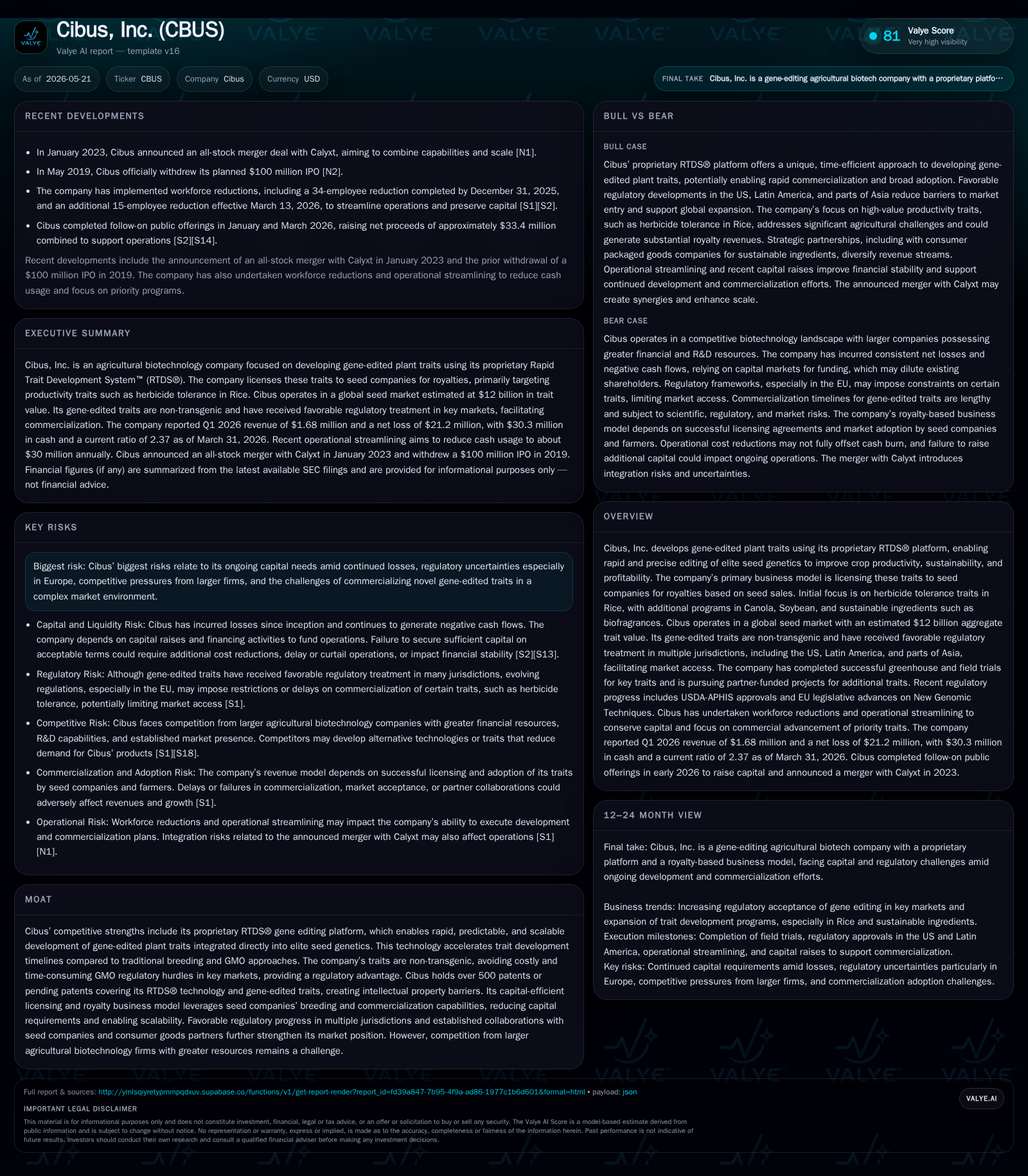
In its Q1 2026 filing, Cibus disclosed significant progress in developing gene-edited crop traits, with a strengthened cash position after recent equity offerings supporting near-term operating needs. The company’s RTDS® platform enables rapid, cost-efficient gene editing of elite seed genetics, focusing currently on herbicide tolerance traits in Rice with additional programs in other crops and sustainable ingredients. Regulatory clarity in key markets outside Europe underpins a favorable commercial environment, while Cibus leverages a capital-efficient royalty-based licensing model to scale. Risks include ongoing operating losses, regulatory uncertainties, and competitive pressures, but upcoming milestones such as licensing deals and trial results will be pivotal to monitor.
Latest Quarterly Operating Highlights
Cibus’ May 2026 10-Q [S2] provides the clearest near-term snapshot of operational momentum intertwined with financing progress that materially improves liquidity runway. Cash and equivalents rose sharply to approximately $30.3 million at quarter end from $9.9 million at December 31, 2025 [F1], following two equity follow-on offerings completed earlier in the year that generated net proceeds totaling roughly $33.4 million after underwriting fees [S2][S26]. These injections augment the company's ability to sustain its development-focused operating profile amid volatile external funding conditions.
However, losses remain pronounced—Q1 2026 net loss totaled $21.2 million with cash usage from operating activities at approximately $11.5 million [S2][S19]. This reflects ongoing investment in R&D efforts around core trait development programs and advancing partner collaborations that have yet to translate into meaningful top-line revenues given the early stage of commercialization.
Operationally relevant is the advancement of the rice herbicide tolerance (HT) traits pipeline—the flagship program underpinning Cibus’ near-term royalty potential—where multiple stacked trait variants are progressing through field trials. Licensing discussions are reportedly ongoing with major seed companies targeting Latin America and U.S. markets [S3]. Concurrently, workforce reductions executed through March 2026 [S21] illustrate management's focus on capital discipline while prioritizing resources toward commercial readiness.
Proprietary RTDS® Platform and Business Model Overview
Cibus’ unique Rapid Trait Development System™ (RTDS®), as detailed in its March 2026 10-K [S1], is central to its business model innovation within the agricultural biotechnology sector. The RTDS® suite facilitates targeted gene edits at single or few base pair resolution directly into elite germplasm—a process that compresses traditional trait development cycles substantially to about one year versus multi-year GMO breeding timelines.
This precision approach circumvents transgenic modification classifications by regulatory bodies recognizing non-transgenic edits as closer to natural breeding variants rather than genetically modified organisms (GMOs). This distinction allows reduced regulatory complexity and accelerated market access relative to conventional GMOs.
The company operates primarily via licensing agreements granting rights to seed companies for integrating these gene-edited traits into their commercial seed lines. Royalties are then collected based on downstream seed sales volumes—an approach that leverages partners' established breeding pipelines and global distribution networks while limiting Cibus’ own commercialization capital burden.
Additionally, Cibus pursues partial partner funding for secondary initiatives such as sustainable ingredients (e.g., biofragrance production), broadening potential revenue streams beyond staple crop traits [S1]
Regulatory Landscape and Industry Position
Cibus benefits from a markedly evolving regulatory environment that favors its non-GMO gene-edited products in several key agricultural markets. As outlined in its annual filings [S1][S20], countries including the United States, Canada, Argentina, Chile, Ecuador, United Kingdom, Africa, and components of Southeast Asia have set precedents positioning non-transgenic gene-edited crops outside traditional GMO frameworks.
This reduces both costs and timelines associated with market entry compared to transgenic competitors who face more stringent evaluation protocols. Consequently, Cibus moves faster from lab to field trials to commercial launch—a crucial advantage for maintaining relevance amid rapid agricultural innovation demands.
Conversely, regulatory ambiguity or restrictive policies within the European Union remain a significant watchpoint due to its slower acceptance trajectory of gene editing technologies for crops [S1][S25]. This limits immediate expansion opportunities within this economically important region.
Overall, Cibus occupies an advantageous niche where regulatory clarity aligns well with product design philosophy centered on non-transgenic edits that meet both sustainability criteria and farmer needs for improved crop resilience.
Competitive Context and Peer Benchmarking
Within the global seed trait market—which management estimates at around $12 billion aggregate value encompassing GMO and non-GMO seeds—Cibus positions itself distinctively through its IP fortress combined with swift RTDS®-enabled product cycles [S1]. Its portfolio includes more than 500 patents or pending patents protecting both platform technology and individual trait edits.
Unlike large biotechnology incumbents primarily focused on transgenic seeds subject to protracted approval processes and higher upfront costs, Cibus’ approach reduces time-to-commercialization barriers significantly while seeking partners able to efficiently scale trait adoption globally.
This positions Cibus competitively against peers exploring CRISPR or other newer gene-editing methods but lacking equivalent patent coverage or holistic licensing models supporting broad trait deployment across multiple crops such as rice—one of humanity's staple grains—and specialty segments like sustainable plant-derived ingredients.
While precise share data lacks disclosure here, these characteristics form structural moats around Cibus’ business defending against commoditization risks typically inherent in ag biotech innovations.
Identifying Key Growth Drivers
A cornerstone growth driver is the rice herbicide tolerance (HT) pipeline which management estimates could generate over $200 million in annual addressable royalties once fully commercialized across targeted U.S. and Latin American markets [S1]. Progression through confirmatory field trials coupled with advancing licensing negotiations constitutes tangible signals toward near-term monetization potential.
Growth is further underpinned by geographic expansion prospects tapping emerging economies where regulatory frameworks are increasingly aligning with non-GMO supervisory models—for instance across parts of Asia outside China—and developing regions including Africa.
Cibus’ diversified pipeline adds optionality beyond rice HT traits; efforts underway extend into canola, soybean productivity traits alongside sustainable ingredient programs such as biofragrances featuring partner-funded R&D reducing upfront investment risks [S1]. This pipeline breadth has the dual effect of mitigating single-trait concentration risk while also attracting interest from varied customer segments aligned with agricultural sustainability imperatives.
The licensing-and-royalty business model supports scalable margin expansion as incremental revenues depend primarily on partner-driven commercialization success rather than escalating fixed costs internally.
Risks and Growth Constraints
Despite promising science and market positioning, several material risks weigh heavily. Foremost is sustained operating loss exposure reflecting ongoing high R&D budgets necessary for pipeline advancement—the Q1 2026 net loss of $21.2 million underscores this challenge alongside associated cash burn rates requiring recurrent capital raises [S2][F1].[S22]
Capital raising constraints related to market conditions or shareholder dilution limits could impede continuous product development or commercialization scaling efforts.
Regulatory uncertainties persist notably regarding European policies where political opposition or changing guidelines may constrain market access or delay launches significantly [S1].
Competitive threats from major agricultural biotechnology players leveraging broader resources or integrating next-gen biotechnologies also pose innovation pace risks affecting long-term relevance.
Farmer adoption dynamics remain another critical variable: entrenched seed suppliers' preferences combined with cautious farmer uptake behaviors towards novel gene-edited germplasm could dampen initial volumes impacting royalty inflows.
Collectively these factors frame an inherently speculative investment environment pending demonstrable commercial milestone achievements.
Upcoming Catalysts and What to Watch
Investors should monitor several milestones signaling commercial validation pathways ahead:
- New licensing agreement announcements expanding geographic reach or adding crop applications provide direct revenue growth indicators.
- Field trial outcomes for core rice HT traits influencing regulatory approvals inform timeline visibility for launch readiness.
- Evidence of partner-funded projects scaling activity particularly in Asian or Latin American agro-markets serves as proxy demand signals.
- Regulatory developments especially clarifications or progresses beyond Americas/Asia toward European alignment will materially affect addressable market size.
- Quarterly earnings guidance updates revealing evolution in cash burn trajectory versus earlier prompts insight on runway management amid variable external financing landscapes [S2][S3][S26]. These operational checkpoints collectively represent execution inflection points critical for sustained pathway growth affirmation.
Current Financial Profile and Liquidity Status
From a financial perspective at March 31, 2026 quarter-end [F1][S2], Cibus held total cash & equivalents of approximately $30.3 million against current liabilities near $13.9 million yielding a healthy current ratio around 2.37x—indicating solid short-term liquidity sufficiency relative to obligations. Total debt remains minimal at approximately $0.56 million underscoring limited leverage risk currently [F1]. Recent equity offerings conducted during January ($19.8 million net proceeds) and March ($13.6 million net proceeds) materially enhanced capital buffers reinforcing operational continuity against ongoing cash use due predominantly to R&D investment spending patterns [S2][S26]. Nonetheless operating losses continue suggesting reliance on further financing rounds until meaningful royalty income streams emerge post-commercial launches.[S2][F1] The company’s cost reduction programs including workforce downsizing aim to dampen annual net cash consumption closer toward targeted sub-$30 million levels providing incremental financial stability.[S21] Overall liquidity posture is adequate near-term but subject to execution risk tied to timely revenue conversion from pipeline deployment phases.
This analyst report synthesizes publicly filed SEC materials without offering investment advice or price targets. It reflects Valye News' assessment grounded exclusively on disclosed evidence as of June 2026.
Disclaimer: This is research-only, informational analysis and not investment advice. It may include AI-generated interpretation and general industry context. Always verify important details using primary sources.

Comments