
ARC Group Acquisition I Corp. IPO Raises $120.75M as SPAC Search Begins
The company’s recent IPO establishes the financial foundation for pursuing its initial business combination within the mandated timeframe.
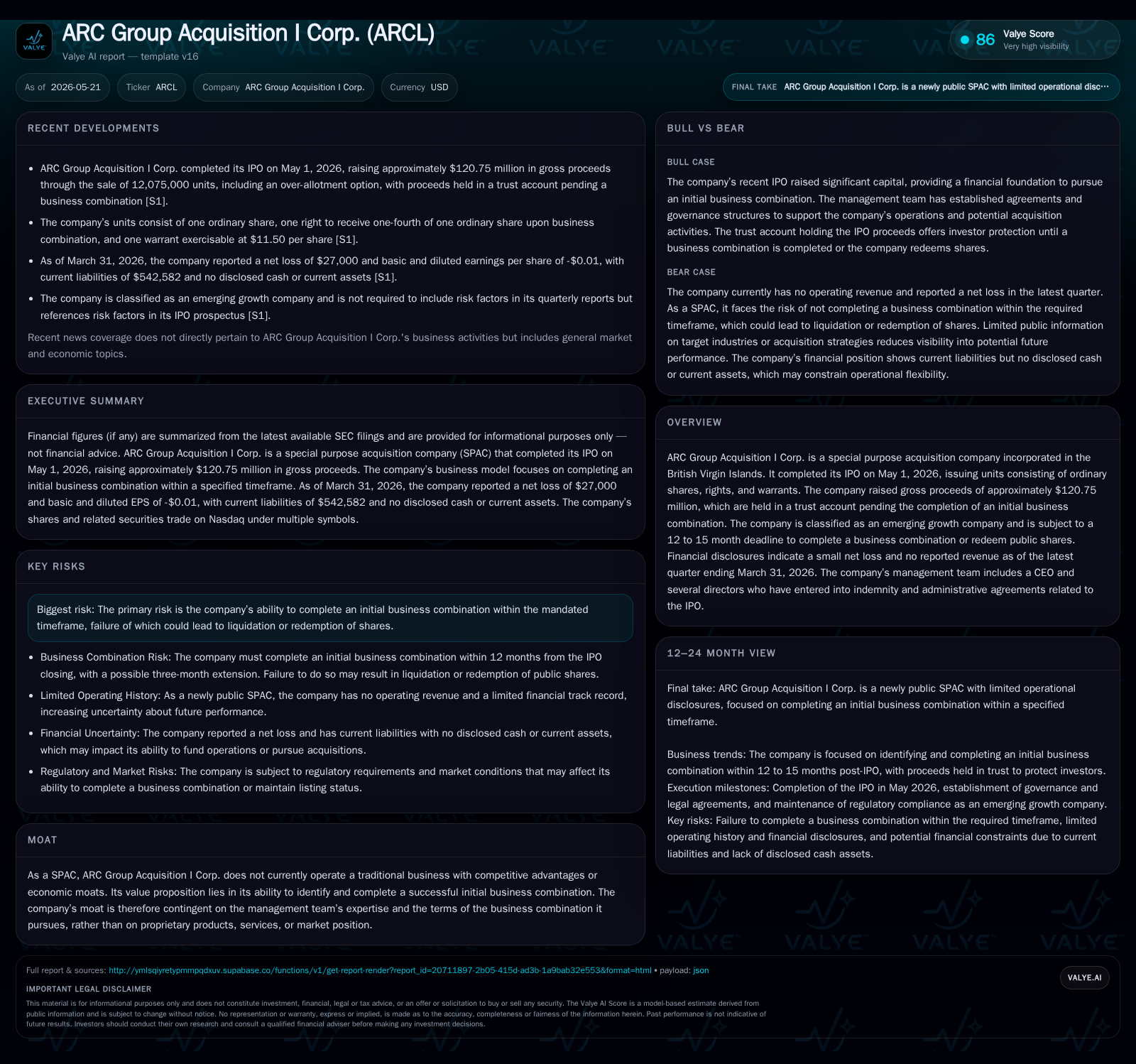
ARC Group Acquisition I Corp. completed its IPO on May 1, 2026, raising gross proceeds of approximately $120.75 million, which are held in trust pending a business combination. As a special purpose acquisition company (SPAC), ARC does not currently generate revenue, reporting a nominal net loss in its latest quarter. The company’s value is tied to its management team's ability to identify and consummate an attractive merger or acquisition within the next 12 to 15 months. Key risks include the potential failure to complete this business combination within the specified deadline, which would trigger asset liquidation and shareholder redemption.
Recent Operating Update: IPO Completion and Financial Position
ARC Group Acquisition I Corp., incorporated in the British Virgin Islands as a special purpose acquisition company (SPAC), completed its initial public offering on May 1, 2026 [S3]. The offering consisted of 12,075,000 units — each unit including one ordinary share (par value $0.0001), one warrant exercisable at $11.50 per share, and one right entitling holders to receive one-fourth of an ordinary share upon consummation of the company's initial business combination. Including the full exercise of an over-allotment option granting an additional 1.575 million units, ARC raised gross proceeds totaling approximately $120.75 million.
These proceeds are currently held in a U.S.-based trust account managed by Efficiency, INC., acting as trustee [S6][S12]. Except for limited amounts potentially released to cover taxes or dissolution expenses, the funds cannot be accessed until ARC completes an initial business combination or is required to redeem shares due to failure to do so within the specified timeframe.
The latest quarterly filing dated May 14, 2026 [S2] reflects minimal operational activity consistent with typical newly formed SPACs. ARC reported no revenue for the quarter ended March 31, 2026; net losses were nominal at $27,000 [F1]. Current liabilities stood at just over $542,000 indicating low operating expenses beyond administrative costs related to IPO completion and compliance.
Business Model: Capital Pooling for Acquisition
ARC functions as a blank-check vehicle designed solely to raise capital via an IPO to finance an acquisition or merger that establishes an operating enterprise under its corporate umbrella. Unlike traditional companies generating revenue through product sales or services, ARC's revenue mechanism revolves around identifying a suitable private entity in need of public market access or capital liquidity. Shareholders essentially entrust management's deal-making ability rather than existing cash flows.
Investors pay upfront for units combining equity shares with attached warrants and rights to sweeten potential upside exposure while maintaining downside protection through trust-account funds held at near-IPO valuations.
Margins and cash conversion mechanics are negligible pre-deal since ongoing expenses relate mostly to public company compliance rather than direct sales operations. This model depends heavily on:
- The quality and sector attractiveness of targeted acquisitions,
- Management’s track record sourcing deals,
- Timing relative to regulatory windows and market conditions.
Pricing power or customer switching does not apply; instead, investor sentiment toward SPAC structures broadly influences post-combination valuations.
Industry Structure and Competitive Position
The company's strategic edge hinges on management expertise rather than operational scale or proprietary assets—common across newly launched blank-check companies. Its moderate $120 million funding pool positions it as mid-sized relative to larger SPAC peers targeting deals in hundreds of millions or billions but still capable of meaningful transactions in small-to-mid market segments.
Growth Drivers
Growth is solely contingent on identifying and successfully executing an initial business combination meeting investor expectations. Drivers include:
- Deal Sourcing Effectiveness: Management’s network access and ability to negotiate favorable terms underpin future expansion.
- Market Receptivity: SPAC popularity fluctuates; positive investor sentiment towards newly listed companies post-merger supports valuation uplift.
- Regulatory Environment: Relaxed SEC regulations on de-SPAC deadlines or easing disclosures can facilitate transaction pipeline acceleration.
- Sector Trends: Targeting industries with high growth potential (technology innovation, healthcare transformation) can boost combined entity appeal.
Furthermore, absence of operational history means persistence depends entirely on management's strategic decisions rather than proven business lines.
What To Watch Next
The immediate priority milestones include:
- Identification and announcement of prospective acquisition targets with detailed due diligence disclosures.
- Formal signing of definitive merger agreements subject to customary closing conditions including shareholder votes expected within coming quarters.
- Investor communications regarding deal structure impacting warrant exercises and share rights implications.
- Market response at each event signaling confidence in ARC's strategic direction.
Given the strict timeline imposed by regulatory requirements documented in ARC's amended charter [S6], progress updates toward deal closure form critical indicators of execution success beyond this foundational capital raise phase.
Financial Profile Context
While ARC currently operates without revenue generation reflective of its blank-check status as confirmed by the zero-revenue quarterly report ending March 31, 2026 [F1], it carries limited short-term liabilities ($543K) indicating efficient cost containment amid setup activities. Net loss was minimal at $27K mainly attributable to administrative expenses during listing preparations [F1]. Capital raised via the IPO constitutes restricted funds held in trust ($120.75 million) awaiting deployment upon successful deal closure [S3][S12].
This financial snapshot is typical for a pre-combination SPAC emphasizing governance alignment between sponsor interests and prospective shareholders committed to future transaction outcomes rather than legacy operations.
This report is based exclusively on publicly filed SEC documents up to May 21, 2026. It provides an analytical overview without investment research views.
Disclaimer: This is research-only, informational analysis and not investment advice. It may include AI-generated interpretation and general industry context. Always verify important details using primary sources.

Comments