
Cardio Diagnostics Advances AI-Driven Cardiovascular Testing Amid Early Commercial and Regulatory Hurdles
Cardio Diagnostics combines genetic and epigenetic data in novel cardiovascular tests while addressing limited revenue, operating losses, and evolving reimbursement challenges.
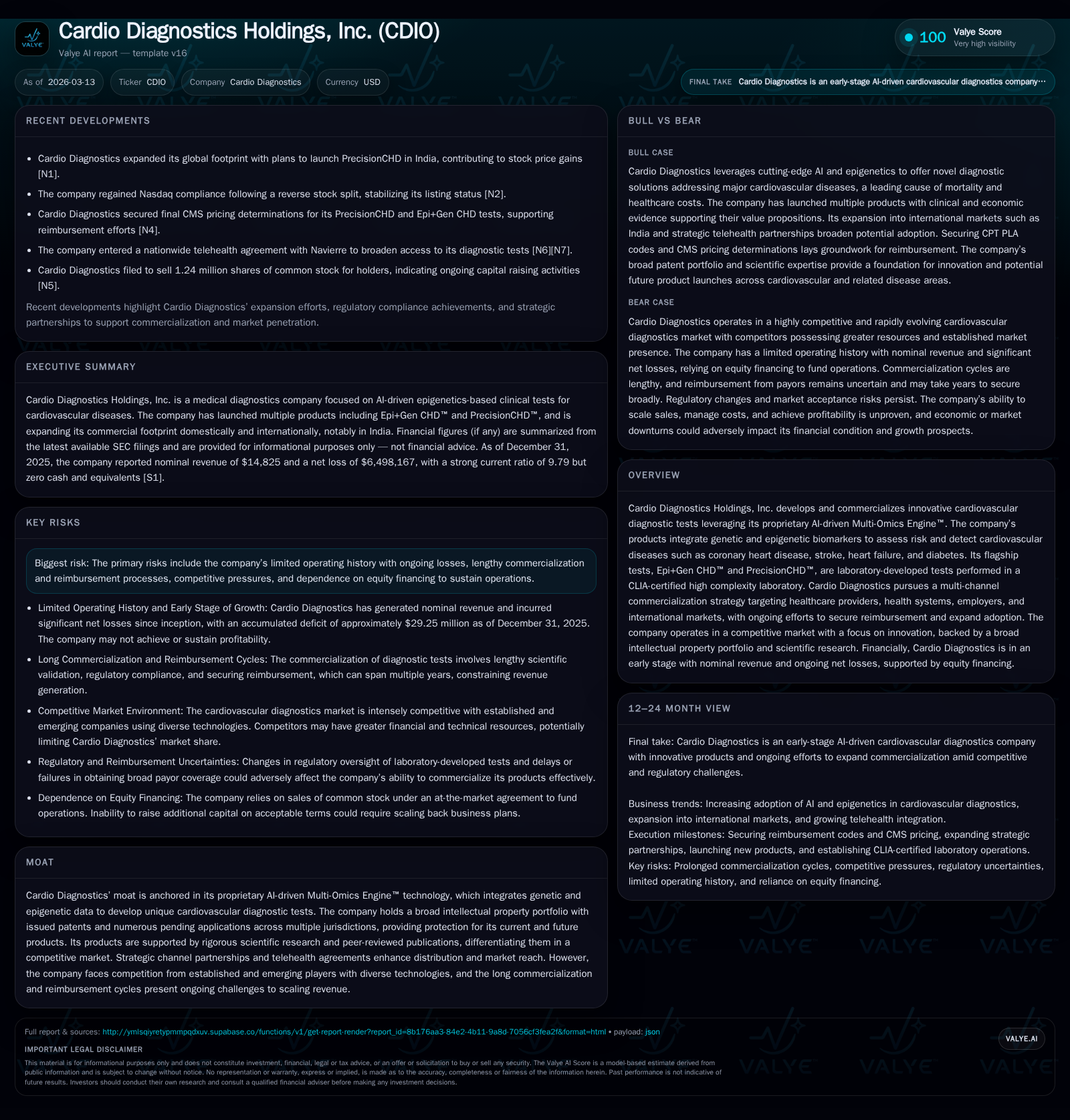
Cardio Diagnostics Holdings, Inc. employs proprietary AI-driven Multi-Omics Engine™ technology combining genetic and epigenetic biomarkers to assess cardiovascular disease risk. Despite promising technology, the company remains in early commercialization with nominal revenue and sustained losses. Growth depends on reimbursement expansion, clinical adoption, and successful market penetration amid regulatory scrutiny and competitive pressures.
Financial Overview: Early Commercialization Phase Characterized by Limited Revenue and Continued Losses
Cardio Diagnostics Holdings operates as an early-stage medical diagnostics company focused on cardiovascular disease risk assessment through innovative epigenetic testing. The company reported revenues of $14,825 for fiscal year (FY) 2025, a decline of approximately 57.5% compared to $34,890 in FY2024 [F1]. This reflects the nascent stage of commercial acceptance despite recent product launches.
Operating losses improved modestly to -$6.48 million in FY2025 from -$8.37 million in FY2024, indicative of ongoing investments required for research, development, marketing expansion, and regulatory compliance [F1]. Net losses closely mirror operating results at -$6.50 million in FY2025 versus -$8.38 million the prior year [F1]. Operating cash flow remained negative at approximately -$5.7 million in FY2025.
Historical performance (annual)
| FY | Rev ($) | Net ($mm) | CFO ($mm) | OpInc ($mm) | Rev YoY | Net YoY |
|---|---|---|---|---|---|---|
| 2025 | 14825 | -6 | -6 | -6 | -57.5% | +22.5% |
| 2024 | 34890 | -8 | -5 | -8 | +104.5% | -0.1% |
| 2023 | 17065 | -8 | -6 | -7 | +1696.3% | -79.7% |
| 2022 | 950 | -5 | -5 | -5 |
Source: SEC companyfacts cache [F1].
Capital returns and efficiency (annual)
| FY | FCF ($mm) | ROE% |
|---|---|---|
| 2025 | -6 | -93.2 |
| 2024 | -5 | -87.7 |
| 2023 | -6 | -283.2 |
| 2022 | -108.4 |
Source: SEC companyfacts cache [F1].
Source: SEC filings and companyfacts data [F1]
Technological Foundation: AI-Driven Multi-Omics Engine™ and Intellectual Property
Cardio Diagnostics’ core technology is its AI-driven Multi-Omics Engine™, which integrates genetic and epigenetic data to provide risk assessment for cardiovascular diseases such as coronary heart disease and stroke. This approach leverages reversible epigenetic modifications influenced by environmental and behavioral factors alongside genetic information.
The company holds an exclusive license from the University of Iowa Research Foundation covering a portfolio of patents including U.S. Patent Nos. 11,414,704 and 12,043,869 issued recently along with pending international applications across key jurisdictions like Europe and Asia [S16][S17][S26]. This intellectual property base establishes barriers to entry while supporting potential international expansion.
Products such as Epi+Gen CHD™ and PrecisionCHD™ operate within CLIA-certified high complexity laboratories ensuring compliance with quality standards essential for clinical diagnostics [S1][S26]. These tests are coupled with the Actionable Clinical Intelligence platform that aids clinicians in personalized patient management.
Commercial Strategy: Transitioning from Niche Telemedicine to Broader Market Engagement
Originally launched during the COVID-19 pandemic targeting telemedicine channels and concierge medicine practices with minimal volume uptake [S1], Cardio Diagnostics pivoted its commercialization strategy around early 2023 toward engaging larger healthcare provider organizations including integrated health systems as well as self-insured employers.
This shift aims to leverage employer wellness programs and negotiations with commercial payors seeking reimbursement pathways critical for scaling test utilization beyond out-of-pocket payments [S1]. Life insurers have also been identified as emerging stakeholders recognizing the underwriting value of these diagnostic tests.
The March 2023 launch of PrecisionCHD™ further expanded product offerings incorporating comprehensive genomic insights supported by companion AI platforms signaling evolution toward enterprise-grade diagnostic solutions.
Regulatory Landscape: Navigating LDT Status Amid Uncertain FDA Oversight
Cardio’s diagnostic tests qualify as laboratory-developed tests (LDTs) performed within CLIA-certified laboratories subject primarily to quality oversight rather than explicit premarket FDA approval [S1][S13]. However regulatory uncertainty persists following federal court rulings vacating FDA attempts to extend stricter controls over LDTs and pending legislative proposals such as the VALID Act that could alter future oversight frameworks [S13][S19].
Reimbursement remains limited; neither Epi+Gen CHD™ nor PrecisionCHD™ currently benefit from broad Medicare or commercial insurance coverage which constrains provider adoption due to cost considerations [S13][S14].
Additionally, compliance with complex federal fraud-and-abuse regulations including Stark Law prohibitions on physician self-referrals and Anti-Kickback statutes requires careful structuring of commercial agreements under Office of Inspector General scrutiny to mitigate legal risks [S6][S25].
These factors contribute to protracted commercialization timelines typical in innovative molecular diagnostics sectors.
Capital Allocation: Sustained Investment Amid Cash Burn Pressures
In FY2025 Cardio Diagnostics reported operating cash outflows of approximately $5.7 million alongside capital expenditures near $0.19 million directed towards laboratory infrastructure maintenance or upgrades [F1]. The resulting free cash flow deficit underscores ongoing reliance on external financing sources.
At December 31st 2025 the company’s cash balance was depleted to zero while current assets stood at roughly $5.92 million against current liabilities near $0.60 million indicating adequate short-term liquidity though highlighting potential funding needs absent revenue growth or cost containment [F1][S12].
Return metrics remain deeply negative; an approximate Return on Equity near -93% reflects persistent net losses consuming shareholder equity since inception without declared dividends or share repurchases consistent with early-stage biotech capital deployment strategies prioritizing reinvestment over distributions [F1].
Equity financing has been the primary funding source given limited access to debt markets under current financial performance conditions.
Risk Factors: Limited Operating History Amid Competitive and Regulatory Complexity
Cardio’s limited operational history combined with minimal top-line traction introduces risks related to execution uncertainty and valuation assessment complexities.
The company’s dependence on successive equity raises presents dilution risks absent clear inflection points toward profitability or sustained revenue growth [S1][S12]. Competitive pressures stem from established diagnostics providers employing alternative biomarker approaches such as genomic sequencing panels or proteomic assays widely used for cardiovascular risk stratification which challenge adoption of novel epigenetic methodologies despite their potential advantages [S26].
Intellectual property exclusivity is anchored by academic licenses but includes non-exclusive technical information rights potentially permitting third-party competition in overlapping markets [S16][S17].
Healthcare regulatory compliance requires navigating evolving fraud-and-abuse statutes imposing operational constraints; enforcement risks persist even under rigorous compliance regimes potentially leading to litigation costs or reputational harm [S4][S6][S25].
Pandemic-era disruptions initially constrained trial enrollments impacting early test volumes necessitating subsequent marketing strategy revisions reflecting challenges inherent in market entry for novel diagnostics [S1][S2][S7].
Outlook: Key Milestones Guiding Future Growth Potential
While explicit forward guidance is not provided publicly at this stage investors should monitor progress on several critical fronts:
- Expansion of third-party reimbursement coverage including Medicare CPT code approvals enhancing provider ordering incentives;
- Inclusion within clinical practice guidelines driven by accumulating evidence demonstrating prognostic benefits over traditional risk calculators;
- Scaling volumes beyond early adopters into integrated delivery networks embedding tests into routine care workflows;
- International expansion via partnerships enabling access to broader markets;
- Pipeline development targeting related indications such as stroke and diabetes offering diversification;
- Operational improvements enhancing margins supporting long-term sustainability.
These milestones collectively frame the pathway toward transitioning from developmental stage toward commercial viability contingent upon overcoming reimbursement barriers while maintaining technological differentiation.
All content is derived from Cardio Diagnostics Holdings’ SEC filings as of March 13th 2026 ([F1],[S1–29]) without speculative forecasts or investment advice.
Disclaimer: This is research-only, informational analysis and not investment advice. It may include AI-generated interpretation and general industry context. Always verify important details using primary sources.

Comments