
XBiotech Inc.: From Platform Innovation to Clinical Pipeline Challenges
XBiotech’s pioneering True Human™ antibody platform underpins its operational growth but faces regulatory, clinical, and financial pressures that cloud its near-term outlook.
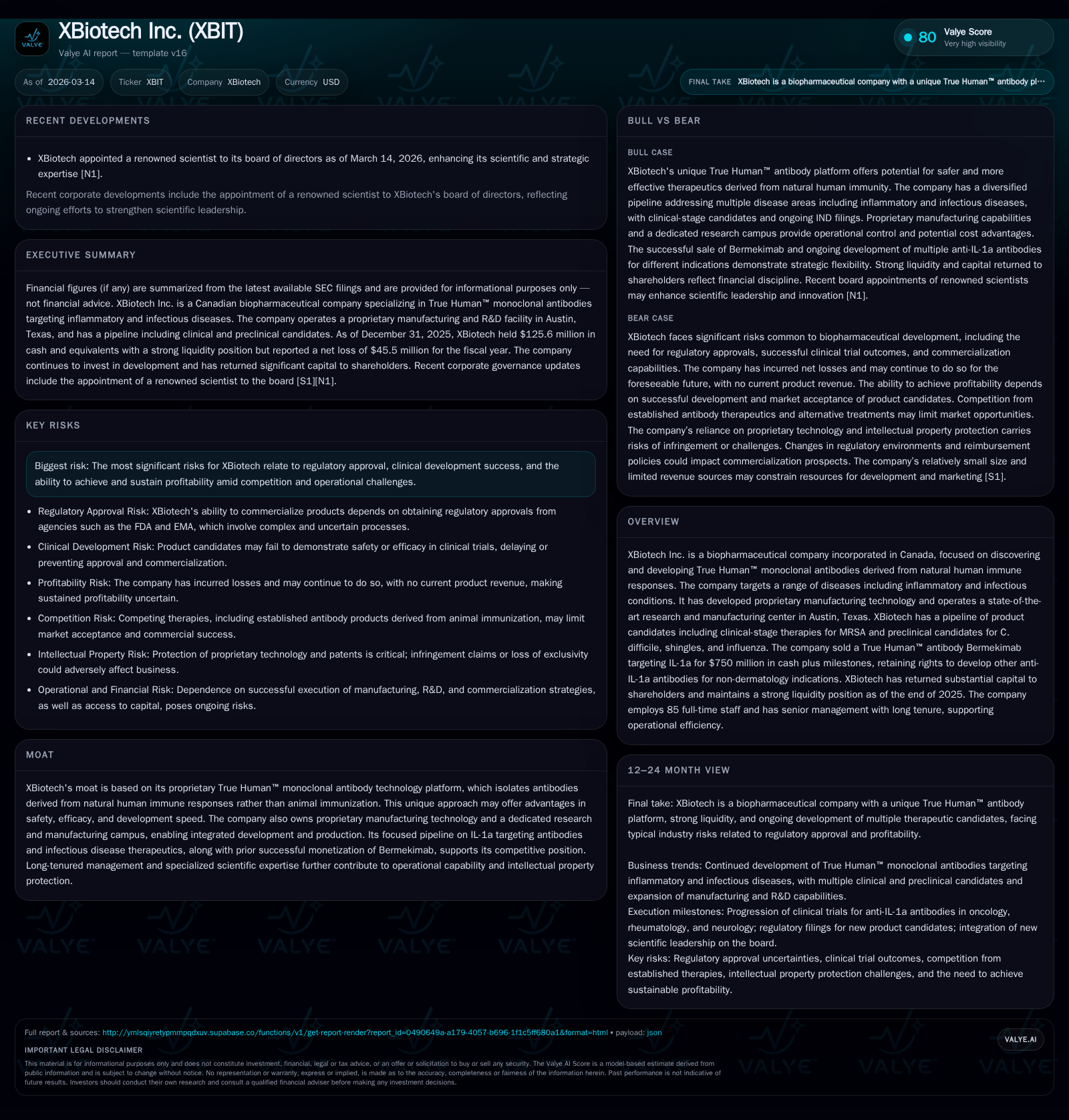
XBiotech Inc. leverages its proprietary True Human™ monoclonal antibody technology and integrated manufacturing to establish a differentiated position in biopharma, particularly targeting IL-1a mediated diseases and infectious agents. Despite this innovative foundation, the company has faced escalating operating losses and clinical setbacks, including trial disruptions and regulatory uncertainties. Financially, XBiotech maintains a strong liquidity buffer but continues to burn cash heavily due to development costs, prioritizing R&D investment over shareholder returns. Upcoming milestones focus on advancing its clinical pipeline amidst considerable risks in regulatory approvals and market commercialization.
Innovative Platform Foundations and Historical Performance Trends
XBiotech Inc. advances a distinct biopharmaceutical model centered on its proprietary True Human™ monoclonal antibody technology platform. Unlike conventional antibody therapeutics created via animal immunization techniques, XBiotech isolates antibodies derived directly from natural human immune responses ([S18]). This biologically native approach aims to yield superior therapeutic safety profiles and potentially streamline development timelines due to reduced immunogenicity concerns encountered with non-human antibodies.
The company complements its discovery engine with proprietary manufacturing capabilities housed in its Austin Texas campus—an end-to-end integration rare among midsize biotech firms ([S18]). This harmonized control over R&D and production intends to enhance scalability while optimizing costs.
Financially, however, XBiotech has confronted intensifying headwinds; operating income deteriorated sharply from -$8.16 million in FY2022 to -$42.47 million in FY2024, further dropping 31.1% year-over-year to -$55.68 million in FY2025 ([F1]). Net losses parallel this trend, expanding from -$3.20 million in FY2022 to -$45.54 million in FY2025. The firm's return on equity is approximately -32.4% as of FY2025 indicating capital erosion against shareholders' equity ([F1]). Operating cash flow reflects sizable cash burn accelerating from -$14.82 million (FY2022) to nearly -$40 million (FY2025), underscoring intensifying investment outlays without offsetting revenues.
Historical performance (annual)
| FY | Net ($mm) | CFO ($mm) | OpInc ($mm) | Capex ($) | Net YoY |
|---|---|---|---|---|---|
| 2025 | -46 | -40 | -56 | 289000 | -18.2% |
| 2024 | -39 | -31 | -42 | 1304000 | -731.3% |
| 2023 | -5 | -19 | -9 | 362000 | -44.7% |
| 2022 | -3 | -15 | -8 | 585000 |
Source: SEC companyfacts cache [F1].
Capital returns and efficiency (annual)
| FY | Buybacks ($) | FCF ($mm) | ROE% |
|---|---|---|---|
| 2025 | -40 | -32.4 | |
| 2024 | 0 | -32 | -21.1 |
| 2023 | 14000 | -19 | -2.1 |
| 2022 | -15 | -1.3 |
Source: SEC companyfacts cache [F1].
These trends reveal a company deeply committed to advancing its technological frontier albeit at the expense of growing operational deficits and shareholder equity consumption.
Pipeline Developments and Clinical Program Challenges
XBiotech's clinical portfolio is anchored by True Human™ antibody candidates directed against infectious pathogens such as methicillin-resistant Staphylococcus aureus (MRSA), alongside preclinical assets addressing Clostridium difficile infections, shingles, and influenza ([S1][N1]). A hallmark project involves targeting interleukin-1 alpha (IL-1a), a cytokine implicated in chronic inflammation and tissue degradation across oncology, rheumatology, and neurology indications ([S18]). Following divestiture of Bermekimab—the firm’s initial IL-1a antibody—via a $750 million upfront plus milestone agreement XBiotech retains rights for anti-IL-1a antibodies outside dermatological uses ([S18]).
Development activity includes the parallel advancement of multiple IL-1a targeting product candidates under Investigational New Drug applications (INDs), emphasizing oncology and inflammatory disease sectors ([S18]). This expansion underscores strategic diversification beyond single asset dependency.
However, clinical execution complexities are notable; the company publicly disclosed a pause in its rheumatology program beginning December 2024 triggered by irregularities at participating clinical sites ([S12]). Such disruptions can extend development timelines substantially due to data integrity reviews or additional patient recruitment needs—a common sector hurdle amid stringent regulatory mandates for trial conduct.
Notably, XBiotech recently bolstered its scientific leadership by appointing a renowned scientist to its board ([N1]), signaling renewed R&D focus intended to reinforce trial design rigor and translational research expertise.
Overall, the clinical landscape confronts usual biotech risks: patient enrollment challenges exacerbated by competing trials; maintenance of favorable safety profiles required by regulators; and uncertainties inherent in translating preclinical promise into late-stage efficacy endpoints.
Regulatory Environment and Commercialization Hurdles
Regulatory approval remains an arduous path for XBiotech’s product candidates given the intricate oversight environments enforced by the U.S Food & Drug Administration (FDA) alongside European Medicines Agency (EMA) protocols ([S6][S10]). The firm warns extensively about potential delays or denials commonly encountered through lengthy review cycles that demand substantial efficacy, safety data packages from Phase III trials—often necessitating post-approval commitments such as Risk Evaluation Mitigation Strategies (REMS) ([S16][S21]).
Moreover, adherence to promotion guidelines is critical; deviations such as off-label marketing could trigger investigations or severe sanctions under federal False Claims Act statutes involving Medicare/Medicaid reimbursement schemes ([S4][S5]). This underscores operational sensitivities tied not just to drug efficacy but strictly controlled corporate communications about indications.
Pricing strategies face added pressures stemming from third-party payers’ cost containment efforts requiring demonstration of comparative effectiveness data beyond regulatory approvals for coverage decisions ([S17][S27]). Reimbursement variability across jurisdictions compounds the commercial uncertainty.
Manufacturing scale-up must also satisfy regulatory cGMP standards at potentially prohibitive cost levels while ensuring uninterrupted supply chains—another critical checkpoint before full commercialization capability is realized ([S3][S6]). Failure on any front may stall product launches or erode competitive positioning.
Financial Overview: Operating Results, Cash Flow, and Capital Structure
XBiotech's financial profile reflects intensive investment alongside mounting losses typical of pre-revenue biopharmaceutical enterprises pursuing multiple drug approvals simultaneously ([F1]). Operating income sank precipitously from roughly negative $8 million annually up through FY2023 into an $55.7 million deficit by FY2025 (-31% YoY), coinciding with net losses accumulating near $45 million last fiscal year ([F1]). Cash flow from operations echoed this trajectory expanding outflows to about $40 million indicating accelerating operational burn without offsetting income streams.
Despite these persistent losses, liquidity remains robust with approximately $125.6 million cash on hand as of end-FY2025 supported by a current ratio exceeding 16—indicative of ample short-term asset coverage relative to liabilities ([F1][S8]). Capital expenditures have decreased significantly (-77% YoY), reflecting moderation after prior facility build-outs or equipment investments with final expenditures being minor at under $300k for FY2025 ([F1]), which helps conserve cash resources.
However, equity has contracted substantially dropping over $100 million since FY2022 consistent with large cumulative deficits drawing down book value ([F1]). The lack of operating profitability combined with no meaningful revenue generation places emphasis on continued efficient capital management strategies to ensure sustained funding for costly clinical programs through key inflection points.
Capital Allocation Strategy: Shareholder Returns versus R&D Investment
Historically, XBiotech returned substantial capital to shareholders including a notable $75 million dividend payment in 2021—the only such distribution recorded recently—demonstrating prior capacity likely driven by Bermekimab asset sale proceeds ([F1],[S15]). However, since then the firm has ceased dividend payments reflecting shifting priorities towards internal reinvestment amid ongoing losses incurred by developmental activities.
Share repurchase activities have been minimal with negligible volumes noted over past years ([F1]), reinforcing R&D expenditure predominance over shareholder returns currently.
Research and development expenses remain significant: approximately $47 million associated with pipeline advancement recorded during FY2025 per disclosures ([S24]), underscoring commitment towards sustaining multiple clinical programs despite challenges.
This capital allocation pattern highlights strategic trade-offs—retaining flexibility for financing pivotal studies takes precedence over distributions until commercialization viability materializes.
Key Milestones Ahead: Upcoming Catalysts and Risk Factors to Monitor
Looking forward, several events warrant close attention that may materially affect XBiotech's trajectory:
- Progression of phase clinical trials for MRSA-targeted therapies alongside data readouts for IL-1a focused candidates remain primary near-term value inflections though exact timing is subject to enrollment pace and regulatory interactions ([N1],[S6],[S28]).
- Potential partnerships or commercial collaborations could ease market entry challenges if secured but no definitive announcements are currently public ([S3],[S21]).
- Regulatory developments including FDA feedback on submissions and acceptance criteria form key gating factors amid evolving compliance landscapes noted earlier ([S6],[S10],[S11]).
- Continued monitoring of safety signals is imperative given past pauses caused by site irregularities which may recur impacting timelines if adverse events emerge during trials ([S12],[S22]).
- Pricing negotiations with payers post-approval will influence commercial success potential amid growing healthcare cost pressure environments globally ([S27],[S17]).
Together these milestones embody typical biotech stage risks compounded by XBiotech's niche technology complexities requiring investors and stakeholders to weigh innovation potential against customary industry uncertainties that often dictate long gestation before revenue generation.
Disclaimer: This analysis synthesizes publicly available information up to March 14, 2026, including SEC filings [F1], news reports [N#], and company disclosures [S#]. It does not constitute investment advice or recommendations.
Disclaimer: This is research-only, informational analysis and not investment advice. It may include AI-generated interpretation and general industry context. Always verify important details using primary sources.

Comments