
BestGofer Inc.'s Transition from Home Inspections to Delivery Ambitions
BestGofer’s current revenue hinges on its home inspection subsidiary while its delivery platform remains pre-operational amid liquidity challenges.
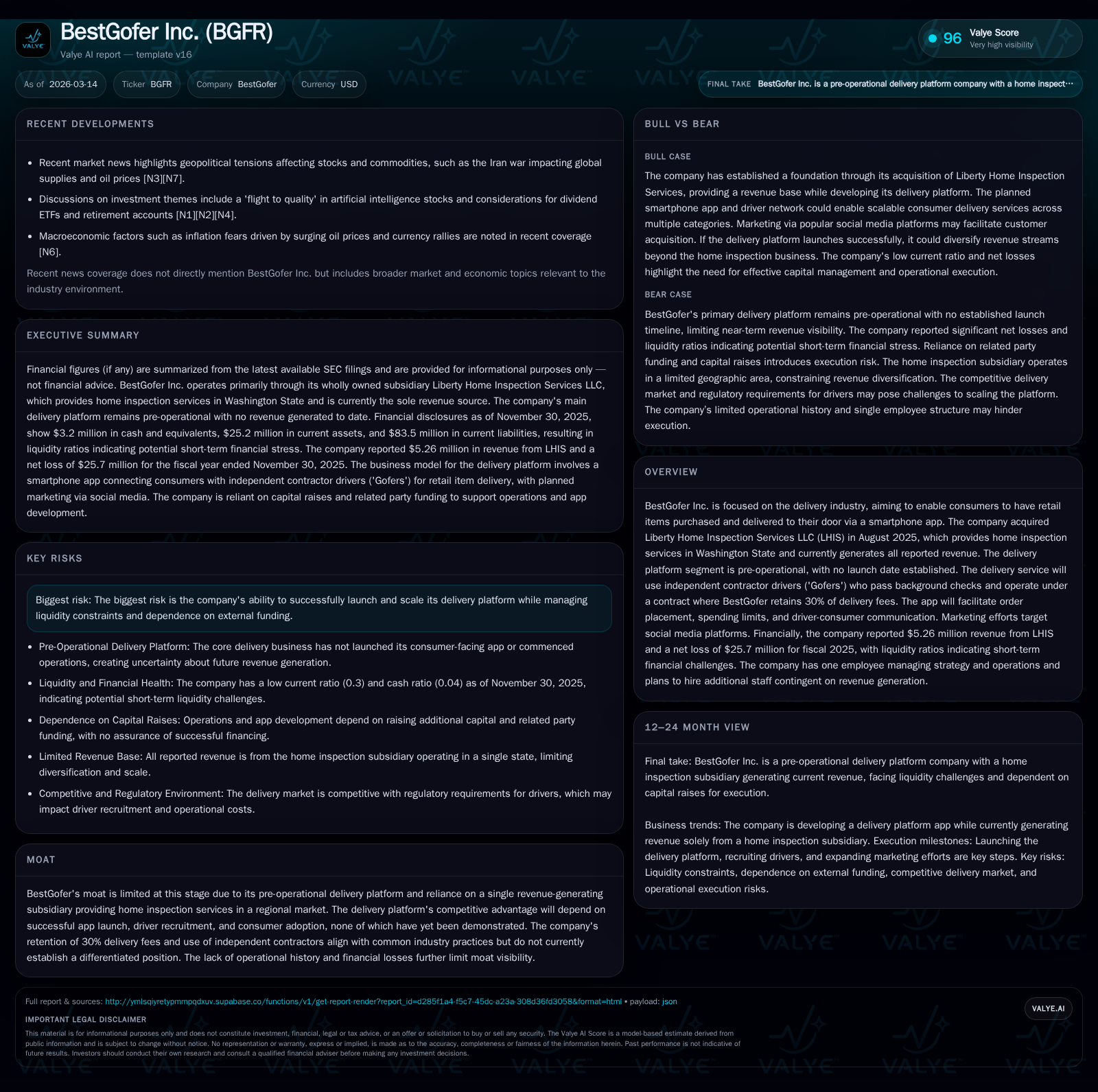
BestGofer Inc. reported $5.26 million in revenue for fiscal 2025 exclusively from its newly acquired Liberty Home Inspection Services LLC, marking the company’s first operational earnings. Despite this, the company recorded a $25.7 million net loss as it prepares for the launch of its planned delivery platform, which currently has no established launch date. The delivery service will employ independent contractors under a commission retention model, targeting consumer convenience via a smartphone app with controlled spending limits. Liquidity remains a critical constraint, with a current ratio around 0.3, underscoring reliance on external financing before the delivery segment can generate revenue.
Historical Revenue Drivers Centered on Liberty Home Inspection Services
BestGofer Inc.'s operational history remains concentrated on its wholly owned subsidiary Liberty Home Inspection Services LLC (LHIS), acquired in August 2025 through issuance of common shares valued at approximately $100,000 [S1][S3][S27]. LHIS specializes in professional home inspection services targeting residential buyers, sellers, and real estate professionals within Washington State—a regional market that confines the company’s current revenue base.
For fiscal year ended November 30, 2025 (FY2025), BestGofer reported $5.26 million revenue exclusively from LHIS operations. Revenue recognition aligns strictly with completed inspections and delivery of reports to customers [S1][S3], reflecting established service performance obligations under ASC 606 standards [S13]. The regional focus implies limited diversification; thus to date, BestGofer lacks direct operating exposure to its intended delivery platform business.
Financial Performance Review: From Net Losses to Improving Cash Flows
Despite achieving positive top-line in FY2025 after four years without revenue [F1], BestGofer posted a substantial net loss of $25.7 million—a modest improvement of roughly 6.6% compared to FY2024 losses of $27.6 million [F1]. This contraction suggests early cost containment but remains symptomatic of heavy investment and pre-revenue development costs associated with preparing their unlaunched delivery business.
Importantly, operating cash flow turned positive in FY2025 at $3.14 million versus negative cash outflows across prior years (-$1.375M in FY24; -$2.75M in FY23) [F1]. This reversal likely reflects improved working capital management or one-time non-cash adjustments rather than sustainable operational profits.
Summary financial metrics are presented below:
Historical performance (annual)
| FY | Rev ($) | Net ($) | CFO ($) | Net YoY |
|---|---|---|---|---|
| 2025 | 5260 | -25748 | 3140 | +6.6% |
| 2024 | 0 | -27562 | -1375 | +37.1% |
| 2023 | 0 | -43792 | -2750 | -31.3% |
| 2022 | 0 | -33343 | -29050 |
Source: SEC companyfacts cache [F1].
Capital returns and efficiency (annual)
| FY | ROE% |
|---|---|
| 2025 | |
| 2024 | |
| 2023 | 61.7 |
| 2022 | 122.6 |
Source: SEC companyfacts cache [F1].
Note: Amounts in USD thousands except Year and Rev YoY (%); CFO = Operating Cash Flow [F1]
Unlaunched Delivery Platform: Key Features, Operational Model, and Market Positioning
BestGofer is developing a consumer-facing delivery platform aimed at facilitating same-day retail item purchases delivered by local 'Gofers'—independent contractor drivers vetted through criminal background checks and driving record verifications [S1][S5][S7]. Drivers enter independent contractor agreements allowing BestGofer to retain a fixed commission rate of 30% on delivery fees.
The consumer app will incorporate features such as geolocation-based Gofer dispatch; categorization of deliveries (grocery, restaurant, convenience stores, liquor, courier services); photo upload options for precise item selection; and strict maximum purchase spending caps capped at $400 per order [S3][S6][S7]. Payment processing is streamlined via stored credit card data charged immediately upon delivery completion — mitigating risks related to driver cash handling [S7].
Restricted items include prescription drugs, controlled substances (including marijuana), pornographic materials, persons' transport, or any orders exceeding the stipulated spending limit [S5]. Gofers reserve the right to refuse noncompliant requests—an essential control layered alongside consumer credit protections under statutes such as the Fair Credit Billing Act of 1986 [S5].
Marketing strategy exclusively targets prominent social media platforms (Facebook, Instagram, Snapchat plus X formerly known as Twitter), indicating a digital-first user acquisition focus tailored for younger demographics [S7]. Operationally BestGofer plans deployment across cities where recruited drivers designate their preferred operating locations supported by app-based navigation tools mapping retail venues [S6][S7].
Growth Prospects and Challenges in Deploying the Delivery Platform
While strategic ambitions position BestGofer within the fast-growing gig economy segment centered on on-demand delivery services , the absence of any operational launch timeline significantly tempers near-term growth visibility [S1][S3]. User adoption depends heavily on both rapid onboarding of qualified drivers and attracting sufficient consumer demand amid intense competition from dominant incumbents.
Driver-independent contractor models align with prevailing industry norms yet do not inherently confer competitive moat without scalable network effects or differentiated technology features . Moreover traditional constraints such as driver retention challenges and regulatory scrutiny around contractor classification persist as hurdles.
Current revenues remain fully dependent on LHIS operations exposed to regional economic fluctuations in Washington real estate transactions limiting diversification benefits until the new platform becomes operational [S14]. Risk disclosures note management’s uncertainty regarding successful scale-up capability or sustained capital availability to bridge the pre-revenue phase [S4].
Liquidity Constraints and Capital Structure Overview
Liquidity stands out as a salient risk factor given BestGofer’s limited working capital buffer evidenced by a current ratio close to 0.3 at fiscal year end November 30, 2025 ($25K current assets vs $83K current liabilities) [F1]. This balance sheet imbalance triggers explicit going concern language highlighting dependence on external financing sources for continued operations beyond short term [S8][S11][S19].
Historically funding has been sourced through common stock issuances combined with related party loans principally from President and director Mohammed Hasan Hamed totaling tens of thousands USD advanced over recent years for operating expenses [S24]. No material debt instruments or equity compensation plans exist which limits funding flexibility absent new capital raises [S8][S9][S24]. There are no reported off-balance sheet liabilities or contingencies exacerbating financial risk profile [S20].
In sum managing liquidity before achieving self-sustaining cash flows from either LHIS expansion or successful delivery platform rollout will critically influence survival prospects . This delicate capital structure dynamic typifies early-stage ventures transitioning toward scalable service models.
Capital Allocation Strategy and Return Metrics Analysis
Reflecting typical growth-stage profiles focused on product development rather than shareholder returns, BestGofer maintains a strict no-dividend policy with zero share repurchase activity since inception [F1][S25][S27]. Capital allocation priority remains preserving resources for scaling operational capabilities rather than distributing cash flows.
Return on equity (ROE) appears elevated at approximately 36% based on trailing twelve-month net income relative to negative book equity reported by fiscal year-end November 30, 2025 ($-25.7 million net loss against negative equity base) but this metric warrants cautious interpretation due to accounting distortions arising from accumulated deficits exceeding invested capital [F1].
Positive operating cash flow contrasts favorably against sustained net losses indicating some operational efficiency gains but recurring losses highlight ongoing necessity for incremental funding rounds until economies of scale manifest materially.
Outlook: Critical Milestones and What Investors Should Monitor
Without formal forward guidance or publicized launch dates for the delivery segment beyond planned app deployment during FY2025 which did not materialize into revenue generation within reporting periods [N1][N2], investors should track qualitative and quantitative KPIs indicative of transition progress:
- Announcement or confirmation of official app launch date with geographic coverage details,
- Scale and quality metrics regarding Gofer recruitment pipeline duration and conversion,
- Consumer active user counts alongside repeat order ratios evidencing stickiness,
- Marketing campaign responsiveness measured via social media engagement analytics,
- Unit economics disclosure covering average order value less driver commissions versus operational costs,
- Continuing liquidity runway updates including anticipated financing events or cost reduction plans,
- Any regulatory developments affecting independent contractor usage frameworks.
Given the substantial gap between legacy home inspection operations supporting baseline revenues and ambition to profitably implement a tech-enabled delivery service catering broadly to retail purchases underscores significant execution risk amidst capital constraints . Close observation of how management disciplines financing next stages will be critical for evaluating strategic credibility moving forward.
This analysis is based solely upon publicly available information provided by BestGofer Inc.’s SEC filings dated through March 13, 2026 ([F1], [S*]) and related news items ([N*]). It is intended for informational purposes without expressing any investment opinion or recommendation.
Disclaimer: This is research-only, informational analysis and not investment advice. It may include AI-generated interpretation and general industry context. Always verify important details using primary sources.

Comments