
KDDI Investment Accelerates Coincheck Group’s Strategic Shift Toward Institutional Crypto Services
Coincheck Group advances beyond retail crypto exchange via acquisitions and strategic investment, expanding institutional and B2B2C offerings.
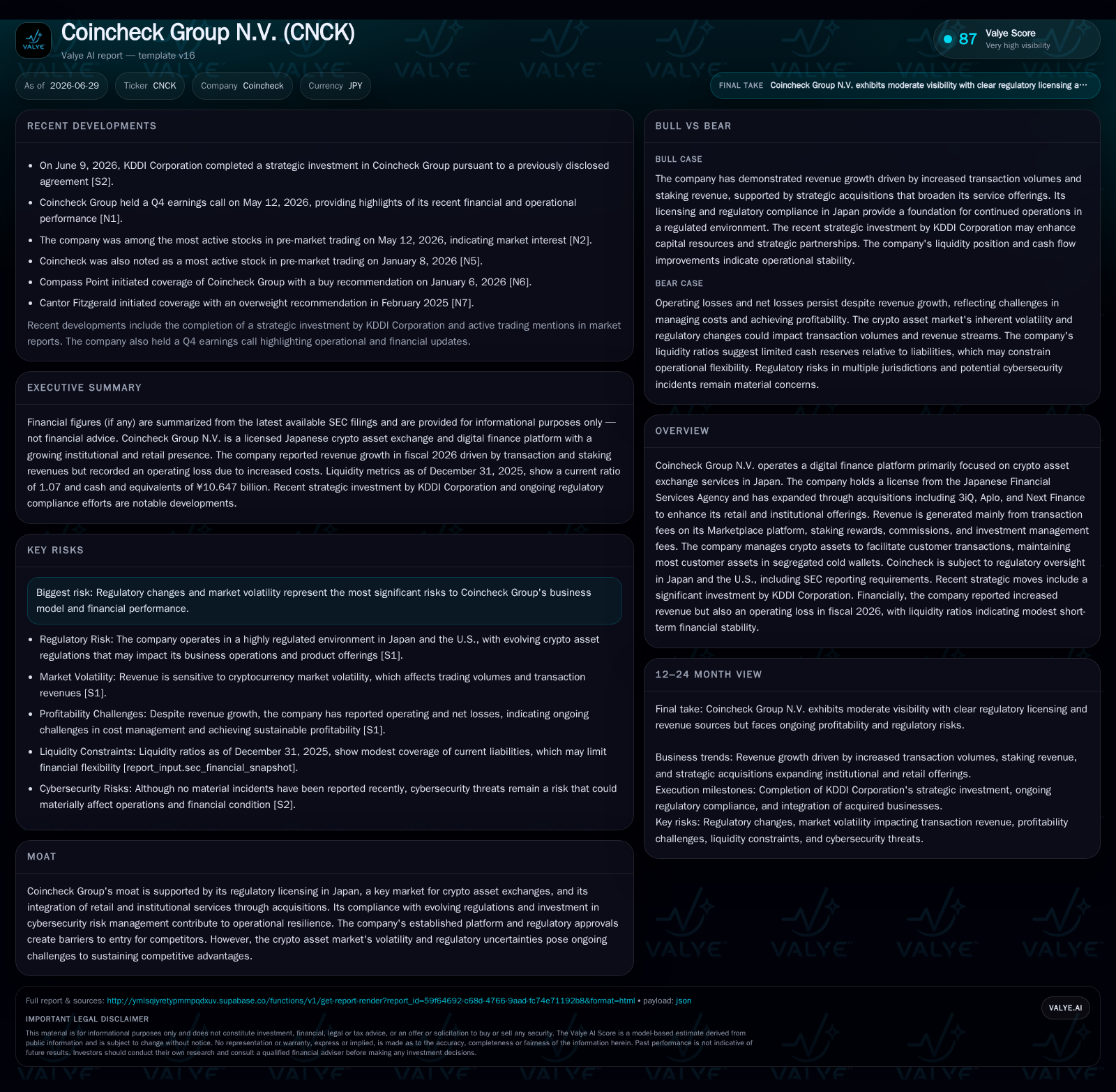
Coincheck Group N.V. remains a leading licensed crypto asset exchange in Japan with a notable market share in retail trading. Recent strategic developments include a significant investment by telecom giant KDDI and acquisitions of 3iQ, Aplo, and Next Finance, signaling a deliberate shift toward non-retail business lines such as crypto asset management, staking services, and crypto-as-a-service (CaaS) partnerships. Despite increased revenue driven by higher transaction volumes and new revenue streams, the company reported an operating loss for fiscal 2026 amid ongoing investments in platform expansion and technology. Regulatory compliance remains foundational to its moat, but crypto market volatility and regulatory uncertainty persist as key risks. Operational KPIs such as trading volumes, verified users, assets under custody, and staking yield illustrate progress in scaling both retail and institutional facets.
Recent Operating Update
Coincheck Group strengthened its financial foundation through a strategic equity investment by KDDI Corporation completed on June 9, 2026 [S2]. This partnership follows a share subscription agreement executed in May 2026 and injects capital critical to advancing Coincheck’s evolving strategy focused on institutional clients and B2B2C offerings beyond its established retail exchange platform.
The company's latest monthly disclosures show sustained high exchange trading volumes throughout mid-2025 (e.g., ¥461 billion in October) indicating robust customer activity [S3]. Fiscal year-end figures confirm this strength: trading volume on the Marketplace platform reached approximately ¥313 billion with verified users growing to about 2.5 million as of March 31, 2026 [S1]. Maintaining close to a third of Japan's retail trading volume illustrates Coincheck's vital position within the domestic digital asset ecosystem.
Business Model Overview
Coincheck operates primarily as a licensed digital asset exchange platform authorized by the Japanese Financial Services Agency (JFSA), serving retail customers via its Marketplace (where it acts as principal) and Exchange platforms (order book facilitation without acting as principal). Revenue is chiefly derived from transaction fees on Marketplace trades alongside commissions from institutional execution services.
A significant recent development is Coincheck’s acquisition of multiple firms—3iQ from Canada enhances institutional-grade crypto asset management capabilities including ETF advisory; Aplo introduces European-focused digital asset custody solutions; Next Finance strengthens fintech infrastructure offerings [S1]. These integrations enable Coincheck to extend service lines into sub-advisory asset management, white-label execution/custody (crypto-as-a-service or CaaS), staking yield generation, lending products leveraging custody assets, and institutional trade settlement—areas typically commanding higher unit economics than retail spot trading.
Coincheck manages custody assets separately: most customer holdings reside securely in segregated cold wallets per regulatory requirements while the company holds borrowed crypto assets in hot wallets used for settlement liquidity under the Coincheck Lending program [S10]. This dual approach balances security with necessary liquidity for efficient trade processing.
Industry Structure and Competitive Position
Japan’s digital asset sector is tightly regulated with JFSA licensing creating high barriers to entry that favor established operators like Coincheck. The company holds an estimated 28.6% market share by trading volume in domestic retail markets according to JVCEA data, positioning it among top Japanese exchanges alongside peers such as bitFlyer or Liquid Global [S1]. Its sizable user base (2.5 million verified users) fosters network effects crucial for liquidity provisioning on both Marketplace and Exchange channels.
Internationally, Coincheck confronts competition from global players such as Coinbase—known for combining retail access with extensive institutional services—and regional operators like Bitstamp or Kraken that have emphasized compliance rigor and security frameworks. Coincheck’s strategic acquisitions mirror peer moves attempting to combine retail scale with institutional service breadth; however, the company remains more Japanese market-centric with growing cross-border ambitions facilitated by its new subsidiary footprint.
Growth Drivers
The cryptocurrency industry's structural growth underpins demand expansion at Coincheck:
- Increased adoption of digital assets by individual investors in Japan stimulates transaction fee revenue on Marketplace offerings.
- Institutional investor interest fuels demand for managed products offered via acquired entities like 3iQ.
- B2B2C distribution partnerships enable third-party firms to embed Coincheck’s traded execution and custody capabilities into their own client services, unlocking new revenue streams beyond direct-to-customer retail sales.
- Expansion into fee-generating activities like staking rewards allows leveraging assets under custody for margin-enhancing returns.
- Regulatory clarity within Japan facilitates trust among cautious investors while establishing compliance benchmarks limiting unlicensed competition.
Monitoring KPIs such as sustained trading volumes (¥300 billion+ monthly), user verification rate growth, assets under custody (¥728 billion), and emerging staking yield income will be key indicators of successful growth execution [S1][S13]
Risks & Watchpoints
Coincheck faces several material risks common across regulated crypto exchanges:
- Market volatility directly impacts transaction volumes and thereby core transaction fee revenue; past operating results demonstrate quarter-to-quarter earnings swings tied closely to pricing cycles.
- Regulatory regimes evolve rapidly; additional licensing conditions or restrictions could impose cost burdens or limit product offerings.
- Cybersecurity threats pose operational disruptions or reputational damage; while governance structures appear robust with dedicated risk committees, maintaining vigilance is essential given industry precedents.
- Liquidity mismatches between customer asset segregation rules and operational needs require precise treasury management to avoid trade settlement delays.
- Competition not only arises from direct exchange platforms but also decentralized finance (DeFi) alternatives that challenge centralized custodianship models.
Execution risk on successfully integrating acquisitions like 3iQ or scaling B2B2C services represents intermediate watchpoints affecting profitability trajectories over coming quarters.
What To Watch Next
Upcoming milestones include monitoring quarterly updates on:
- KPIs around institutional client uptake post-acquisition integration,
- Revenue diversification progress through staking and lending income recognition,
- Liquidity ratios reflecting balance sheet health relative to volatile asset holdings,
- Regulatory developments impacting cross-border custody or product approvals,
- Technology platform uptime metrics ensuring uninterrupted service essential for customer trust,
- Ongoing announcements regarding additional strategic partnerships especially linked with telecom ecosystem leveraging KDDI’s involvement.
Coincheck’s ability to demonstrate tangible traction toward meaningful non-retail revenue segments will be crucial signals for assessing durability of growth beyond Japan’s consumer-centric exchange dynamics.
Financial Profile Discussion
Financial position in context
As of December 31, 2025 (the latest available snapshot preceding fiscal year end), Coincheck held cash and cash equivalents totaling approximately ¥10.65 billion with current assets balancing near ¥118.7 billion against current liabilities of roughly ¥111.4 billion—producing a current ratio of about 1.07 which suggests modest working capital coverage [F1]. By fiscal year end March 31, 2026, cash reserves slightly declined but remained sufficient at ¥9.46 billion per filings indicating ongoing short-term liquidity adequacy supported by committed credit lines from affiliated lenders notably Monex Finance Corporation [S4][S10].
Capital expenditure focusing on intangible assets such as software development increased markedly reflecting prioritization of platform enhancement supporting institutional-scale requirements along with better risk management automation capabilities needed given heightened regulatory scrutiny [S7][S9]. Financing activities saw an inflow increase aligned with related party loan draws facilitating expansion initiatives though no material long-term external debt burden is evident currently reducing fixed financial obligations pressure [S7][F1].
In summary, Coincheck exhibits a stable liquidity profile appropriate for near-term operational needs accompanied by active capital deployment aimed at strategically shifting business mix — balancing between sustaining leadership in Japan’s competitive retail market while building credible differentiated presence across high-growth institutional crypto asset finance.
Disclaimer: This is research-only, informational analysis and not investment advice. It may include AI-generated interpretation and general industry context. Always verify important details using primary sources.

Comments