
Concord Acquisition Corp II Poised at Critical Junction with Extended Merger Deadline
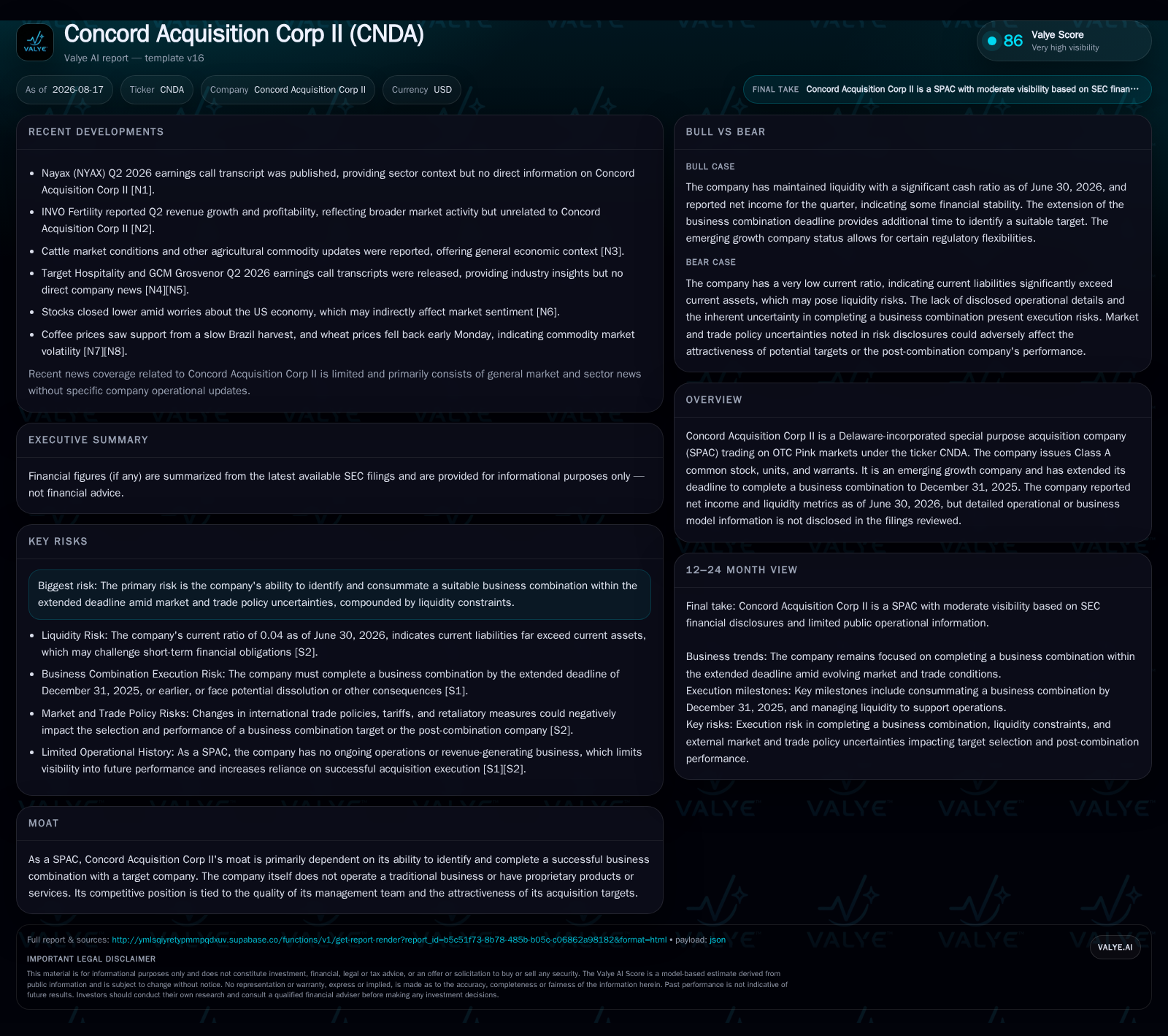
CNDA’s latest filings reveal acute liquidity pressures and compressed timing ahead of its extended 2025 merger deadline, underscoring significant structural challenges in closing a transformative business combination.
Concord Acquisition Corp II is a special purpose acquisition company that continues to operate as a blank check vehicle seeking a qualifying business combination following an IPO raise of over $250 million. Its latest quarterly report shows severely constrained liquidity, with current assets barely covering a fraction of its immediate liabilities, coinciding with an extended deadline to complete a merger by the end of 2025. While the SPAC’s capital structure features standard IPO units and warrants incentivizing sponsors, significant redemption risks and going concern warnings highlight the precariousness of completing a value-accretive de-SPAC transaction within the narrowed timeframe. The company’s prospects hinge on rapidly securing shareholder support and supplemental financing as it contends with market headwinds and redemption dilution potential.
The company reports cash and equivalents standing at only $123,573 as of June 30, 2026 — an extremely limited cushion given that current liabilities simultaneously ballooned to approximately $6.42 million [F1]. Because SPACs typically depend on their trust accounts (which hold IPO proceeds) to fund deal-related costs and tender offers before closing a merger, such thin liquidity heightens going concern risks flagged by the independent auditor in prior filings [S1], [S6].
This acute cash constraint underscores the urgency for Concord to consummate the de-SPAC transaction promptly to access new funding sources or unlock shareholder value. It also elevates risk around operational continuity if the merger stalls further or if investor redemptions accelerate — both scenarios would further erode available capital essential for closing expenses.
SPAC Model Mechanics: Units, Warrants, and Redemption Rights Define Capital Structure
Concord Acquisition Corp II operates as a classic blank check company: it raised approximately $280 million gross at IPO through issuing units consisting of one share of Class A common stock paired with one-third of one warrant exercisable at an $11.50 strike price [S1]. Privately placed warrants granted to sponsors at $1.50 each augment this structure, aligning management incentives via warrant ownership which typically converts into equity upon de-SPAC completion
This capital framework aims to balance raising sufficient cash upfront while motivating sponsors to secure an accretive acquisition; however, it introduces complex dilution dynamics post-merger driven by warrant exercises and sponsor promote economics. Furthermore, public shareholders retain redemption rights allowing them to redeem shares if dissatisfied with proposed combinations or valuations. High redemption rates would directly reduce merger proceeds held in trust accounts and thus impair deal financing capability — often necessitating supplementary PIPE raises or more dilutive tender offers.
Thus, three KPIs are critical here: the percentage of shares redeemed by public investors directly affects liquidity; the exercise rates of warrants impose future dilution constraints; finally, sponsor track record can influence shareholder confidence in management's ability to consummate favorable deals without provoking mass redemptions.
Competitive Set Overview: Sponsor Track Record and Peers’ De-SPAC Outcomes Provide Context
Placing CNDA within the broader SPAC landscape highlights significant headwinds related to its management pedigree and past attempts. Members of its team have previously launched other blank check companies under Atlas Merchant Capital affiliates (Concord I and Concord III), both unable to complete initial business combinations leading to liquidation processes [S1]. This history suggests above-average execution risk compared with peers led by seasoned SPAC sponsors boasting robust deal pipelines and transaction success — e.g., Pershing Square Tontine Holdings or firms with multiple closed mergers in growth sectors like healthcare or technology.
The mixed track record among SPACs exemplifies how critical experienced management is in sourcing suitable target companies swiftly while managing shareholder expectations skillfully during merger negotiations. Failure to do so commonly results in heightened redemption activity or forced wind-downs negatively affecting capital returns.
Industry peer comparisons also reveal competitive tension from traditional IPO mechanisms pursued by private companies as viable alternatives due to evolving regulatory scrutiny on SPACs. Thus sponsor credibility is both an operating lever and vital investor signaling factor.
Extended Deadline Pressure: Timeline, Deal Likelihood, and Structural Market Headwinds
Originally set for March 3, 2025, Concord Acquisition Corp II's deadline for completing a business combination was extended by shareholder approval on February 28, 2025, pushing the termination date out to December 31, 2025 [S1], effectively compressing remaining time during mid-2026 filings. While such extensions provide temporary reprieve for searching suitable targets or renegotiating deal terms, they also constrict runway amid volatile market conditions reducing valuation multiples for potential acquisitions.
Moreover, increasing regulatory scrutiny targeting de-SPAC transactions along with fluctuations in investor appetite for alternative listing vehicles compound these pressures. Private companies may opt instead for traditional IPO routes when market uncertainty rises or SPAC terms deteriorate due to high redemptions diluting value.
Consequently, Concord faces narrowing chances not only due to temporal proximity but also because macroeconomic factors limit sectors amenable for acquisition while raising capital cost for completing deals or PIPE arrangements.
Critical Risks: Liquidity Shortfall, Shareholder Redemption Impact, and Going Concern Doubts
Integral risks clearly emerge from Concord’s disclosures: foremost is failure temptation if they cannot identify agreeable targets timely leading either to liquidation or forced termination [S1]. Coupled with dire liquidity metrics — minimal cash reserves against looming payables — operating challenges intensify substantially.
Additional hazards stem from drawn-out redemption campaigns where public investors choosing exit options impair transaction proceeds further undermining financial flexibility necessary for funded closings [S4]. Such dilution can cascade into negative feedback cycles involving diminished warrants' attractiveness among potential acquirers.
Compounding these are auditor-noted going concern qualifications reflecting genuine doubts about viability absent merger success or swift infusion of new capital sources [S1], [S6]. This caveat typically signals substantial uncertainty over continued operations beyond upcoming quarters without substantive corrective actions such as completing deals or securing PIPE financing commitments.
"Watch Next": Milestones Around Business Combination Approval and PIPE Financing Developments
Key near-term milestones will decisively influence whether CNDA can clear hurdles toward successful de-SPAC execution. These include any scheduled stockholder voting events on proposed combinations pivotal both legally and reputationally for garnering needed approvals [S1]. Tender offer outcomes will also illuminate investor sentiment toward deal terms influencing redemption levels impacting net transferable cash pools.
Market responsiveness post-announcement periods will materially impact CNDA’s ability to maintain listing status on OTC markets moving toward full business operation post-transaction closure.
Financial Profile Discussion: Trust Account Health and Implications for Viability
The absence of operating revenues before completing the initial business combination further emphasizes reliance entirely on trust account funds raised during IPO plus private placements; hence dilution effects through share redemptions can dangerously erode this pool leaving CNDA vulnerable unless alternative capital injections materialize promptly.[S1]
Historical net income figures remain marginally positive but not indicative of sustainable profitability until successful de-SPAC consummation introduces commercial operating enterprises [F1]
Ultimately these financial markers corroborate why timely closure is paramount alongside effective shareholder engagement ensuring minimal redemptions so that Concord Acquisition Corp II can progress beyond shell status toward becoming an operational entity delivering intrinsic equity value.
This analysis focuses strictly on publicly filed data without speculation on target entities or deal specifics absent formal disclosures. The company's precarious financial footing coupled with expiring timelines reflects systemic vulnerabilities characteristic across later-stage SPACs struggling amid evolving market conditions post-IPO capital raise phase.
Investors monitoring CNDA should closely track redemption activity levels announced proxy results on merger approvals as well as any newly disclosed PIPE financings — all pivotal variables shaping final outcomes between liquidation scenarios versus successful transition into active going concerns through consummated business combinations.
Disclaimer: This is research-only, informational analysis and not investment advice. It may include AI-generated interpretation and general industry context. Always verify important details using primary sources.

Comments