
Coda Octopus: Specialized Marine Tech, Defense Contracts, and the Limits of Niche Strength
Coda Octopus leverages proprietary underwater imaging and engineering expertise to secure defense and marine contracts, but its reliance on government spending and concentration in specialized markets shapes both its upside and vulnerabilities.
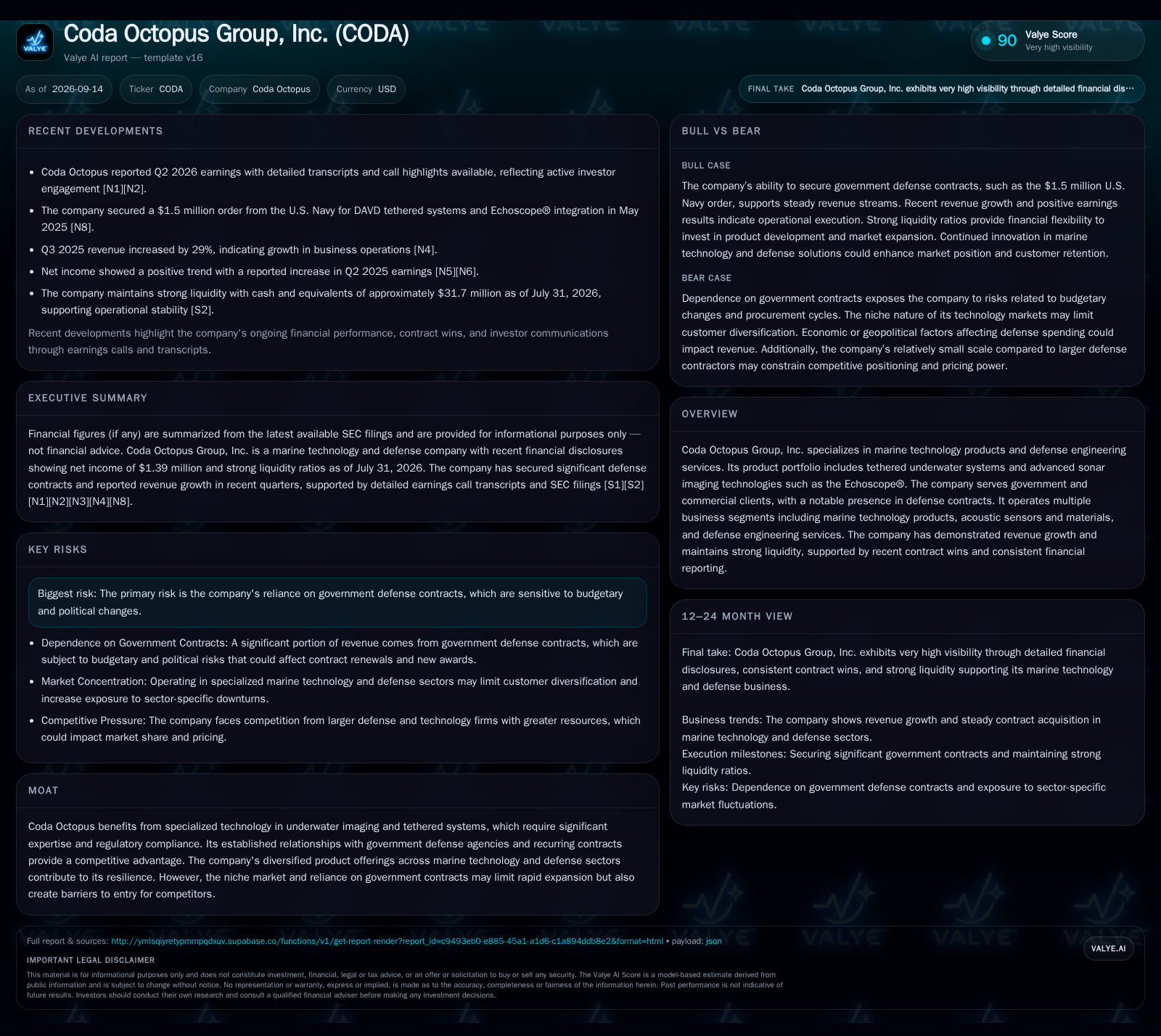
Coda Octopus Group, Inc. continues to grow revenue and secure defense contracts, with reported liquidity position and profitable operations as of July 2026. Its business is underpinned by advanced sonar and tethered systems, especially for government clients like the U.S. Navy. However, the company's dependence on defense spending and niche market focus remain double-edged, supporting margins but limiting diversification and exposing it to sector-specific risks. Future performance hinges on contract flow, technology adoption, and the ability to broaden its customer base beyond core defense relationships. [S2] [N8]
Coda Octopus Group, Inc. stands at the intersection of innovation in underwater imaging and the steady cadence of government defense contracting. Recent financial disclosures highlight both operational momentum and a robust balance sheet, with significant contract wins—such as a $1.5 million U.S. Navy order—fueling growth. Yet, the company’s fortunes are closely tied to specialized marine and defense markets, where customer concentration and procurement cycles are ever-present realities. The challenge is to convert technological differentiation into durable, diversified revenue streams while navigating the inherent constraints of its niche.
Contract Wins and Financial Strength Define Current Trajectory
Coda Octopus’s business profile has been shaped in the past year by several material developments. The company secured a $1.5 million order from the U.S. Navy in May 2025 for DAVD tethered systems and Echoscope® sonar integration, reinforcing its ongoing role as a specialized supplier to defense customers [N8]. Financially, the company reported net income of $1.39 million for the quarter ended July 31, 2026, with basic and diluted EPS of $0.12, and maintained cash and equivalents of $31.7 million—yielding a current ratio above 10 and a cash ratio of 5.85 [S2]. Q3 2025 saw a notable 29% year-over-year revenue jump, pointing to operational momentum beyond a single contract [N4]. These facts matter because they underscore both the company’s ability to win meaningful government business and its capacity to sustain operations and invest in R&D without immediate funding pressure.
Marine Technology Economics: Margins, Mix, and Capital Flexibility
Coda Octopus’s economics are shaped by the interplay of high-value, low-volume marine technology sales and recurring defense engineering services. The company’s core products—such as Echoscope® sonar and tethered systems—are likely priced at a premium due to technical differentiation, regulatory barriers, and mission-critical applications. This product mix can support robust gross margins, but volume is inherently limited by the specialized nature of the market and procurement cycles.
The business model appears to blend project-based revenue from government contracts with potential follow-on engineering and support services. Fixed costs are likely dominated by R&D and specialized personnel, while variable costs scale with production and service delivery. Given the reported liquidity position and low current liabilities, Coda Octopus is not capital-constrained and could fund incremental product development or modest expansion without external financing in the near term [S2]. Operating leverage is plausible if contract flow accelerates, but cost structure flexibility is limited by the need to retain technical expertise and certifications.
The capital intensity of Coda Octopus’s business model also warrants consideration. While the company’s current liquidity suggests short-term potential financial flexibility, the long development cycles typical of advanced sonar and underwater imaging systems imply sustained investment before realizing returns. This dynamic necessitates a careful balance between R&D spending and revenue generation to avoid cash flow mismatches. Moreover, the interplay between fixed and variable costs means that scaling production to meet larger orders could improve margins, but only if demand materializes consistently. In the absence of volume growth, fixed costs may weigh on profitability, highlighting the importance of contract pipeline visibility and backlog management.
Specialization as Both Moat and Limitation in Defense and Marine Tech
Coda Octopus’s competitive edge is rooted in proprietary underwater imaging and acoustic technologies, with Echoscope® and DAVD systems serving as differentiators in the eyes of defense and select commercial customers. The company’s history of securing U.S. Navy orders signals credible technical validation and creates high switching costs for incumbent contracts, as integration and regulatory hurdles deter rapid displacement by competitors.
However, the same specialization that confers a moat also narrows the customer base, exposing the company to procurement cycles and the idiosyncrasies of government budgeting. Larger defense primes and diversified industrial technology firms represent indirect competition, possessing greater resources, broader portfolios, and the ability to bundle solutions. The company’s ability to defend its position rests on continued innovation, deepening relationships with defense agencies, and, potentially, broadening its platform to adjacent applications or commercial markets.
Another dimension of Coda Octopus’s specialization is the regulatory and certification environment surrounding defense and marine technologies. Compliance with stringent standards creates barriers to entry that protect incumbents but also impose ongoing costs and complexity. The company’s ability to maintain certifications and adapt to evolving regulatory requirements is critical to sustaining its competitive position. Additionally, the niche nature of its products may limit economies of scale compared to larger competitors, necessitating a focus on innovation and customization. This environment also means that partnerships or alliances with larger defense contractors could be strategic avenues to broaden market reach without diluting technical focus.
Scaling Beyond Defense: Technology Adoption Unlocks New End Markets
A favorable trajectory for Coda Octopus hinges on leveraging its technology into new verticals. If the company can extend Echoscope® and related solutions into commercial marine markets—such as offshore wind, oil & gas inspection, or subsea construction—it could unlock higher volume opportunities with less dependency on government procurement cycles. Evidence of this scenario would include announcements of new non-defense contracts, partnerships with commercial marine operators, or product adaptations for broader industry use.
Another upside lever is deeper penetration within defense, such as multi-year contract awards or integration into additional naval systems. Clear signals would be repeat or expanded orders from the U.S. Navy or allied agencies, and a growing backlog of contracted work. A falsification of this scenario would be a stagnation in non-defense revenue or a lack of new product launches targeting adjacent markets.
Sustained Performance Driven by Defense Contract Flow and Incremental Innovation
The most plausible outlook is one where Coda Octopus maintains its core business rhythm: steady contract wins in defense, moderate growth from incremental technology upgrades, and continued profitability supported by disciplined cost management. The company’s reported liquidity position removes near-term solvency concerns, allowing it to weather procurement lulls and fund ongoing R&D [S2].
This scenario would be confirmed by a stable cadence of defense orders, modest expansion of engineering services, and persistent positive net income. It would be challenged if defense contract flow weakens, if cost overruns erode margins, or if the company fails to convert technological advances into commercial wins.
Procurement Disruptions and Customer Concentration Expose Vulnerabilities
Coda Octopus’s principal risk remains its reliance on defense contracts and a concentrated customer base. An adverse outcome would be triggered by a slowdown or interruption in government defense spending—whether from budget cuts, shifting priorities, or delayed procurement cycles. This could lead to revenue volatility, underutilization of R&D assets, and pressure on margins if fixed costs cannot be flexed downward quickly.
Additional downside drivers include the emergence of new competing technologies, regulatory changes reducing barriers to entry, or a failure to win follow-on contracts. Evidence of this scenario would be a sharp drop in order flow, negative net income, or the need to draw down cash reserves to support ongoing operations.
Testing the Thesis: Concrete Developments That Will Shape Coda Octopus’s Future
Order flow from the U.S. Navy and other defense agencies, including the frequency and size of new contract awards.
The proportion of revenue derived from non-defense commercial customers, if disclosed, as a sign of market diversification.
Gross margin trends and cost structure evolution, especially as new products or services are launched.
Balance sheet changes, particularly any material drawdown in cash or increases in short-term liabilities.
Product development milestones and evidence of successful adaptation of core technologies to new verticals.
Changes in the competitive landscape, such as new regulatory requirements or the entry of larger technology firms.
Retention and renewal rates for existing defense contracts, if disclosed, as a proxy for switching costs and customer satisfaction.
Disclaimer: This is research-only, informational analysis and not investment advice. It may include AI-generated interpretation and general industry context. Always verify important details using primary sources.

Comments