
United Natural Foods: Margin Recovery and Digital Initiatives Amid Persistent Operational Risks
UNFI’s FY26 results show margin gains and cost savings, positioning the company to benefit from surging clean-label food demand. Yet, product liability, cybersecurity, and regulatory risks remain prominent, and the success of digital service bets will shape the next leg of performance.
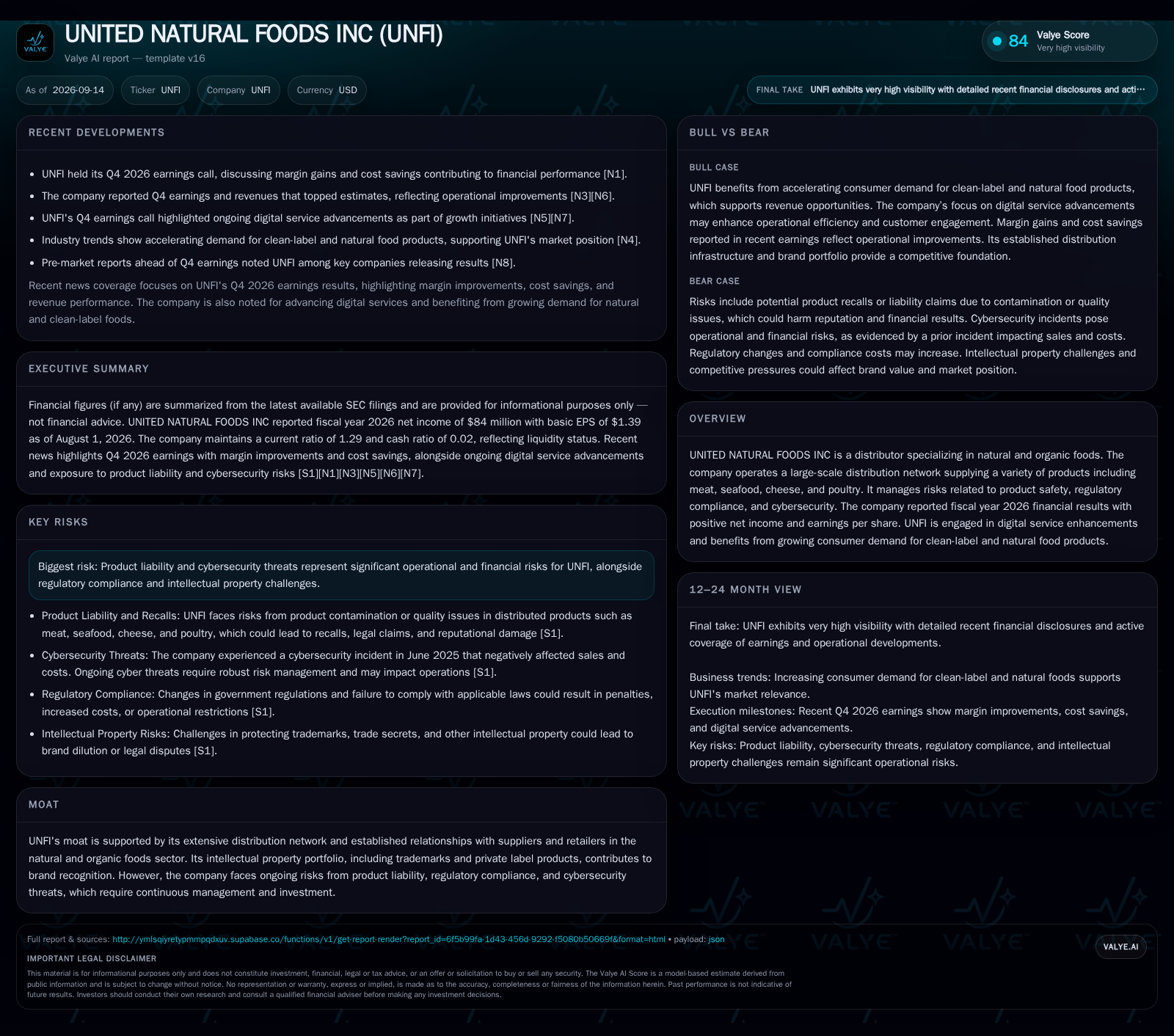
UNFI reported FY26 net income of $84 million and margin improvements, supported by operational cost savings and digital service initiatives. The company’s large-scale distribution network and exposure to clean-label food trends underpin its competitive position, but product liability and cybersecurity risks remain significant. The next phase of value creation will likely hinge on UNFI’s ability to further digitize operations, maintain margin discipline, and manage regulatory and operational headwinds. [S1] [N1] [N3] [N5] [N6] [N7] [N4]
United Natural Foods (UNFI) enters FY27 with momentum from margin gains and cost savings that drove positive net income in FY26, despite a challenging risk backdrop. As the largest distributor focused on natural and organic foods, UNFI is positioned to benefit from the continued surge in demand for clean-label products. However, the company’s exposure to product liability, cybersecurity incidents, and regulatory overhead remains material. The ability to sustain margin improvements and execute digital service initiatives will be central to determining whether UNFI can convert its operational scale and industry positioning into durable shareholder value.
Recent Margin Gains and Digital Moves Define FY26 Performance
UNFI reported net income of $84 million for fiscal 2026, with basic earnings per share of $1.39 and diluted EPS of $1.34, marking a return to profitability amid margin gains and cost savings [S1] [N1] [N3] [N5] [N6] [N7]. These improvements were highlighted across multiple Q4 earnings calls and news reports, reflecting successful operational initiatives. Liquidity remains tight, with cash and cash equivalents at $37 million and a current ratio of 1.29 as of August 1, 2026, but there is no immediate sign of distress [S1]. The company is also advancing digital service offerings as part of its growth strategy, aiming to improve efficiency and customer stickiness [N1] [N3] [N5]. Meanwhile, UNFI is riding a wave of consumer demand for clean-label and natural foods, a trend reinforced in recent industry coverage [N4].
How Scale, Mix, and Digital Initiatives Could Reshape Unit Economics
UNFI’s core business model relies on high-volume, low-margin distribution of natural and organic foods to retailers, including perishable categories such as meat, seafood, cheese, and poultry. Gross margin expansion in FY26 was achieved through cost savings—likely from logistics optimization, procurement leverage, and operational discipline—though the precise drivers are not detailed in the filings [S1] [N1] [N3] [N5] [N6] [N7]. The company’s fixed-cost base (distribution centers, fleet, IT systems) creates potential for operating leverage if revenue growth continues.
Digital service advancements may unlock new revenue streams or reduce customer churn if they improve ordering, inventory management, or data analytics for clients. However, the commercial structure of these digital services is not disclosed, so it is unclear whether they are bundled, subscription-based, or priced as premium add-ons. If successful, digital initiatives could improve gross margins and customer retention, but execution risk remains. Liquidity is a watchpoint: a current ratio of 1.29 and a cash ratio of 0.02 suggest UNFI must tightly manage working capital and may have limited flexibility for large-scale investments without external funding [S1].
The fixed-cost intensity inherent in UNFI’s distribution infrastructure implies that incremental revenue growth can disproportionately enhance operating margins if managed effectively. However, this leverage is conditional on maintaining high utilization rates of distribution centers and transportation assets, which may be challenged by fluctuating demand patterns or supply chain disruptions. Additionally, the perishability of many SKUs necessitates sophisticated inventory and demand forecasting capabilities, where digital initiatives could play a pivotal role. If these technologies enable more precise matching of supply with retailer demand, they could reduce waste and obsolescence costs, further improving unit economics. Conversely, failure to optimize these processes could erode margins despite scale advantages.
Distribution Reach and Clean-Label Focus Anchor Competitive Standing
UNFI’s competitive position is anchored by its extensive distribution network, established relationships with suppliers and retailers, and focus on the growing natural and organic food segment. This infrastructure allows it to serve a wide array of SKUs and respond to shifting consumer preferences. The company’s brand portfolio, including private label offerings and intellectual property protections (trademarks, service marks), supports differentiation, though enforcement and brand value risks exist [S1].
Competitive threats come from both traditional broadline food distributors expanding into natural/organic and from digital-first or specialty wholesalers. Substitution risk is present if retailers vertically integrate or if e-commerce platforms disintermediate legacy distributors. The secular shift toward clean-label foods provides a growth tailwind, but also attracts new entrants and intensifies price competition. UNFI’s ability to leverage its scale, data, and digital investments will determine whether it can maintain or expand its relative advantages.
UNFI’s competitive moat is partly contingent on its ability to integrate data analytics and digital platforms to offer value-added services beyond traditional distribution. If UNFI can leverage its extensive transaction data to provide predictive insights or customized assortment recommendations, it may deepen retailer partnerships and could increase switching costs. However, this advantage depends on the company’s success in developing proprietary technology and overcoming potential resistance from customers accustomed to legacy ordering systems. Moreover, the competitive landscape’s evolution toward omnichannel retailing and direct-to-consumer models poses strategic questions about how UNFI can adapt its distribution model to remain relevant and capture emerging revenue pools.
If Digital Transformation and Margin Discipline Compound, Shareholder Value Could Inflect
A favorable scenario for UNFI would see sustained margin expansion as operational discipline persists and digital service offerings gain traction with customers. If digital investments translate into measurable improvements in customer retention, order frequency, or share of wallet—potentially through data-driven services or supply chain automation—UNFI could achieve higher incremental margins and reduce price sensitivity.
Confirmation would come from future disclosures of digital revenue growth, improved gross or EBITDA margins, and growing wallet share with key retail partners. Evidence of successful cross-selling, lower churn, or higher average order value from digital tools would further validate the thesis. Stronger free cash flow generation and a less constrained liquidity position would indicate that operational improvements are translating into potential financial flexibility.
Steady Execution Amid Persistent Headwinds Remains Most Likely
The most plausible path is that UNFI continues to deliver modest top-line growth, supported by secular clean-label demand, while maintaining recent margin gains through ongoing cost control and selective digital investments. Product liability, cybersecurity, and regulatory risks will likely remain manageable but ever-present, occasionally causing volatility in costs or reputation.
This scenario would be confirmed by continued profitability, stable or slightly improving margin profiles, and incremental growth in digital service adoption if disclosed. Periodic disruptions—such as product recalls or cyber incidents—may still occur but would not fundamentally derail the business model. Liquidity would remain tight but sufficient for normal operations, with no urgent need for dilutive capital raises.
Operational Shocks or Digital Execution Misses Could Erode Gains
In a negative scenario, UNFI could face one or more operational shocks, such as a large-scale product recall, regulatory penalty, or another significant cybersecurity breach. These events would drive up costs, disrupt customer relationships, and damage brand equity. If digital service initiatives fail to deliver efficiency or customer value, investments could weigh on margins without providing offsetting revenue or retention benefits.
Falsification would be evident in deteriorating gross or EBITDA margins, a return to net losses, or a worsening liquidity position (e.g., a declining current ratio or increased reliance on short-term debt). Customer attrition, shrinking order volumes, or negative headlines around safety or compliance would further support the downside case.
What Will Shape UNFI’s Next Chapter in Clean-Label Food Distribution?
Gross margin and EBITDA margin trends—continued improvement would support the upside thesis; deterioration would challenge it.
Digital service revenue or adoption rates, if disclosed—evidence of traction would confirm the strategic value of these initiatives.
Customer retention or churn rates—a useful metric would be the stickiness of retailer relationships following digital rollouts.
Liquidity and working capital metrics—monitoring the current ratio and cash flows to assess UNFI’s ability to self; these figures do not by themselves establish operating, investment, or financing capacity.
Incidence and financial impact of product recalls or liability claims—material events would directly test risk management.
Cybersecurity disclosures—frequency and severity of incidents, plus associated costs or insurance recoveries, would signal operational resilience.
Regulatory compliance costs or penalties—unexpected increases may indicate tightening risk profile or execution gaps.
Market share or wallet share with major retail partners—would help assess competitive positioning and customer dependency risk.
Disclaimer: This is research-only, informational analysis and not investment advice. It may include AI-generated interpretation and general industry context. Always verify important details using primary sources.

Comments