
Copley Acquisition Corp Advances Toward Initial Business Combination with Focused Sector Strategy
The latest quarterly filing highlights Copley Acquisition Corp's capital position and ongoing search for a transformative merger in the technology and lifestyle sectors.
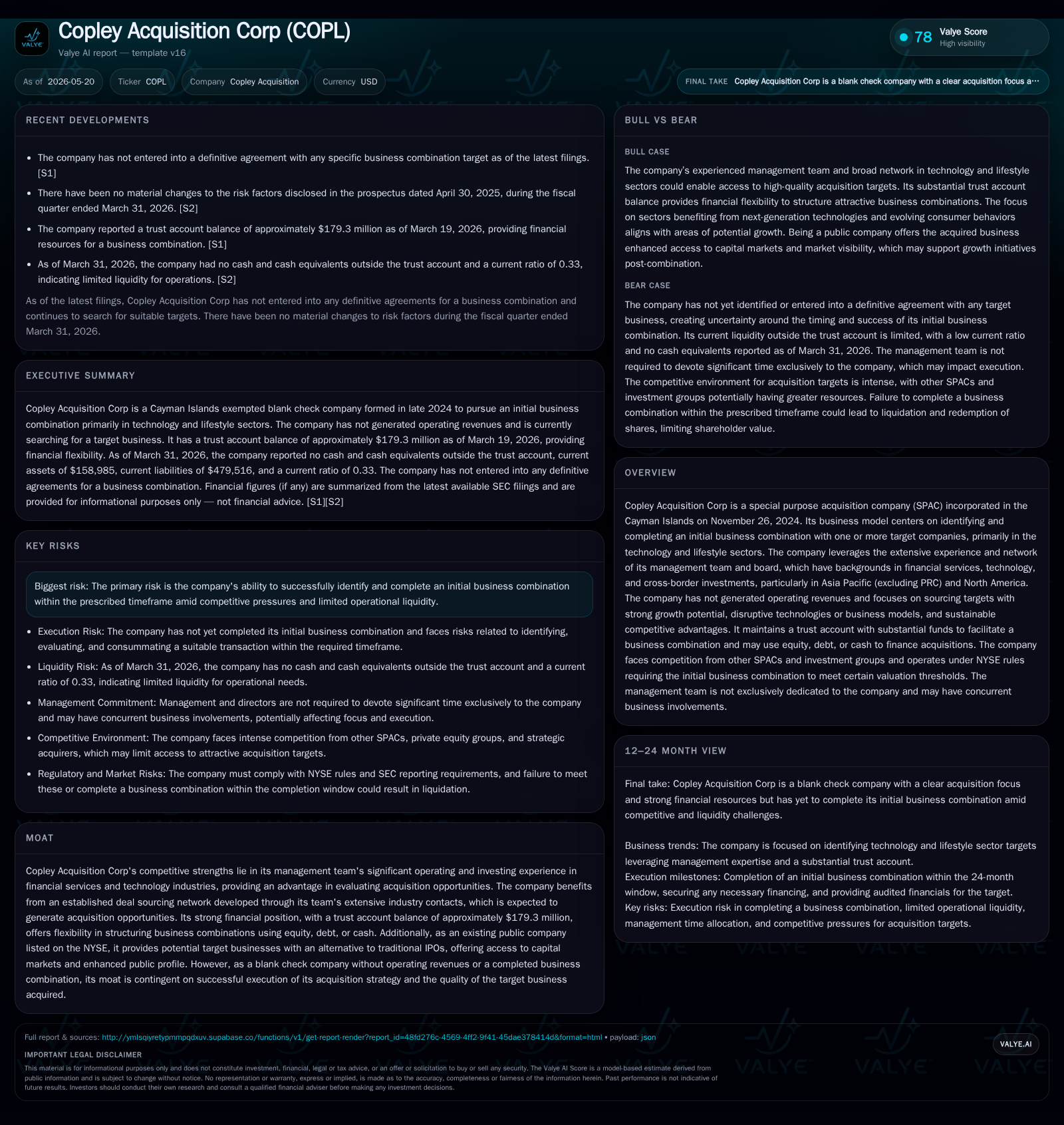
Copley Acquisition Corp continues progressing toward its initial business combination, targeting companies in enabling technologies and lifestyle services primarily across Asia Pacific (excluding PRC) and North America. Leveraging a management team with deep sector expertise and an extensive deal-sourcing network, the company faces near-term execution challenges including strict NYSE deadlines and competitive acquisition markets. Its financial flexibility is anchored by $179 million held in a trust account, while operational liquidity outside this trust remains limited.
Latest Quarterly Operating Update: Progress Toward Business Combination
Copley Acquisition Corp's Q1 2026 10-Q confirms its status as a blank check company with no operating revenues to date [S2]. The company holds approximately $179.3 million in a trust account earmarked exclusively for financing its initial business combination [S5]. Outside this trust account, working capital is constrained; current assets are approximately $159,000 against current liabilities exceeding $479,000, yielding a low current ratio of 0.33 [F1]. This highlights negligible operational cash flow support and the urgency for closing an acquisition.
Risk factors remain consistent with prior disclosures, emphasizing the time-sensitive nature imposed by NYSE listing rules that require consummation of an initial business combination within defined periods to avoid liquidation [S2]. No definitive agreements or third-party financing arrangements have been secured yet, placing execution responsibility firmly on management’s sourcing capabilities.
Business Model Overview: SPAC Structure and Strategic Focus
As a Cayman Islands-incorporated special purpose acquisition company (SPAC), Copley Acquisition Corp operates solely as a vehicle to raise capital for a qualifying transaction without generating operating revenues until consummation [S1]. The core strategy is to identify a private company within technology or lifestyle sectors and facilitate its public market entry through merger or share exchange.
Revenue generation depends entirely on completing this "initial business combination," after which operational results will emerge [S6]. Funding sources include sponsor equity, proceeds held in the trust account from the IPO, and potentially debt or equity issuance concurrent with the transaction
Target sectors encompass enabling technologies such as electric vehicles, robotics, and cybersecurity—areas experiencing rapid innovation—and lifestyle services including luxury apparel, wellness, and travel that benefit from evolving consumer preferences and digital engagement trends [S15]. These sectors offer structural growth prospects aligned with demographic shifts and technological advancements.
Competitive Strengths: Experienced Management and Robust Deal Sourcing
Copley's competitive advantage lies in its management team's substantial experience across financial services and technology investments spanning Asia Pacific (excluding PRC) and North America [S5][S19]. This expertise facilitates rigorous evaluation of potential targets possessing disruptive technologies or defensible market positioning.
The team’s extensive network includes venture capital firms, private equity sponsors, industry executives, regulatory bodies familiar with cross-border transactions, and public market intermediaries [S19]. Such relationships enable early access to high-quality opportunities less accessible to generalist SPACs.
Excluding PRC operations reduces regulatory complexities associated with mainland China while preserving access to rapidly growing adjacent Asian markets alongside North American opportunities. This geographic focus further differentiates Copley from peers lacking comparable regional or sector specialization.
Industry Context: Regulatory Environment and Market Dynamics
Operating within the SPAC sector subjects Copley to regulatory frameworks including SEC rules under the JOBS Act that provide emerging growth companies certain reporting exemptions pre-merger [S3]. Post-merger compliance with Sarbanes-Oxley Act internal control audits often entails extensive due diligence on targets, potentially extending timelines or restricting candidate pools [S9].
NYSE rules mandate that initial business combinations involve targets whose fair market value equals at least 80% of the trust account balance at signing—the "80% test"—limiting flexibility in deal sizing [S6][S22]. This intensifies competition among SPACs seeking appropriately sized targets.
Additional challenges include managing shareholder redemptions which can reduce available transaction cash [S26], addressing dilution risks from outstanding warrants [S20], and adapting to heightened investor scrutiny following volatility in the SPAC market segment.
Growth Drivers: Strategic Sector Focus and Capital Deployment Flexibility
Copley’s growth potential hinges on securing an acquisition aligned with its targeted high-growth sectors. The enabling technology segment benefits from accelerating global IT spending projected above $8 trillion by decade’s end per Gartner estimates cited by Copley [S15]. Areas like electric vehicles, cybersecurity, and robotics are key innovation drivers.
Lifestyle services capitalize on evolving consumer behaviors driven by digital ecosystems involving e-commerce, influencer marketing, and immersive experiences—especially relevant to millennial and Gen Z demographics. Post-pandemic recovery trends such as "revenge travel" further bolster these verticals’ prospects [S15].
Capital structure flexibility allows acquisitions to be financed through cash from the trust account, equity issuance, or debt financing [S5][S6], though no third-party debt arrangements have yet been secured. The sizable trust fund provides negotiating leverage to support growth initiatives post-combination.
Risks and Execution Challenges Ahead
Key risks include meeting stringent NYSE deadlines typically requiring completion of an initial business combination within two years post-IPO to avoid liquidation scenarios detrimental to shareholders [S2][S25]. Precise valuation is critical to satisfy the 80% fair market value standard; misvaluation risks deal disqualification or investor dilution [S6].
Management attention may be divided due to concurrent external commitments given their involvement in other businesses [S1][S9]. Liquidity outside the trust account remains minimal—with zero unrestricted cash reported as of quarter-end coupled with higher short-term liabilities posing solvency challenges absent prompt financing or sponsor support [F1][S2].
Sarbanes-Oxley compliance requirements present hurdles as many high-growth private companies lack mature internal controls systems complicating audit processes and increasing costs [S9]. Competition from well-resourced SPACs and private equity funds also pressures deal sourcing effectiveness [S20].
Upcoming Milestones for Investors to Monitor
Investors should watch for announcements regarding definitive agreements selecting target companies. Proxy filings will detail shareholder voting procedures including redemption rights crucial under tender offer regulations [S1][S26]. Typically, there is a minimum 20-day window between announcement and vote allowing informed investor decisions.
Due diligence progress reports focusing on audit outcomes related to SOX compliance will inform transaction timelines. Market developments such as warrant exercises or third-party financing discussions may signal evolving capital strategies post-deal announcement.
Delays beyond regulatory deadlines or shifts in valuation assumptions could jeopardize planned combinations. Ongoing regulatory guidance updates affecting SPAC operations warrant close observation given their potential impact on reporting standards.
Financial Position Summary Reinforcing Strategic Capacity
As of March 31, 2026, Copley reported no cash or equivalents outside its restricted trust account; current liabilities outstrip liquid current assets resulting in a current ratio of 0.33 indicating limited non-trust liquidity reserves [F1][S2]. The trust account balance of approximately $179.3 million remains segregated specifically for acquisition funding.
Historical operating losses reflect typical pre-combination organizational expenses without substantive net income given absence of commercial operations thus far [F1]
Overall fiscal posture reflects prudent resource management focused on preserving optionality until deployment via successful initial business combination.
Disclaimer: This analysis relies exclusively on publicly disclosed information from Copley Acquisition Corp’s SEC filings as of May 20, 2026. It does not constitute investment advice but aims to present an informed perspective grounded strictly in documented data without speculative assumptions beyond cited sources.
Disclaimer: This is research-only, informational analysis and not investment advice. It may include AI-generated interpretation and general industry context. Always verify important details using primary sources.

Comments