
Coty Inc. Q3 2026: Strategic Review and CFO Transition Amid Liquidity and Market Challenges
Coty’s Q3 2026 update highlights a focused portfolio review, leadership change, and financial constraints impacting its growth and operational execution.
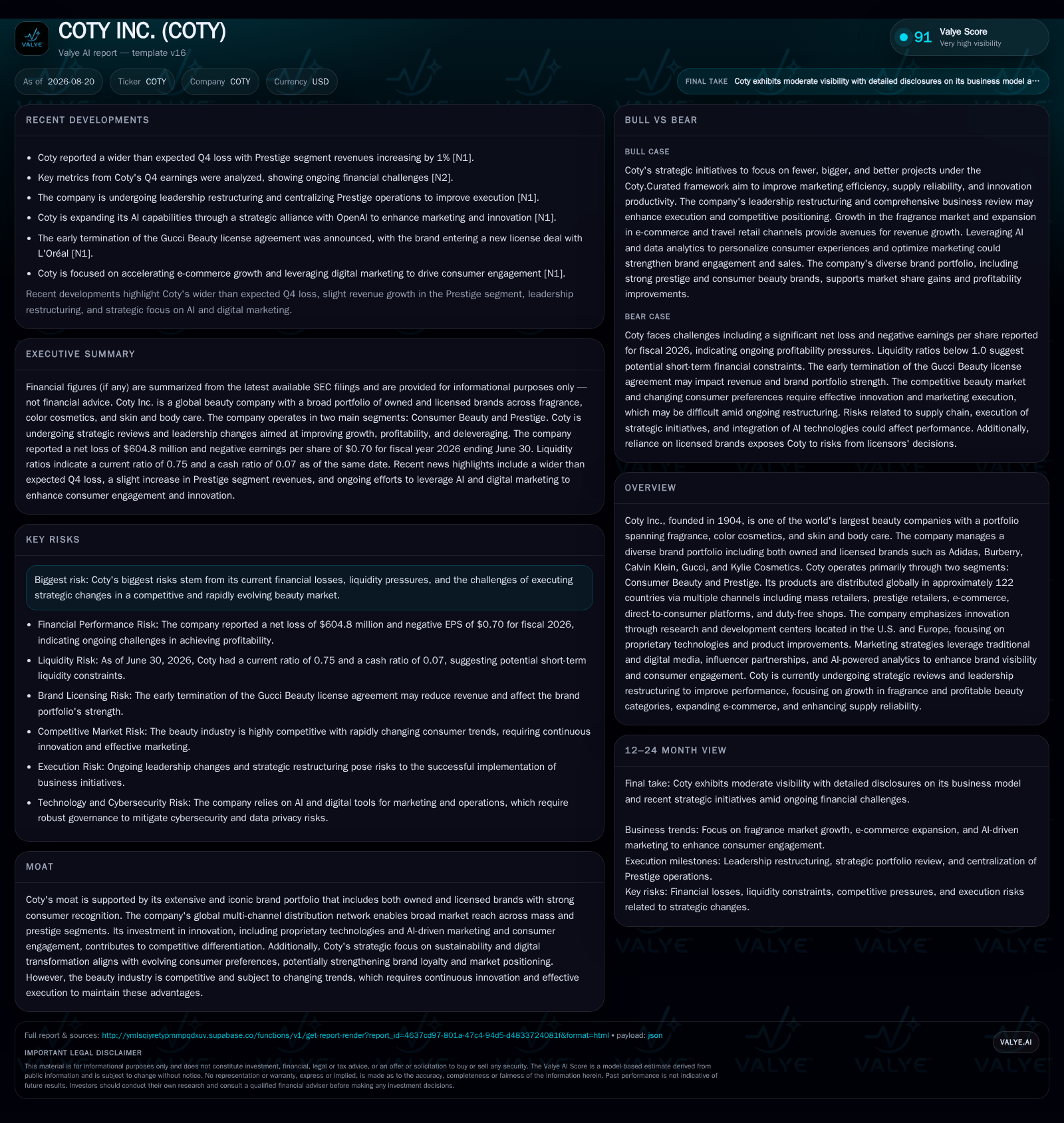
In Q3 2026, Coty Inc. continued its strategic review of the consumer beauty business and Brazil operations, emphasizing growth in the fragrance segment. The company faces liquidity pressures with a current ratio of 0.75 and high net debt near $2.9 billion as of June 30, 2026. A CFO transition effective September 1, 2026, introduces new financial leadership during this critical phase. These factors collectively influence Coty’s ability to stabilize growth and deleverage amid competitive and market challenges.
Q3 2026 Operating Performance and Strategic Review
Coty Inc.'s Q3 2026 operating update, covering the quarter ended March 31, 2026, reports an ongoing strategic review of its consumer beauty business and Brazil market operations. This review is described as intended to explore opportunities to enhance performance and potentially strengthen Coty’s competitive positioning by concentrating on growth in the fragrance segment and other profitable categories [S1]. The company’s strategic framework, branded as Coty.Curated, emphasizes focusing on fewer, bigger, and better initiatives, improving marketing sufficiency, supply reliability, consumer engagement, and innovation. These efforts correspond with market trends favoring premium and specialty beauty products, particularly in fragrance, which Coty identifies as a potential structural growth area [S1].
The update indicates that while the Consumer Beauty segment faces ongoing challenges, the Prestige segment shows some growth momentum, though exact revenue figures for Q3 2026 are not detailed in the filings [S2]. The company reported current assets of $1.92 billion against current liabilities of $2.54 billion, resulting in a current ratio of 0.75 and a working capital deficit [F1]. This liquidity position suggests limited short-term financial flexibility, which could impact operational execution and the ability to invest in growth initiatives.
Total debt stood at approximately $3.07 billion, with net debt—total debt minus cash and equivalents—around $2.89 billion as of the same date [F1]. Such leverage levels constrain Coty’s financial flexibility and increase refinancing risk. The company’s cash balance was $176 million, indicating relatively tight liquidity given the scale of liabilities [F1]. These financial metrics underscore the urgency for Coty to execute its strategic initiatives effectively to improve cash flow and deleverage.
Leadership Transition and Governance Implications
In August 2026, Coty announced a planned CFO transition, with Soraya Benchikh succeeding Laurent Mercier effective September 1, 2026 [S3]. This leadership change occurs during a critical strategic phase as Coty seeks to stabilize growth and improve financial health. Ms. Benchikh brings over two decades of international finance and general management experience in global consumer goods companies, which could influence Coty’s financial strategy and capital allocation going forward [S3].
The CFO succession reflects a governance decision aimed at strengthening financial leadership amid liquidity pressures and strategic execution demands. How smoothly this transition unfolds and its impact on capital management will be important to monitor in subsequent quarters.
Business Model and Competitive Positioning
Coty operates as a global beauty company with an iconic portfolio spanning fragrance, color cosmetics, and skin and body care products. Its revenue is generated primarily through two segments: Consumer Beauty, which targets the mass market, and Prestige, which includes premium brands [S1]. Coty distributes products in approximately 122 countries through multi-channel networks including mass retailers, prestige outlets, e-commerce, direct-to-consumer, and travel retail.
Margins and cash conversion in this sector depend heavily on brand portfolio mix, marketing effectiveness, supply chain reliability, and innovation [S1]. Coty’s Coty.Curated strategy focuses on improving these drivers by prioritizing marketing sufficiency and supply reliability, alongside leveraging AI-driven consumer engagement to enhance brand advocacy and innovation productivity.
Competitive constraints include intense market rivalry and Coty’s high leverage and liquidity pressures, which limit its ability to invest aggressively compared to peers with stronger balance sheets. However, Coty’s broad brand portfolio and global distribution remain valuable assets if operational execution improves.
Scenario Analysis and Forward-Looking Considerations
One possible positive scenario is that Coty successfully executes its Coty.Curated strategy, particularly by expanding its fragrance segment and improving operational efficiency. This could lead to market share gains and margin expansion. Confirmation of this scenario would include quarterly revenue growth in fragrance and prestige segments and margin improvements.
Conversely, if liquidity pressures intensify and strategic initiatives fail to gain traction, Coty may face operational disruptions, forced asset sales, or distressed refinancing conditions. The current working capital deficit and high leverage create financial vulnerability, especially given competitive pressures in the beauty market [F1]. The ongoing portfolio review and focus on fragrance growth represent a structural shift aimed at reversing recent performance challenges. However, the company’s negative working capital position and high net debt constrain financial flexibility, making effective execution urgent to avoid liquidity stress.
Key watchpoints for investors and analysts include:
- Quarterly revenue growth trends in fragrance and prestige segments to assess market share momentum.
- Changes in gross and operating margins indicating margin recovery or deterioration.
- Liquidity ratios and net debt levels in upcoming filings to monitor financial flexibility.
- Progress on Coty.Curated initiatives reflecting operational execution.
- Impact of the CFO transition on financial management and capital allocation strategies.
These factors will be critical in determining Coty’s near-term ability to stabilize growth, improve profitability, and deleverage in a competitive and evolving beauty market.
Disclaimer: This is research-only, informational analysis and not investment advice. It may include AI-generated interpretation and general industry context. Always verify important details using primary sources.

Comments