
Corpay, Inc.: Sustaining Growth Momentum Through Digital Payment Innovation
Examining how Corpay’s diversified payment segments and technological controls underpin growth amid legal and liquidity challenges.
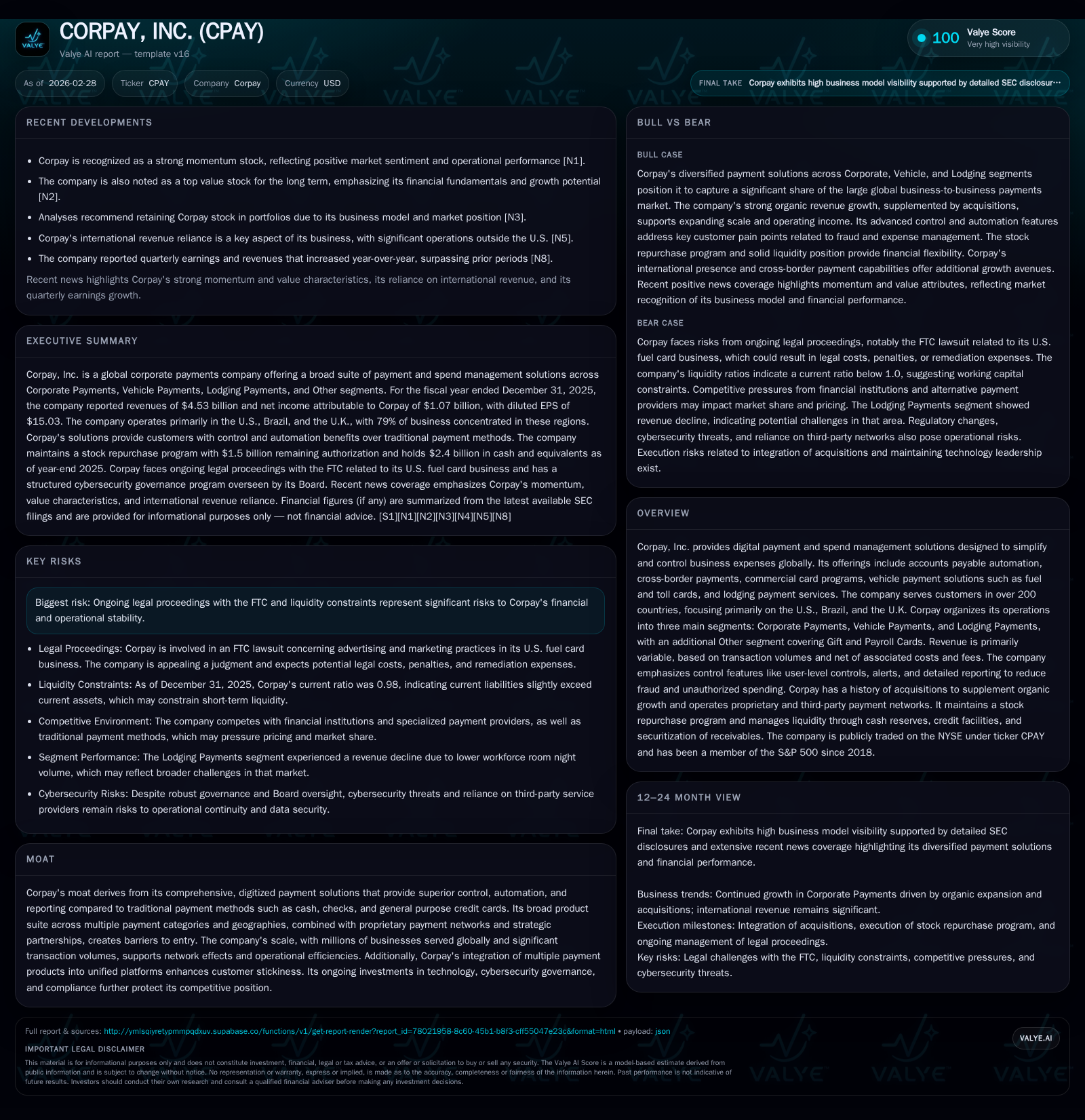
Corpay continues to demonstrate robust revenue growth, driven primarily by its Corporate Payments segment accelerating faster than its traditionally dominant Vehicle Payments. The company leverages proprietary and third-party payment networks across multiple geographies to expand its transaction volumes and spread-based revenues. Despite ongoing FTC litigation and liquidity management constraints from a complex debt structure, Corpay’s strong operational cash flows and disciplined capital allocation, including substantial share repurchases, support its investment in technology and risk mitigation. Investors should closely monitor regulatory developments, segment profitability trends, and the upcoming 2026 annual meeting for guidance on strategic direction.
Corpay’s Revenue Growth and Segment Dynamics Over Recent Years
Corpay delivered a strong top-line performance with net revenues reaching $4.53 billion in fiscal year 2025, reflecting an impressive 13.9% increase compared to $3.97 billion in 2024 [F1]. Operating income also grew robustly by approximately 11.6% to $1.99 billion while net income rose more modestly by 6.6% to about $1.07 billion for the same period [F1]. This signals effective operational leverage but also margin pressure potentially linked to investment in growth initiatives or legal costs.
Segment analysis highlights a significant shift in the revenue mix: the Corporate Payments segment accelerated fastest among all segments with a nearly 34% jump from $1.22 billion in 2024 to $1.64 billion in 2025, increasing its share of total revenues from 31% to 36% [S4][F1]. Vehicle Payments, historically the largest segment generating $2.14 billion or 47% of revenues in FY2025, expanded more moderately from $2.01 billion (51%) the prior year, indicating slowing momentum [S4]. Lodging Payments experienced mild contraction to $469 million (10%), or down roughly 4%, reflecting cyclical pressures in hospitality sectors [S4]. The Other segment—which includes Gift and Payroll cards—grew modestly to $285 million (6%) maintaining stable contribution.
Historical performance (annual)
| FY | Rev ($bn) | Net ($mm) | CFO ($bn) | OpInc ($mm) | Rev YoY | Net YoY |
|---|---|---|---|---|---|---|
| 2025 | 4.5 | 1070 | 1.5 | 1994 | +13.9% | +6.6% |
| 2024 | 4.0 | 1004 | 1.9 | 1787 | +5.8% | +2.2% |
| 2023 | 3.8 | 982 | 2.1 | 1657 | +9.6% | +2.9% |
| 2022 | 3.4 | 954 | 0.8 | 1447 |
Source: SEC companyfacts cache [F1].
Capital returns and efficiency (annual)
| FY | Buybacks ($mm) | FCF ($mm) | ROE% |
|---|---|---|---|
| 2025 | 783 | 1299 | 27.5 |
| 2024 | 1288 | 1765 | 32.1 |
| 2023 | 687 | 1947 | 29.9 |
| 2022 | 1405 | 603 | 37.5 |
Source: SEC companyfacts cache [F1].
Data from consolidated financial statements reflects strong topline gains outpacing operating cash flow declines influenced by working capital volatility[F1]._
Drivers Behind Corporate, Vehicle, and Lodging Payments Expansion
The surge in Corporate Payments is tied closely to Corpay’s emphasis on digitized automation solutions that simplify vendor payables while leveraging proprietary payment networks that command spread revenue—a revenue model earning income on the difference between customer charges and third-party payouts plus interchange fees from card transactions [S4][S11]. This segment benefits significantly from integration of advanced controls such as detailed transaction reporting and user-level programmable alerts that minimize fraud exposure while enhancing spend transparency—a critical factor given rising enterprise compliance demands [N1][S20].
Vehicle Payments sustain leadership due primarily to network scale supporting fuel cards and toll services across broad geographic footprints especially in the U.S., Brazil, and U.K., although lower growth rates suggest maturation in core markets or increased competitive pricing pressures within vehicle fleet spend categories [S4][N1]. Cross-border foreign exchange spreads contribute materially here via risk management products that hedge currency exposure inherent in international transactions—a sophisticated earn mechanism requiring active market making and counterparty management capabilities [S11].
Lodging Payments faced moderate headwinds likely attributable to fluctuating travel demand patterns impacting hotel commission structures; however, ongoing platform integrations enabling T&E card use also present potential upside if adoption accelerates beyond current commercial travel recovery levels [S4][N1].
Collectively Corpay’s multi-channel go-to-market strategy combining direct sales with digital channels and strategic partnerships supports expanding touchpoints even as payments landscape sees increasing fintech competition targeting automated spend management tools [S16].
Legal and Liquidity Headwinds: Navigating Risk Factors in 2026
A notable cloud over Corpay’s trajectory remains the protracted legal dispute originating from FTC allegations regarding unfair marketing practices within its North American fuel card business segment dating back several years [S8][S10]. Despite district court rulings affirming liability for unfair conduct components against Corpay and CEO Ron Clarke—with money damages relief remanded—appellate processes continue aiming at en banc review filings seeking reconsideration of penalties imposed [S8]. Management publicly maintains defense confidence asserting lawsuit claims lack merit while recognizing potential costs inclusive of legal fees and remediation efforts could attach but are not expected material enough to disrupt longer-term fundamentals [S8][S12].
On liquidity front, Corpay manages complex funded debt aggregates exceeding $10 billion peaking through several tranches including a revolving credit facility ($2.8B), Term Loans A ($3.3B) & B ($4.1B), supplemented by a significant receivables securitization facility expanded recently from $1.8B to $2.3B with extended maturities through late 2028 and better pricing terms fostering cost efficiency of capital usage [S5][S6][S14][S18][S26]. Amendments throughout calendar year 2025 also scaled revolving commitments by additional $1B aligning with acquisition funding needs notably for Alpha purchase completion leveraging bridge term loans refinanced into term loans B-6 totaling approximately $900 million repayable over seven years [S6][S14][S19]
Compliance remains solid with no breaches reported across covenant thresholds despite near-parity current ratio (~0.98) driven by essentially matched current assets/liabilities balances dominated by customer deposits/restricted cash reserves mandated for regulatory purposes across jurisdictions served [F1][S9]. The firm utilizes these facilities flexibly not only for operational liquidity but also for acquisitions enhancing overall market footprint.
Technology Controls, Cybersecurity Governance, and Operational Governance
Cybersecurity oversight at Corpay is institutionalized via a dedicated Information Technology & Security Committee composed of board members possessing combined expertise spanning information security standards assessment, technology risk management frameworks and financial controls oversight—ensuring alignment of long-term IT modernization plans with competitive imperatives alongside direct evaluation of quality at major project milestones [S1]. Regular third-party audits supplement internal assessments covering incident response preparedness plus continual monitoring/testing of deployed security controls mitigate risk exposures inherent in processing sensitive payment data across millions of daily digital transactions globally.
The company's CISO leads day-to-day data security efforts supported by experienced teams managing incident triage scenarios logically integrated with business continuity planning requirements achieving regulatory compliance across multiple operating jurisdictions including coordination with law enforcement where warranted [S21]. Such layered governance promotes confidence among stakeholders that operational resilience sustains even through evolving cyber threat landscapes—a key competitive differentiator especially given fintech payment ecosystems’ frequent targeting vulnerability incidences.
Projections and Market Expectations From Recent Earnings Insights
Recent earnings releases spotlighted continued beat-and-raise outcomes positioning Corpay as both strong momentum equity favored by growth-centric investors alongside attributes appealing to value-oriented shareholders focusing on recurring cash flows and disciplined margin management strategies seen through incremental operational efficiencies discussed on Q4 ’25 calls ([N2],[N3]). Investor sentiment actively debates balancing rapid Corporate Payments scaling against moderation risks posed by Vehicle segment's plateauing expansion.
Nasdaq coverage frames Corpay as straddling "momentum stock" status due to technological innovation pipeline driving next-generation payment automation capability advances while not losing sight of "value stock" traits manifested via robust free cash flow conversion supporting ongoing buyback programs ensuring shareholder returns remain prioritized ([N7],[N8]). Key metrics flagged for monitoring include transaction volume growth cadence across segments; forex spread performance within cross-border payments; impact timeline of legal resolution costs; alongside capital expenditure pacing aligned with software development cycles boosting platform integration efficacy.
Capital Structure, Cash Flows, and Shareholder Returns Analysis
Capital allocation emphasizes shareholder return without dividend payments currently authorized or expected due to credit agreement restrictions but compensated via aggressive share repurchase activities [$783M spent on buybacks during FY2025 leaving ~USD$1.5B authorization remaining] under an enlarged program totaling over $10 billion approved late ’25 increasing flexibility for opportunistic stock price engagement actions ([F1],[S23]).
Operating cash flow declined from about $1.94 billion in FY2024 to roughly $1.50 billion FY2025 mainly attributable to working capital fluctuations connected with seasonally variable receivables/payables timings plus increased deposit balances held as collateral for cross-border transactions ([F1],[S9]). Capital expenditures climbed moderately to about $201 million reflecting intensified capitalization of internally developed software enhancing processing platform sophistication ([F1],[S25]).
Approximate return on equity calculated using latest_net income over equity stands near healthy ~27.5%, consistent with efficient use of invested capital balancing reinvestment requirements alongside shareholder distributions ([F1]). Financing cost improvements stem from amendments lowering facility fees slightly while lengthening debt maturities mitigating refinancing risk concentration particularly notable given large tranche maturity clusters due mid-to-late decade ([S14],[S18],[S19]).
What Investors Should Monitor Ahead of the 2026 Annual Meeting
Investors should watch closely the upcoming May 7th annual meeting anticipated as a strategic inflection point encompassing:
- Updates on status/progress/resolution prospects regarding FTC litigation including any material financial impacts or settlement disclosures ([S3],[S8])
- Announcements regarding credit covenant compliance given leveraged balance sheet profile plus refinancings or amortization schedules adjustments ([S5],[S24])
- Product innovation releases or platform rollout updates especially those integrating multiple payment modalities enhancing client retention via improved UX/automation ([N3],[N2])
- Geographic mix evolution driven by growing Brazil/U.K./Other regions contribution balanced against dominant U.S market dynamics monitored via segment-level disclosures ([S4],[N1])
- Governance signals potentially influencing board composition or cybersecurity policy enhancements reinforcing risk mitigation ethos outlined at board committee levels ([S21],[S1])
These elements combined carry significant weight for valuation judgments due to their implications for sustainable growth pathways versus contingent liabilities shaping risk reward evaluations over medium term horizons.
This analysis synthesizes disclosed facts without endorsing any security positions; readers should consult available filings directly for comprehensive details.
Disclaimer: This is research-only, informational analysis and not investment advice. It may include AI-generated interpretation and general industry context. Always verify important details using primary sources.

Comments