
Cirrus Logic's Earnings Surge Highlights Financial Strength and Apple Reliance
A detailed analysis of Cirrus Logic reveals robust liquidity and a competitive moat tempered by concentrated customer risk and market pressures.
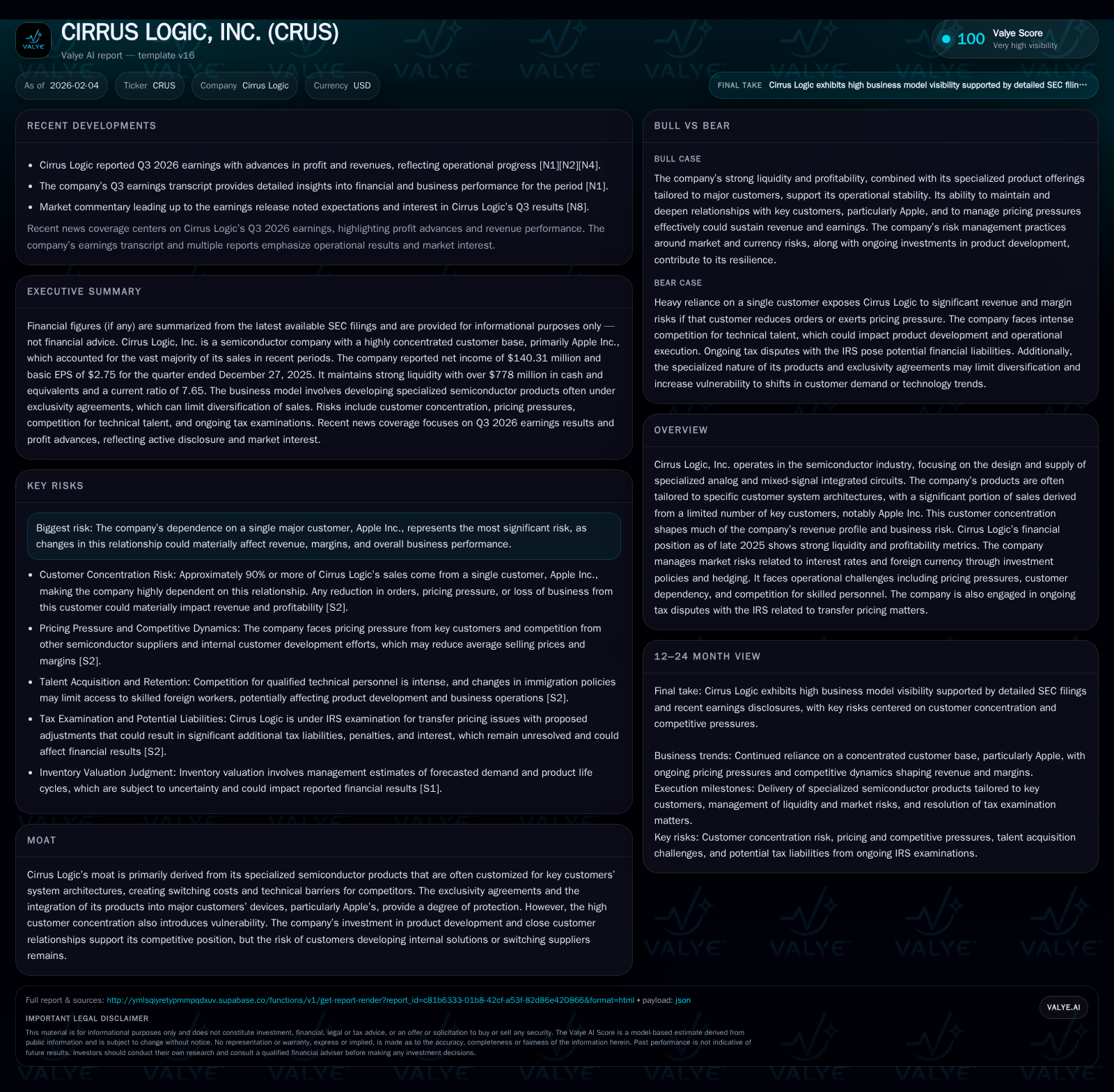
Cirrus Logic posted a notable Q3 2026 earnings beat signaling ongoing operational momentum despite challenging sector dynamics. The company remains heavily dependent on Apple, which accounts for roughly 90%+ of its revenue, raising inherent business risks. Strong liquidity, including a current ratio above 7, and prudent hedging strategies bolster its financial resilience. Yet, external challenges such as pricing pressure, talent competition, and ongoing IRS tax disputes underscore the nuanced risk environment.
Navigating Earnings Triumphs: Cirrus Logic’s Recent Beat and What It Means
Cirrus Logic demonstrated solid operational traction in its Q3 2026 financial results, exceeding consensus expectations on both topline revenue and earnings per share. The latest earnings transcript reveals management’s confidence amidst a challenging economic backdrop accentuated by supply chain tightening and inflationary cost pressures [N1]. Revenue growth was supported by sustained demand in audio-related integrated circuits primarily sold into high-end mobile devices.
This earnings beat signals that the firm’s tailored product offering retains strong relevance among key customers. However, spotlighting this success also foreshadows an underlying fragility — a palpable reliance on a scant number of customers. Market observers note that while strong financial execution is commendable, the durability of growth remains heavily tethered to those few major partners' purchasing behaviors [N2][N3].
Transitioning from praise for recent results to a focus on risk is essential given Cirrus Logic's outsized dependence on single clients.
Anatomy of Customer Concentration: The Apple Dependence Dilemma
Cirrus Logic’s revenue profile is notably concentrated, with approximately 90% generated from Apple Inc., either directly or through multiple contract manufacturers, for the third quarter of fiscal year 2026 [S2]. This extreme customer concentration presents a double-edged sword: On one hand, the symbiotic relationship fosters close collaboration and integration into Apple’s sophisticated system architectures — effectively raising switching costs for Apple.
On the other hand, such dependency amplifies financial vulnerability should Apple reduce orders, shift to alternative suppliers, or internally develop substitute components. Importantly, contracts typically do not bind customers to minimum purchase volumes or penalize them for supplier changes [S2]. Apple’s substantial negotiating leverage can translate into aggressive price pressures or sudden order fluctuations.
This dynamic imposes persistent uncertainty over revenue visibility and margin sustainability. Moreover, several secular trends in semiconductor procurement reveal customers’ strategic desire to diversify their supplier base as risk mitigation. This trend may clash with Cirrus Logic’s objective to deepen exclusivity arrangements but underscores the tension between concentration benefits and inherent counterparty risks.
Strong Liquidity and Financial Health in Focus
Financially, Cirrus Logic projects solid resilience bolstered by a robust liquidity position. As of December 27, 2025, cash and cash equivalents totaled $778 million with current assets eclipsing current liabilities by more than sevenfold—a current ratio estimated at approximately 7.65—placing Cirrus comfortably above typical semiconductor industry benchmarks [F1][S1].
Net income stood around $140 million for the latest quarter period ended December 2025 [F1], underscoring profitability supported by operational efficiencies. The company has also actively repurchased shares under two board-authorized programs totaling $1 billion aggregate authorization since mid-2022 — demonstrating capacity for capital returns while retaining cash buffers [S1].
This strong balance sheet provides flexibility to navigate cyclical downturns or invest selectively in R&D initiatives. Nonetheless, the financial strength does not negate strategic constraints imposed by customer concentration which weighs on bargaining power despite liquidity advantages.
Competitive Moat Rooted in Custom Semiconductor Integration
Cirrus Logic’s competitive moat rests significantly on its specialized design expertise in analog and mixed-signal integrated circuits deeply embedded within customers’ device ecosystems [S1]. Unlike commoditized semiconductor components easily swapped across suppliers, these ICs often require bespoke engineering aligned tightly with end-product system architecture.
Exclusive arrangements entrench long-term partnerships particularly with dominant customers such as Apple. This technical integration yields switching costs discouraging customer migration due to the complexity of redesign efforts.
Continuous investment in product innovation constitutes another pillar reinforcing the moat while mitigating risks related to customers developing internal solutions or exploring alternative vendors. However, this moat is not impregnable; increasingly sophisticated in-house R&D teams within large customers pose credible threats over time.
The Invisible Pressures: Pricing, Talent War, and Supply Chain Risks
Behind the curtain of earnings beats lie persistent pressures shaping Cirrus Logic's margins and operations. Pricing pressure from its principal customer exerts downward influence on average selling prices compressing gross margins—a reality explicitly acknowledged within SEC filings and quarterly disclosures [S2]. Such demands reflect Apple's tremendous leverage stemming from purchasing scale coupled with competitive supplier landscapes.
Talent acquisition further complicates matters. Specialized skills needed to engineer complex analog/mixed-signal chips face fierce competition in semiconductor hubs globally—from Austin to Asia-Pacific—making retention costly yet mission-critical [S1][S2]. Concurrent supply chain challenges remain salient as well given global semiconductor industry tightness impacting component availability.
Together these factors represent subtle but material drags that could limit upside margin expansion beyond recent levels unless managed adeptly.
Legal and Tax Challenges: IRS Transfer Pricing Disputes
On the regulatory front, Cirrus Logic contends with ongoing IRS transfer pricing audits. These disputes revolve around intercompany pricing mechanisms affecting taxable income allocation across jurisdictions [S1]. Although current management commentary suggests no material impact has been recognized historically nor at present time, the potential for adverse outcomes persists.
Such tax uncertainties can influence cash flow planning and increase administrative burdens even absent immediate financial losses. Transparency about these matters reflects prudent corporate governance amidst complex multinational tax regimes pervasive in semiconductor multinational operations.
Currency and Interest Rate Risks: Hedging Strategies Unveiled
While predominantly generating revenue in U.S. dollars, Cirrus Logic operates design centers internationally exposing it to currency translation fluctuations on non-functional currency balances [S1]. To mitigate these exposures, it employs foreign exchange forward contracts targeting balance sheet exposures related to foreign currencies — chiefly Chinese yuan, Japanese yen, Korean won among others.
The hedging program effectively reduces potential volatility so that hypothetical currency swings would yield immaterial pretax effects at period ends reported in filings [S1]. Similarly, interest rate risk is attenuated by constraints confining investment portfolios to high-quality short-maturity debt instruments minimizing sensitivity to rising rates—estimated impact being modest per management analysis.
This comprehensive risk management foundation offers relative stability amid otherwise volatile macro environments especially critical given global footprint.
Looking Forward: Strategic Priorities Amid Market and Customer Dynamics
Going forward, strategic themes emerge centered on sustaining product innovation leadership alongside cautious steps toward diversification in customer base where feasible [S1][N1]. Expanding geographic reach—through design centers spanning Austin’s tech corridor to multiple Asian hubs—supports global innovation velocity crucial for staying ahead technologically.
Capital deployment continues balancing R&D investments against shareholder returns via repurchases reflecting confidence but measured prudence given sector cyclicality. Moreover, ongoing dialogue during earnings calls highlights intent to deepen Apple partnership while remaining attentive to competition from internal developments within such customers as well as from rival IC providers.
While diversification away from single-customer dependence may be constrained due to entrenched specialization requirements underlying customized solutions architecture, even incremental broadening would enhance resilience over time.
Investor Takeaways: Balancing Opportunity With Inherent Risks
In sum, Cirrus Logic portrays an intriguing blend of operational strength underscored by strong liquidity metrics alongside an occupying niche defined by high technical barriers yet singular customer reliance risks [N2][S1].
Its ability to consistently exceed quarterly estimates affirms effective execution capacity; however, investors must maintain perspective on vulnerability arising from concentrated demand sources exposing revenues to abrupt shifts or pricing erosions. External challenges extend beyond customer dynamics into regulatory tax scrutiny and broader industry structural issues such as talent scarcity and supply chain fragility.
Navigating this landscape requires disciplined product evolution strategies supplemented with robust risk mitigation frameworks evidenced by hedging practices outlined periodically by management. A nuanced understanding favors recognizing both commendable technological differentiation alongside embedded risks intrinsic to its business model — key elements shaping valuation deliberations.
This analysis is based solely on publicly available information as of early February 2026 including SEC filings ([S1], [S2]) and recent earnings transcripts ([N1], [N2], [N3]). It does not constitute investment advice but aims to provide a comprehensive overview integrating quantitative data with qualitative industry insights.
Disclaimer: This is research-only, informational analysis and not investment advice. It may include AI-generated interpretation and general industry context. Always verify important details using primary sources.

Comments