
Integrated BioPharma Inc: Navigating Customer Reliance Amid Regulatory and Supply Chain Shifts
INBP balances manufacturing expertise against concentrated revenues, regulatory demands, and global supply challenges shaping its near-term outlook.
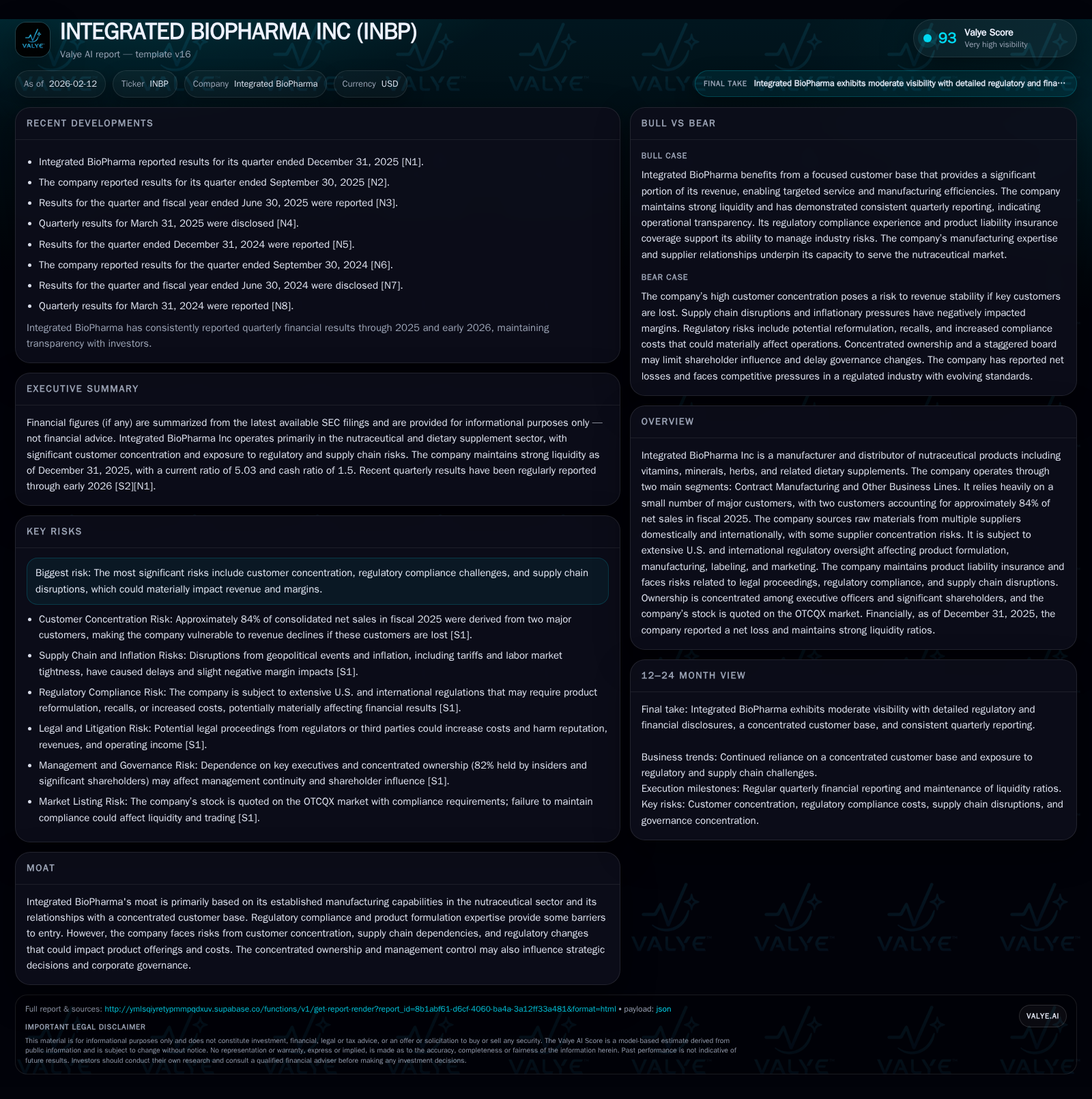
Integrated BioPharma Inc specializes in nutraceutical contract manufacturing, building a defensible position through sophisticated production capabilities and compliance expertise. However, its substantial customer concentration—two clients represent roughly 84% of fiscal 2025 net sales—creates pronounced revenue risks, intensified by complex regulatory oversight and ongoing supply chain pressures. Financial snapshots reveal operational strain, with recent negative net income alongside solid liquidity metrics. Governance features concentrated ownership that can both expedite strategic action and constrain minority voices. Overall, INBP’s future hinges on managing intertwined external vulnerabilities while leveraging its entrenched manufacturing moat.
Navigating Narrow Customer Anchors: Revenue Reliance Risks
Integrated BioPharma Inc (INBP) operates under the shadow of significant customer concentration in its contract manufacturing segment. Two primary customers alone constituted approximately 84% of consolidated net sales during fiscal 2025 [S1]. These clients—identified as Life Extension and Herbalife in filings—are pivotal anchors anchoring revenue streams but simultaneously expose the company to acute operational risk should relationships weaken or terminate unexpectedly.
The reliance on such a narrow base amplifies revenue volatility; loss or volume reduction with any of these customers would likely lead to pronounced declines in sales given the proportionate magnitude. The 2024 figure, hitting an even higher concentration at about 90%, indicates this pattern is entrenched rather than transitional [S1]. For a manufacturer serving the nutraceutical sector—a market characterized by evolving consumer trends and stringent quality expectations—maintaining these accounts involves both operational rigor and pricing discipline.
Notably, other customer groupings in INBP’s diversified segments appear far less concentrated; however, the contract manufacturing division drives the lion’s share of operational scale. This focus can bring efficiencies but compounds dependency risk. The lack of broader clientele diversification remains a pressing strategic concern as it narrows negotiating leverage and amplifies cash flow sensitivity to client retention dynamics.
This vulnerability also reverberates through investor perception and credit considerations, especially as regulatory complexities increase costs across operations. The tight coupling between financial health and client stability invites careful monitoring of customer contractual terms, renewal rates, and pricing concessions over time.
Decoding Financial Signals: Profitability and Liquidity Insights
Reviewing recent quarterly data brings into sharp relief INBP’s operational challenges juxtaposed against liquidity strengths. The company reported a net loss of $762,000 for the quarter ended December 31, 2025, despite maintaining a robust current ratio near 5.03 (current assets of $17.8 million versus current liabilities of $3.54 million) [F1].
This discrepancy suggests that while short-term obligations are well covered by liquid assets—including cash equivalents of approximately $5.3 million—the cost structure is under pressure, limiting profitability. Inflationary trends affecting raw material prices, tariffs, labor markets tightening, and logistical delays each chip away at margins [N1], [S1]. Although supply chain disruptions have not disastrously undermined profitability yet, their incremental impact manifests as margin compression alongside heightened operational expenses.
Additionally, negative net income reflects challenges in balancing fixed overheads intrinsic to contract manufacturing against fluctuating order volumes tied closely to major customers’ demand patterns. Without meaningful client diversification or pricing power increases aligned with input cost inflation, margin recovery could be constrained in the near term.
Given the company's financials, sustaining liquidity buffers appears prudent; capital deployment toward operational improvements or regulatory compliance modernization will require careful balancing not to exacerbate cash burn. The snapshot reveals a company capable of weathering storms financially but needing strategic alignment to reverse profitability trends sustainably.
Manufacturing Mastery as Moat: How INBP Sustains Competitive Edge
Integrated BioPharma’s core competitive advantage emanates from its established manufacturing infrastructure tailored to nutraceutical products—spanning vitamins, minerals, herbs, and dietary supplements [valye_report_excerpt]. This technical capacity couples with deep regulatory knowledge forming tangible barriers against new entrants lacking analogous certifications or formula expertise.
The company operates sophisticated formulation processes that meet rigorous regulatory standards required by federal agencies including FDA mandates for Good Manufacturing Practices (GMPs). Such requirements encompass product purity verification techniques, contamination controls, yield optimization protocols as well as labeling compliance—all critical elements demanding both capital investment and institutional know-how.
Moreover, INBP’s ability to combine contract manufacturing services with existing customer relationships embeds trust-based economic moats difficult to replicate quickly. These factors collectively underpin relative pricing power as well as switching costs for clients who depend on consistent quality outputs aligned with complex dietary supplement regulations.
However, this moat is somewhat porous due to external forces such as shifting government regulations and emerging competitors willing to accept narrower margins or adopt disruptive technologies (e.g., ingredient biotechnology). The need for continuous innovation within product formulations keeps the company perpetually anchored in compliance vigilance while guarding operational excellence.
Thus manufacturing mastery is pivotal but not impregnable: it functions more as a dynamic defense requiring investments parallel to evolving industry standards.
Regulatory Landscape: Compliance Complexities and Cost Pressures
Navigating the intricate mosaic of U.S. federal agencies such as FDA, FTC, CPSC alongside environmental regulators like EPA embodies an ongoing operational challenge for INBP [S1], [valye_report_excerpt]. Even routine product lines necessitate adherence to prescribed formulation limits, labeling mandates (including allergen disclosures), advertising claims substantiation, packaging safety standards plus periodic reporting — particularly adverse event notifications mandated since mid-2000s legislation.
These layered regulations affect virtually every stage from raw material sourcing through finished good distribution internationally. Enforcement actions may trigger costly product recalls or mandate reformulations that temporarily stall revenue generation while also casting reputational shadows.
Furthermore, emergent proposals hinting at amplified oversight—stricter clinical substantiation thresholds or expanded adverse event documentation—could impose fresh burdens raising compliance costs materially [S1]. Such changes risk stranding certain product lines if reformulation proves infeasible or cost-prohibitive.
Consequently, regulatory navigation transcends mere compliance; it entails active risk mitigation budgeting embedded into product lifecycle economics. Anticipatory adjustments reduce surprise disruptions but elevate baseline cost structures exerting pressure on net margins witnessed recently.
In this context regulation supplies an effective economic moat layer yet simultaneously acts as a capital-consuming complexity fueling long-term operating cost escalation.
Supply Chain Crosswinds: Geopolitics and Inflation Challenges
Post-pandemic recovery efforts clash with lingering geopolitical tensions framing a volatile supply landscape impacting INBP’s raw materials procurement [S1], [valye_report_excerpt]. Ingredients sourced globally face transportation challenges stemming from port congestions linked to covid-era backlogs compounded by tariff implementations affecting costs directly.
Labor market tightness further restricts logistics fluidity—increasing freight expenses while elongating lead times jeopardizing timely deliveries promised under contractual arrangements chiefly within the contract manufacturing division servicing high-volume clients.
While overall margin erosion remains moderate so far due partly to proactive inventory management strategies and supplier diversification efforts executed by management [N1], the incremental negative margin pressure is visible when juxtaposed against prior periods without global disturbances.
The fragility highlights inherent vulnerabilities if geopolitical escalations intensify or inflationary pressures persist unchecked over extended horizons. Any exacerbation risks cascading production interruptions ultimately impacting shipment schedules critical to sustaining dominant customer relationships discussed earlier.
Therefore supply chain resilience remains critical: material procurement flexibility combined with contingency logistics planning signals an area meriting ongoing executive focus amid macro uncertainties weighing on operational predictability.
Ownership Concentration: Governance Implications for Strategy
INBP exhibits significant ownership concentration within executive officers and major shareholders [valye_report_excerpt]. This configuration influences governance dynamics distinctly compared with companies featuring dispersed shareholder bases.
The tightly knit ownership group can facilitate streamlined decision-making processes enabling swift strategic shifts or resource allocation maneuvers without protracted shareholder dissent risks. Such alignment assists in executing long-term plans responsive to fast-evolving regulatory requirements or market opportunities where bureaucratic inertia might otherwise delay outcomes.
Conversely this concentration raises concerns regarding minority shareholder protections: potential entrenchment reduces external oversight rigor constraining broader input into strategy evaluation or risk assessment perspectives. Questions around board independence surface when influential shareholders maintain dominant sway over corporate direction potentially sidelining diverse stakeholder interests.
In sum governance structure embodies a double-edged feature—offering flexibility alongside accountability tradeoffs requiring vigilant internal controls complemented by transparent communication channels fostering confidence among smaller investors despite asymmetric power distributions.
Balancing Opportunity and Risk: Growth Prospects in a Constrained Market
Integrated BioPharma faces an intricate balancing act shaped by its unique position at the intersection of specialized nutraceutical manufacturing strengths and pronounced external adversities revealed through multifaceted risk vectors [N1], [F1], [valye_report_excerpt].
On one hand its entrenched manufacturing expertise combined with deep regulatory compliance experience presents a resilient foundation supporting sustained client service continuity amid heightened market complexity. This moat positions INBP favorably among peers lacking similar scale or certification breadth—especially valuable given increasing scrutiny industries face globally concerning product safety assurance.
On the other hand considerable customer concentration leaves revenue streams highly exposed to specific client demand fluctuations or contractual renegotiations. Overlaying this are rising costs from inflation-driven raw material price hikes plus ongoing supply chain uncertainties threatening fulfillment reliability essential to preserving key partnerships in contract manufacturing sectors.
Regulatory developments remain unpredictable variables capable of imposing costly reformulations or additional administrative burdens further compressing margins unless appropriately managed through R&D investments or pricing strategies reflecting higher compliance expenditure pass-throughs.
Financially recent losses underscore operating leverage risks compounded by constrained order diversification though ample liquidity buffers mitigate immediate solvency concerns allowing breathing room for strategic adjustments targeting margin restoration alongside organic growth initiatives exploring niche supplement demands expanding beyond existing clients’ portfolios.
Future prospects depend heavily on deftly navigating these interwoven factors while exploring portfolio diversification avenues balancing innovation with cautious resource deployment designed to sustain competitive positioning without destabilizing core operations reliant on few large customers’ business continuity.
Disclaimer: This analysis is for informational purposes only and does not constitute investment advice. Readers should conduct their own due diligence before making financial decisions.
Disclaimer: This is research-only, informational analysis and not investment advice. It may include AI-generated interpretation and general industry context. Always verify important details using primary sources.

Comments