
VivoSim Labs' Bold Biotech Pivot Redefines Toxicology Testing Landscape
Transforming from Organovo to a NAMkind™-focused innovator, VivoSim repositions amid regulatory and financial headwinds.
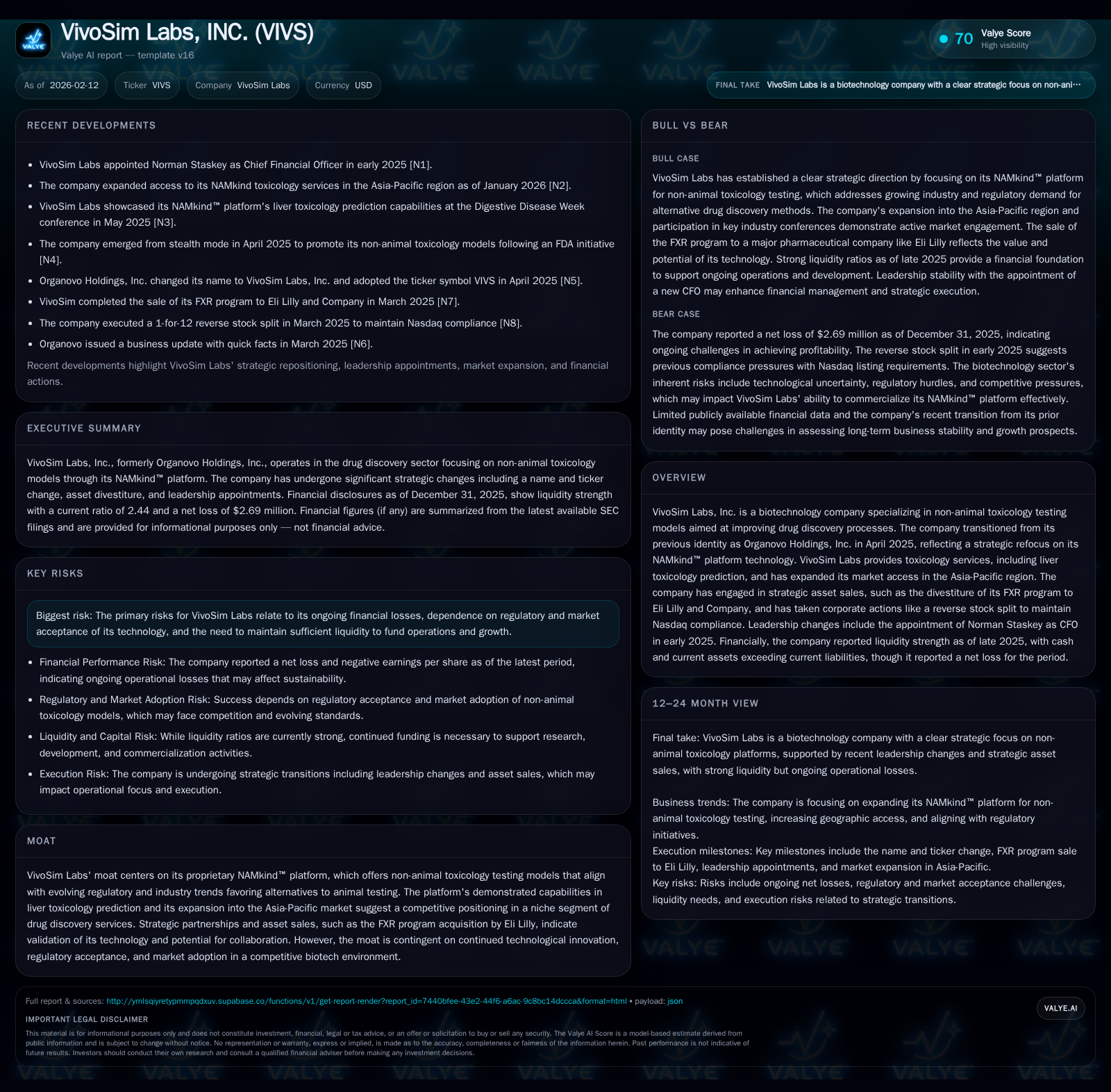
VivoSim Labs’ evolution from Organovo signals a purposeful leap into non-animal toxicology testing through its proprietary NAMkind™ platform. This strategic pivot is underscored by divestitures like the FXR asset sale to Eli Lilly and expanded Asia-Pacific market access, reflecting validation and growth ambition. Despite strong liquidity supporting operations, persistent net losses and regulatory acceptance challenges shadow its path forward. Leadership changes with CFO Norman Staskey bring sharper financial stewardship as VivoSim navigates competitive biotech waters.
From Organovo to VivoSim: Reinventing the Company's DNA
In April 2025, the company once known as Organovo Holdings, Inc. shed its former identity to emerge as VivoSim Labs, Inc., a move emblematic of a significant strategic overhaul rather than mere rebranding. This transition reflects a decisive migration away from prior ventures towards pioneering non-animal methods within toxicology testing — an arena ripe for innovation amidst mounting ethical and regulatory pressures against animal experimentation. By anchoring itself around the NAMkind™ platform technology, VivoSim signals both intent and capability to recast its role in drug discovery services [valye_report_excerpt; S1].
The renaming thus serves not only branding purposes but also reorients stakeholder expectations toward an updated mission: providing scalable, scientifically robust alternatives that promise enhanced predictive accuracy in toxicology without reliance on animal models. Given historical volatility in bioprinting segments occupied by its predecessor brand, this reinvention lays groundwork for clearer differentiation.
NAMkind™ Platform: Decoding the Edge in Non-Animal Toxicology Testing
At the core of VivoSim’s moat lies the proprietary NAMkind™ platform — a collection of non-animal modeling techniques geared primarily toward liver toxicology prediction. The platform capitalizes on computational biology innovations and cell-based assay integrations that align closely with evolving regulatory frameworks advocating for qualitative risk assessment (QRA) alternatives globally [valye_report_excerpt; S1].
Unlike conventional animal testing—which faces increasing scrutiny for ethical concerns and translational limitations—NAMkind™ positions itself within a niche that commands heightened attention both from regulators and pharmaceutical companies aiming to streamline drug development pipelines with more predictive, quicker turnaround assays.
However, this technological edge remains conditional. Realizing sustainable advantages depends heavily on continual scientific advances embedded into NAMkind™, advocacy success amid disparate regulatory landscapes, and demonstrable industry uptake over incumbent testing standards. In other words, while trailblazing in concept, VivoSim must perpetually innovate to stay ahead of competitive forces and validation hurdles.
Strategic Moves: Asset Sales and Asian Market Expansion
VivoSim’s strategic agenda has manifested through notable maneuvers designed to sharpen focus and exploit nascent markets. Foremost among these is the divestiture of its FXR program rights to pharmaceutical giant Eli Lilly & Company — a transaction that not only infused capital but served as a third-party endorsement of VivoSim’s underlying technology credence [valye_report_excerpt; N2; S2]. Such asset sales enable VivoSim to streamline R&D priorities around NAMkind™ without diluting organizational resources.
Complementing internal realignment, VivoSim ambitiously expanded its Asia-Pacific footprint by enhancing access to its NAMkind™ liver toxicology services across this high-potential region [N2]. The Asia-Pacific biopharma sector’s rapid growth coupled with tightening regulations favoring ethical testing alternatives presents fertile ground for adoption. Market reaction was immediate: shares surged following announcements highlighting revenue diversification prospects outside traditional Western-centric customer bases.
Together, these calculated moves validate not only technology but also positioning — balancing short-term capital needs with mid-to-long-term growth imperatives.
Leadership Dynamics: The Impact of New CFO Norman Staskey
Early 2025 saw a pivotal leadership shift as Norman Staskey assumed the CFO role amid ongoing operational transitions [N1; valye_report_excerpt]. His arrival correlates temporally with crucial corporate actions such as reverse stock splits implemented to meet Nasdaq listing requirements — underscoring heightened emphasis on financial discipline.
Staskey brings experience presumably oriented toward navigating small-cap biotechnology financial management challenges including liquidity preservation, investor relations restructuring, and cost containment—all critical given VivoSim's reported losses. Although direct operational decisions remain under CEO purview, the CFO’s stewardship has likely contributed materially to sustaining adequate cash reserves while managing liabilities prudently during this transformative phase.
This governance recalibration aims at reinforcing confidence among investors wary from prior volatility, signaling intent to stabilize balance sheet dynamics alongside executing ambitious R&D commercialization strategies.
Financial Fundamentals: Liquidity Strength vs. Persistent Losses
As of late 2025 filings, VivoSim reported current assets approximating $6 million compared with current liabilities near $2.5 million—yielding a healthy current ratio around 2.44 [F1; S2]. Cash and equivalents stand at $4.3 million providing operational runway assumptions supportive of near-term activities without immediate refinancing urgencies.
Yet beneath this liquidity cushion lurk persistent net losses of approximately $2.7 million for calendar year-end 2025 [F1]. Operating deficits reflect ongoing investment in technology development and market expansion spending necessary for platform maturation but spotlight challenges typical among early-stage biotechs striving toward profitability.
From an analytical perspective, these figures underscore that while short-term survival appears secured via capital management measures including asset divestitures or equity maneuvers (e.g., reverse splits), VivoSim must ultimately attain scalable revenue streams or secure additional funding channels to ensure longer-term viability.
Opportunities within Challenges: Regulatory Trends and Industry Adoption
A critical lifeline emanates from global legislative and industry trends progressively curtailing animal testing paradigms. Regulatory agencies worldwide—including EU bodies under REACH legislation and FDA guidelines encouraging alternative methods—position technologies like NAMkind™ at forefronts of acceptable safety evaluations [valye_report_excerpt; S2].
These shifts create expanding addressable markets where compliance combines with efficiency gains sought by pharmaceutical developers burdened by cost-intensive traditional methods. For VivoSim, leveraging this wave means not just refining core science but actively engaging with regulators across multiple jurisdictions to establish trust frameworks that legitimize its approach as standard practice.
However, commercial success rides on demonstration projects translating experimental sophistication into reproducible outcomes driving client acquisition beyond early adopters—a typical challenge given hesitancy rooted in conservative validation cultures within life sciences segments.
Risk Radar: Weighing Market Risks and Competitive Pressures
VivoSim’s cautious optimism coexists with defined downside factors directly linked to its operational reality [valye_report_excerpt; S2]. Chiefly:
- Continued net losses highlight dependence on sustained financing availability amid uncertain timelines toward break-even or profit generation.
- Regulatory acceptance remains uneven globally; failure to secure robust approval pathways or industry endorsements could constrict growth avenues.
- Technological rivals investing heavily in alternative testing models escalate competitive pressures requiring ongoing innovation investments that further strain finances.
- Liquidity management entails risks if unforeseen expenditures arise or if strategic asset sales cannot be replicated or supplemented sufficiently. These specifics place exigent demands on management agility along with transparent market communications vital for stakeholder confidence during protracted commercialization cycles.
Looking Ahead: What VivoSim’s Next Chapters Might Hold
With foundations refreshed through its rebranding coup and key strategic steps behind it—including partnering validation exemplified by Eli Lilly’s FXR acquisition plus Asia-Pacific expansion—VivoSim stands positioned at an inflection point [valye_report_excerpt; N2]. The company’s future trajectory hinges on how swiftly it can translate NAMkind™’s technological promise into wider regulatory acceptance paired with expanding commercial clients adopting non-animal toxicology solutions.
Potential catalysts encompass additional collaborations with pharma incumbents seeking innovative safety testing tools or garnering novel regulatory designations legitimizing their test platforms as industry standards. Yet execution risks remain substantial: scaling scientific rigor into reproducible routine services demands consistent investment alongside effective market education efforts targeting entrenched legacy behaviors.
In summary, VivoSim embodies an intriguing case study of biotech adaptation—balancing transformative technology aspirations against pragmatic challenges embedded in finance, regulation, competition, and adoption dynamics.
Disclaimer: This report is for informational purposes only based on available data as of February 2026 and does not constitute investment advice.
Disclaimer: This is research-only, informational analysis and not investment advice. It may include AI-generated interpretation and general industry context. Always verify important details using primary sources.

Comments