Golden Star Resource Corp.: Navigating Two Decades of Exploration Without Revenue
An in-depth look at how Golden Star Resource Corp. persists as a zero-revenue, exploration-stage miner operating on minimal cash and subcontracted labor.
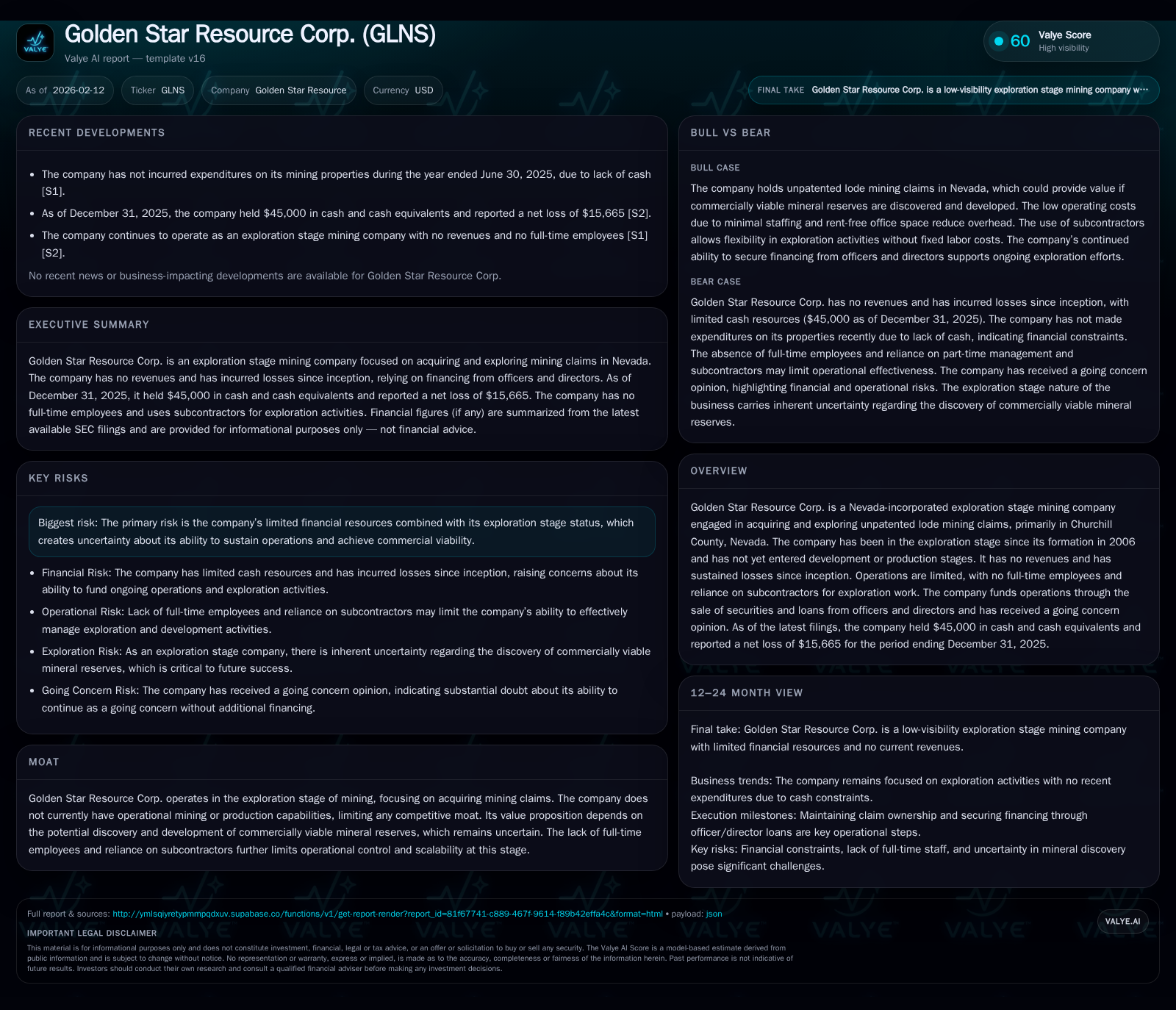
Since its founding in 2006, Golden Star Resource Corp. has remained exclusively in the exploration phase of mining, holding unpatented lode claims in Nevada without advancing to development or production. The company operates with virtually no cash on hand, no full-time employees, and depends heavily on loans from insiders and subcontractors to maintain minimal operations. The prolonged absence of development milestones highlights the immense challenges faced by small exploration companies and underscores the inherent financial and operational risks they bear. With no foreseeable growth catalysts or strategic pivots, Golden Star’s future hinges on either an unlikely mineral discovery or alternative outcomes such as asset disposition.
The Long Haul: More Than 20 Years in Exploration Limbo
Golden Star Resource Corp.’s story is one of persistence at the margins—a mining company that has remained doggedly in the exploration stage since its incorporation in Nevada in April 2006 [S1]. Despite more than two decades passing, it has not advanced into development or production phases that might materialize revenue streams. This prolonged limbo is highly unusual; most exploration firms either fail earlier or transition toward development based on promising discoveries to justify raising capital for mine construction.
The implications are striking. Continuous existence without tangible progress places immense pressure on financial resources and tests the resolve of management amid mounting skepticism about commercial viability. This endurance suggests a strategic choice—whether out of hope for a breakthrough discovery or lack of alternative exit strategies—but also starkly illustrates the uphill battle faced by pure exploration entities operating in isolation.
Nevada Claims and Quiet Ambitions: The Groundwork of Golden Star
Central to Golden Star's portfolio are unpatented lode mining claims situated primarily in Churchill County, Nevada, secured through a Quitclaim Deed from Kee Nez Resources, LLC in August 2013 [S1]. These mineral rights underlie any future potential but remain undeveloped and have seen no significant capital expenditure for years—the last reported activity was nil during fiscal 2025 due to insufficient funds.
This static asset base signals stagnation rather than growth. Without new claim acquisitions, investments in geological surveys, drilling programs, or exploration technology upgrades, the company's foothold appears frozen rather than expanding. For a sector dependent on iterative exploration cycles that incrementally advance knowledge and value, such inertia dims prospects for attracting investor interest or catalyzing resource discoveries.
Financial Stress Test: Operating with Barely Any Cash
The company’s financial snapshot reflects fragility bordering on untenability. As of December 31, 2025, Golden Star reported only $45 in cash and equivalents alongside a net loss for the period of $15,665 [F1,S2]. It has generated no revenue since inception—a hallmark trait of exploration-stage firms—but such minimal liquidity raises fundamental questions about operational sustainability.
Faced with these constraints, Golden Star funds activities through security sales and loans extended by its officers and directors rather than traditional financing channels [S1]. This reliance underscores limited access to external capital markets and may reflect investor wariness given ongoing losses and absent development milestones. Consequently, liquidity risk remains acute; even routine expenditures could prove challenging without fresh infusions of capital.
Outsourcing Survival: What Reliance on Subcontractors Signals
Operationally, Golden Star eschews maintaining full-time staff entirely, instead engaging subcontractors for manual labor related to property surveying and exploration tasks [S1]. While cost-effective on paper, this strategy comes with trade-offs—in diminished operational control over field activities, potential variability in work quality, and slower execution capability compared with having dedicated personnel.
Moreover, it leaves leadership disconnected from day-to-day site conditions and reliant on third parties' expertise. Such dependence can constrain responsiveness if critical decisions hinge upon timely data gathering or adaptive tactics during exploratory phases. In effect, subcontracting may be both a necessity born of resource scarcity and a structural limitation inhibiting scalability.
Leadership Under the Microscope: A Solo Officer Steering a Barebones Ship
Governance centers tightly around a single officer and director who dedicates roughly four hours per week (about 10% time commitment) to company affairs without a formal employment agreement or benefits [S1]. Marilyn Miller handles administrative duties but lacks experience with mineral exploration and delegates technical work to contracted specialists.
This skeleton management framework raises questions about strategic oversight capacity and the bandwidth available to shepherd complex geological undertakings. While showing commendable commitment through personal loans supporting operations, the absence of broader leadership depth makes sustained momentum difficult especially when navigating regulatory compliance challenges or considering strategic pivots.
Risks in the Shadows: Going Concern and What It Means for Investors
Auditors have attached a going concern qualification reflecting substantial doubt about Golden Star’s ability to continue funding its current level of activities [S1]. Such opinions serve as stark warnings—indicating potential insolvency risks should capital raising fail or losses accelerate.
For investors—particularly those unfamiliar with early-stage mining dynamics—this highlights the speculative nature embedded within GLNS’s profile. Without revenues or positive cash flow projections anytime soon, shareholders face heightened exposure to total loss scenarios unless transformative developments occur. The risk envelope here is thus among the highest within resource equities.
Absent Growth Catalysts: No Plans, No Development, No Production
Official filings express no intention to alter business activities nor pursue mergers/acquisitions [S1]. There are currently no plans for entering development stages nor indications of scaling exploration efforts beyond contracting external services. In essence, Golden Star remains tethered firmly to its current static status quo.
Such operational inertia implies value creation is deferred indefinitely pending mineral deposit identification—a process highly uncertain both geologically and economically. Without proactive steps toward growth catalysts—be they capital infusion enabling drilling programs or partnerships enhancing technical capabilities—the path forward appears bleakly narrow.
Valye Viewpoint: Assessing Potential and Pitfalls Inherent to Exploration-Only Players
Exploration-stage miners like Golden Star embody one end of the mining lifecycle spectrum characterized by high uncertainty balanced by occasional outsized reward upon discovery success. There is inherently no moat beyond speculative geological upside prior to proven reserves delineation; every announcement confirming commercially viable minerals can radically reshape valuation while extended barren periods erode credibility.
In GLNS’s case distinctive traits—minimal cash reserves, lack of full-time workforce, negligible active capital investment—exacerbate vulnerability relative to peers who might sustain multi-project pipelines or possess stronger institutional backing. Discovery potential remains latent but speculative; absence of concrete developmental steps limits immediate upside visibility.
Paths Forward: What Would a Turnaround or Exit Look Like?
Possible future scenarios for Golden Star include breakthrough discovery driving progression into development stage—but given historical dormancy this appears remote. Alternatively, continued operational stagnation could precipitate asset liquidation or corporate dissolution if funding dries up further. Another conceivable avenue involves acquisition by another entity seeking inexpensive claim consolidation or speculative portfolio expansion.
Absent internal strategic pivot plans disclosed in filings [S1], outcomes largely depend on exogenous factors such as commodity price environments stimulating interest among juniors/mid-tier miners willing to invest exploratory capital. Ultimately direction hinges less on company initiative today than external geology-driven opportunity discoverable only through technically robust testing.
Disclaimer: This report is provided solely for informational purposes based on publicly available data as of February 2026. It does not constitute investment advice or recommendations regarding securities listed herein.
Disclaimer: This is research-only, informational analysis and not investment advice. It may include AI-generated interpretation and general industry context. Always verify important details using primary sources.

Comments