
Navigating Cyclical Challenges and Sustainability in Mercer International’s Commodity Pulp and Lumber Business
Mercer International balances deep cyclical exposure with operational resilience and strategic sustainability initiatives amid volatile global markets.
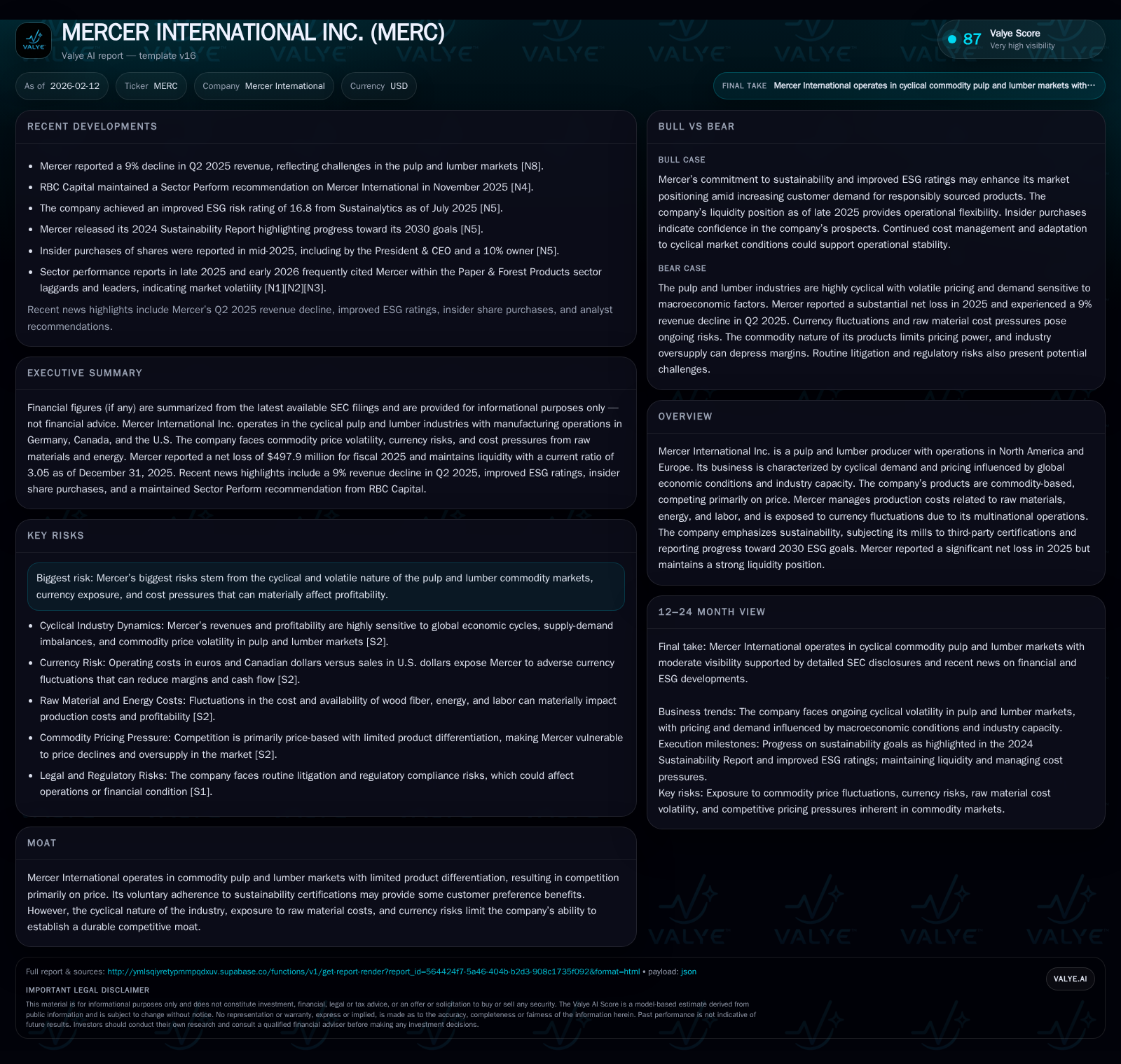
Mercer International’s 2025 fiscal year concluded with a significant net loss reflecting the pronounced cyclicality of commodity pulp and lumber markets influenced by macroeconomic shifts and capacity-driven price swings. Despite this financial setback, the company maintains a solid liquidity position, providing a buffer against ongoing market uncertainties. Its multinational footprint subjects it to currency risks and cost pressures, yet Mercer leverages third-party sustainability certifications to align with emerging environmental demands. This report dissects Mercer’s operational dynamics, cost structures, risk exposures, and strategic posture as it navigates an industry landscape shaped by shifting demand, pricing volatility, and increasing ESG scrutiny.
Mercer International: Navigating Cyclical Tempests
Mercer International’s financial results for 2025 illustrate the brutal realities facing commodity pulp and lumber producers operating amid highly cyclical global markets. The reported net loss nearing half a billion dollars starkly contrasts with the company's robust liquidity profile — a duality emblematic of deep industry cyclicality compounded by macroeconomic headwinds [F1], [N1]. This tension between pronounced earnings volatility and operational durability underscores Mercer's challenge: maintaining stability when product pricing can swing dramatically due to supply overhangs or economic slowdowns.
The pulp and lumber sectors exhibit well-documented boom-bust patterns. Demand sensitivity to worldwide business activity means that periods of oversupply or sluggish construction can quickly depress prices [S2]. Furthermore, the industry's behavior—such as mills choosing to operate at a loss rather than idling—can extend downcycles by suppressing price recovery opportunities. Mercer’s 2025 financials reflect these broader trends playing out across its asset base.
Unpacking Mercer's Operational Footprint and Market Dynamics
Mercer's operations span North America and Europe—two major hubs for pulp production and wood products supply [S1-Item 1 Business]. This multinational footprint exposes the company to varying regional demand cycles, regulatory environments, and currency fluctuations. The core products—commodity pulp grades like NBSK and lumber segments such as spruce/pine/fir dimension lumber—lack unique differentiators that would command premium pricing.
Instead, Mercer competes largely on cost efficiency amid a marketplace where customers perceive product interchangeability. This level-playing field intensifies price-based competition, making volume management and operational leverage critical to generating returns. Notably, certain integrated producers may pivot between paper production and market pulp sales depending on economics, adding further pricing complexity [S2].
Pricing Pressures: The Commodity Puzzle of Pulp and Lumber
Price volatility in both pulp and lumber markets has been stark over recent years. For example, European NBSK pulp prices ranged from lows near $790 per ADMT in 2016 to peaks approaching $1,635 per ADMT in 2024; North American pulp markets exhibited similar wide swings [S2]. Lumber prices tracked equally dramatic paths tied closely to U.S. housing starts — foundational drivers for wood product demand — fluctuating from roughly $259 per Mfbm in 2016 up to $1,604 per Mfbm at the construction boom peak in 2021.
This volatility stems from a complex interplay of factors: global economic health impacting demand; supply additions or mill closures affecting capacity balances; strategic behaviors such as producers running operations below cash costs; plus unexpected shocks like currency shifts influencing export competitiveness [S2 Risk Factors]. These dynamics combine to create an environment where managing timing around production levels is crucial but exceptionally difficult.
Costs, Currency, and Capacity: A Triple Headwind Analysis
Beyond pricing challenges, Mercer confronts persistent cost pressures across raw materials (e.g., wood fiber supply), energy inputs essential for pulp drying processes, and labor expenses subject to regional market conditions [valye_report_excerpt], [S1 Production Costs]. These inputs fluctuate alongside global commodity markets themselves; for instance, energy price surges can severely compress margins if selling prices lag.
Currency exposure presents another layer of complexity given Mercer's geographically diverse operations. Foreign exchange shifts impact reported earnings—as revenues earned in one currency translate differently back into reporting currency—and can exacerbate input cost inflation depending on procurement geographies [valye_report_excerpt].
Capacity decisions remain pivotal; Mercer must balance utilization rates judiciously. Idling or permanently closing mills involves cash costs but may be necessary during prolonged market downturns to stabilize prices. Conversely, adding capacity during favorable cycles risks exacerbating oversupply effects later [S2]. The fine line between operational flexibility and capital commitment is a persistent strategic dilemma.
Sustainability as Strategy: Certification’s Place in Mercer’s Market Posture
In an industry typified by commoditization, Mercer increasingly relies on voluntary third-party environmental certifications aligned with internationally recognized sustainable forestry standards [valye_report_excerpt], [S1 Commitment to Sustainability]. This strategic move aims at satisfying rising customer demands for transparently sourced products amid broader societal expectations around environmental responsibility.
While compliance can provide some differentiation against less transparent competitors—and reduce reputational risk—the tangible moat conferred appears limited given price remains the dominant purchase driver. Nonetheless, failure to maintain certification could imperil customer relationships or restrict access where green procurement policies are strictest.
Additionally, sustainability commitments dovetail with emerging low-carbon economy trends influencing product design (e.g., cross-laminated timber demand growth) that may unlock new market niches [S1 Solid Wood Industry]. Thus, while not fully insulating against market cyclicality or pricing pressure, these efforts represent an evolving component of Mercer's strategic toolkit.
Financial Health Check: Balancing Losses with Liquidity Strength
Despite posting a preeminent net loss of approximately $498 million in fiscal 2025—a figure highlighting severe operational stress—Mercer concludes with healthy liquidity metrics providing some operational runway [F1]. Current assets of roughly $866 million versus current liabilities near $284 million yield a current ratio above 3x; this suggests sufficient short-term financial flexibility amidst volatile conditions.
Such liquidity levels enable the company to absorb working capital fluctuations tied to inventory turns or receivables collection impacted by uneven sales cycles. Moreover, access to capital markets or credit lines (discussed within debt-related sections of filings) likely remains intact owing to prudent capital structure management [S1 Description of Certain Indebtedness], enabling investments aligned with corporate strategy despite transitory earnings weakness.
Risk Landscape: From Macroeconomic Shocks to Regulatory Terrain
Mercer confronts a risk spectrum anchored chiefly in its exposure to cyclical global economic developments shaping pulp and lumber demand [S1 Risk Factors], [S2 Risk Factors]. Price collapses driven by oversupply or construction slowdowns can rapidly erode profits given fixed cost burdens. Concurrently, currency swings amplify income statement volatility given multinational operations.
Input cost inflation—whether wood fiber availability constraints or energy price hikes—further pressures margins. Legal and regulatory risks also loom large; evolving environmental legislation or trade policies could impose additional compliance costs or disrupt established supply chains. Finally, shareholder ownership dynamics might add governance complexity affecting strategic execution timelines.
These interconnected risks highlight that sustained financial performance hinges not only on external market recovery but also on effective internal cost management, decisive capacity adjustments, and maintaining stakeholder trust through compliance and transparency.
Looking Ahead: Strategic Priorities and Industry Outlook
While specific forward-looking guidance remains unprovided per company disclosures,[S1 Corporate Strategy] Mercer's approach centers on reinforcing operational resilience via cost discipline, improving capacity utilization responsiveness, and deepening sustainability credentials aligned with climate change mitigation efforts elaborated within filings.[S1 Climate Change]
Broader industry trajectories point toward progressive consolidation, as marginal producers exit during weak cycles, and carbon-conscious policies steer product innovations especially in engineered wood segments. Although cyclicality will persist as an inherent structural feature, those players capable of nimble adjustments combined with credible ESG performance may gain incremental competitive advantage. Mercer's balanced liquidity position equips it reasonably well for this environment, but successful navigation requires continuous vigilance over costs, investment prioritization,and risk monitoring.
This analysis is based solely on publicly available information including Mercer International Inc.'s latest SEC filings as of February 12th, 2026 and relevant market news sources. It does not constitute investment advice or recommendations.
Disclaimer: This is research-only, informational analysis and not investment advice. It may include AI-generated interpretation and general industry context. Always verify important details using primary sources.

Comments