
VIVIC CORP.: Navigating the Niche Electric Yacht Market Amid Financial Headwinds
An early-stage innovator striving to establish itself in green maritime manufacturing confronts liquidity challenges and competitive pressures.
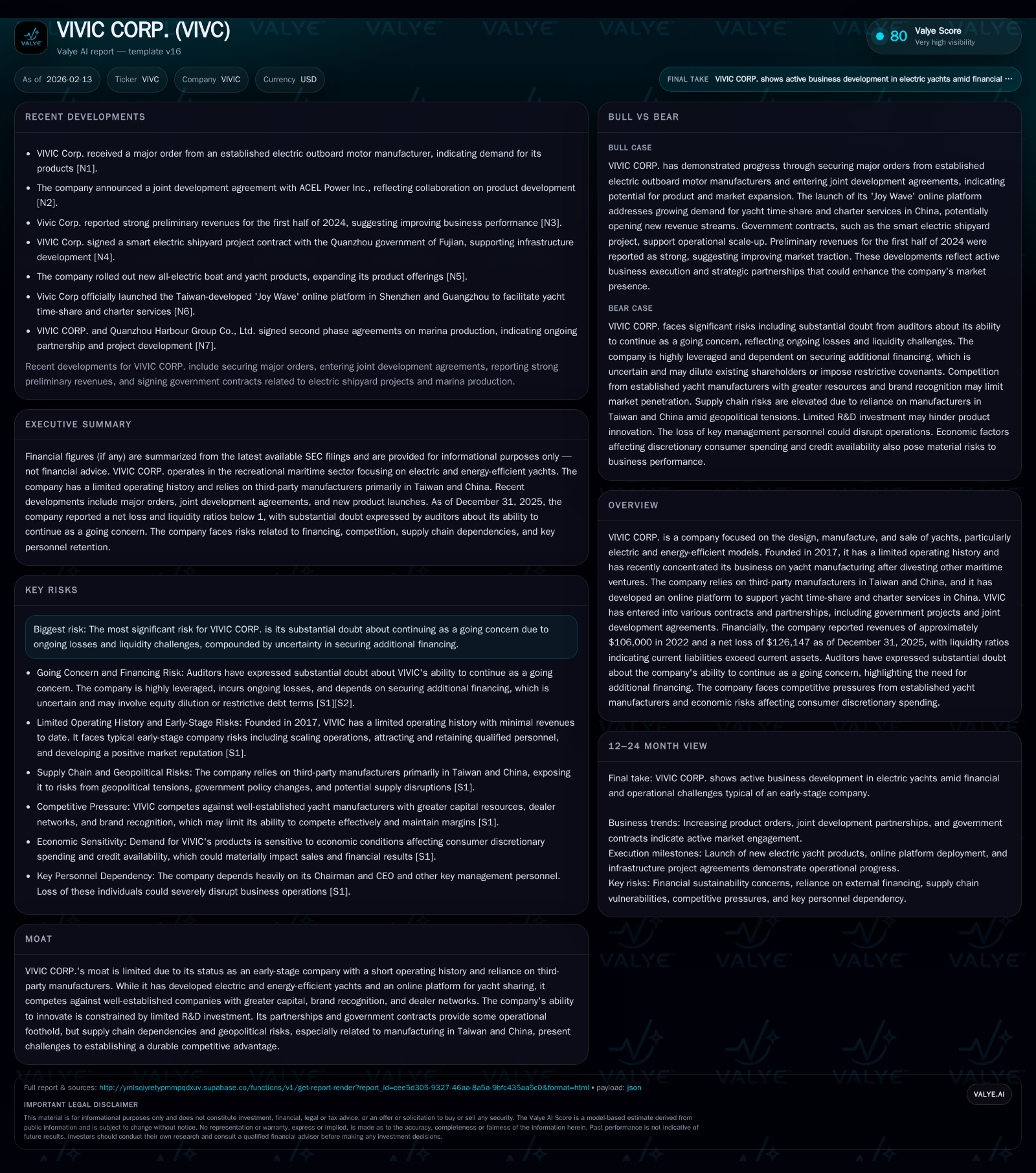
Founded in 2017, VIVIC CORP. has pivoted to focus exclusively on electric and energy-efficient yachts after shedding other maritime ventures. While it leverages partnerships and third-party manufacturing primarily in Taiwan and China, its limited operating history, modest revenue scale, and significant net losses have prompted auditor concerns about its ability to continue as a going concern. The company faces considerable risks from liquidity shortages, dependence on external financing, and an intensely competitive market dominated by established players. Strategic initiatives such as government contracts and a time-share platform offer some promise but remain nascent amid ongoing financial uncertainty.
From Marine Dreams to Electric Reality: VIVIC’s Evolution
Established in 2017, VIVIC CORP. embarked initially on various recreational maritime activities but faced capital constraints that hindered development across its ventures [S1]. Over time, the company sharpened its strategic focus exclusively on the design, manufacture, and sale of yachts emphasizing electric and energy-efficient models — a niche segment within luxury marine vessels. This move involved divesting non-core maritime operations to streamline resources toward this ambition [S1]. As of December 31, 2022, reported revenues amounted to a modest $106,322 [F1], reflecting an early-stage commercial footprint.
Despite the promise of eco-friendly yacht innovation fitting broader sustainability trends in transportation, VIVIC remains hampered by its relatively short operating history and limited market penetration. Nonetheless, this refocusing underscores management’s intent to align with emergent consumer demand for green alternatives in leisure marine craft.
The Yacht Design & Manufacture Frontier: Technology and Partnerships
Operating without fully captive manufacturing capabilities, VIVIC relies substantially on third-party manufacturers located primarily in Taiwan and China [S1]. This asset-light model allows agility but introduces complex risks around quality control, supply chain reliability, and geopolitical exposure.
Innovation efforts appear restrained by capital limits; the company lacks the scale for substantial R&D investments seen among larger maritime conglomerates [S1]. To offset these constraints, VIVIC has entered various joint development agreements and government contracts that may provide incremental operational stability or technological inputs [S1]. Moreover, it launched an online platform targeting yacht time-share and charter markets within China — signaling attempts to diversify revenue streams beyond direct sales through digital channels.
While partnerships and platform initiatives add some operational depth, their impact is nascent given underdeveloped scale.
Financial Tightrope: Liquidity, Losses, and Going Concern Alarms
The financial picture through December 31, 2025 outlines persistent fragility. Revenues remain minimal relative to fixed costs inherent in product development industries [F1]. Measured net losses totaled $126,147 as of year-end 2025 [F1], reflecting ongoing negative cash flow dynamics.
Liquidity metrics underline vulnerability: current assets stand at approximately $1.05 million versus current liabilities near $1.19 million — yielding a current ratio of 0.88 below the threshold generally considered financially healthy [F1]. The company's cash reserves are scant ($17,906) relative to obligations [F1].
Auditors have flagged "substantial doubt" regarding VIVIC’s capacity to continue as a going concern repeatedly in recent filings [S1][S2], spotlighting intense pressure to secure additional financing or operational support imminently. Past capital funding primarily came through related-party loans alongside some commercial borrowing; however, no assurances exist for future financing availability under favorable terms [S1].
The Competitive Waters: Moat Challenges Against Established Giants
VIVIC’s fledgling status severely limits any durable competitive moat. Established yacht manufacturers possess entrenched brand recognition, extensive dealer networks, broad R&D budgets driving technology leadership, and greater access to capital markets — attributes difficult for an early-stage firm to match [S1].
Dependence on external manufacturing dampens proprietary control over design innovations or cost advantages. Further constraining moat building is modest R&D investment capacity restricting breakthroughs or differentiation essential for premium marine markets.
Thus, despite sustainable product positioning potentially resonating with environmentally conscious buyers, vivid execution gaps leave VIVIC shadowed by dominant incumbents.
Supply Chain and Geopolitical Tides: Manufacturing in Taiwan and China
Offshoring production chiefly to Taiwan and China affords cost efficiencies but also embeds significant operational risk linked to geopolitical instability in East Asia [S1]. Rising tensions between these regions nationally complicate supply chain continuity for critical components or assembly processes.
Interruptions could delay product delivery cycles significantly impacting customer satisfaction or contract fulfillment amid still-small revenue bases. Additionally, vulnerabilities include currency fluctuations or export regulation shifts which may affect input costs or logistics.
These factors collectively elevate uncertainty over predictable manufacturing throughput necessary for scaling.
Strategic Moves: Divestitures, Government Contracts, and Time-Share Platforms
In seeking sustainable footholds amidst tough conditions, VIVIC strategically shed scattered maritime businesses enhancing concentration on core electric yacht manufacturing — aiming better capital utilization [S1].
Alongside traditional sales ambitions, the firm secured government-related contracts potentially offering steady work streams while fostering credibility within official marine program circles [S1].
Complementing physical assets is the online time-share platform rolled out targeting China's emerging luxury leisure segment, hoping this digital channel will broaden market access beyond outright ownership toward shared experiences — a contemporary consumer trend.
While these initiatives hint at diversified revenue mechanisms, they remain early-stage with unproven scale or profitability impact thus far.
Risks Lurking Beneath the Surface: Capital Needs and Financing Uncertainties
A critical concern remains ongoing capital scarcity threatening operational continuity. The company's ability to raise further funds is uncertain; reliance on equity issuances risks shareholder dilution whereas debt instruments often impose restrictive covenants limiting flexibility [S1].
As of mid-2025,VIVIC carried over $339K in third-party loans excluding further accrued debt increases by year-end [S1], heightening leverage burdens.
Nonpayment or refinancing failures could precipitate abrupt disruptions including forced cutbacks or insolvency scenarios detrimental both operationally and reputationally.
This fragile funding situation necessitates vigilant management execution alongside potential investor scrutiny regarding viability without fresh injections.
Investor Takeaway: Potential vs. Peril in VIVIC’s Voyage Ahead
VIVIC CORP.’s story is one of ambitious alignment with green innovation trends set against stark financial realities constraining near-term survival odds. Its commitment to electric-powered yachts fits evolving leisure preferences motivated by sustainability but clashes with inadequate capitalization limiting growth velocity or resilience against shocks. Strategic pivots toward government collaborations and digital sharing platforms convey adaptability yet remain embryonic compared with dominant market incumbents' scale advantage. Financial disclosures highlight a razor-thin margin between progress opportunity versus insolvency risk underscored by auditor warnings that cannot be ignored. Ultimately, entwined operational dependencies across geopolitically sensitive supply chains add another dimension of complexity requiring cautious navigation. For stakeholders tracking emergent clean tech niches within marine sectors, the tension between disruptive promise versus entrenched execution challenges embodied by VIVC demands close continuous observation rather than assured optimism.
This analysis synthesizes publicly available regulatory filings through February 13, 2026. It intentionally refrains from investment recommendations or price projections.
Disclaimer: This is research-only, informational analysis and not investment advice. It may include AI-generated interpretation and general industry context. Always verify important details using primary sources.

Comments