
SCHMID Group N.V.: Balancing a Storied Technological Legacy Against Financial and Market Headwinds
A deep dive into SCHMID Group’s enduring innovation in advanced PCB machinery amid tightening liquidity and competitive pressures.
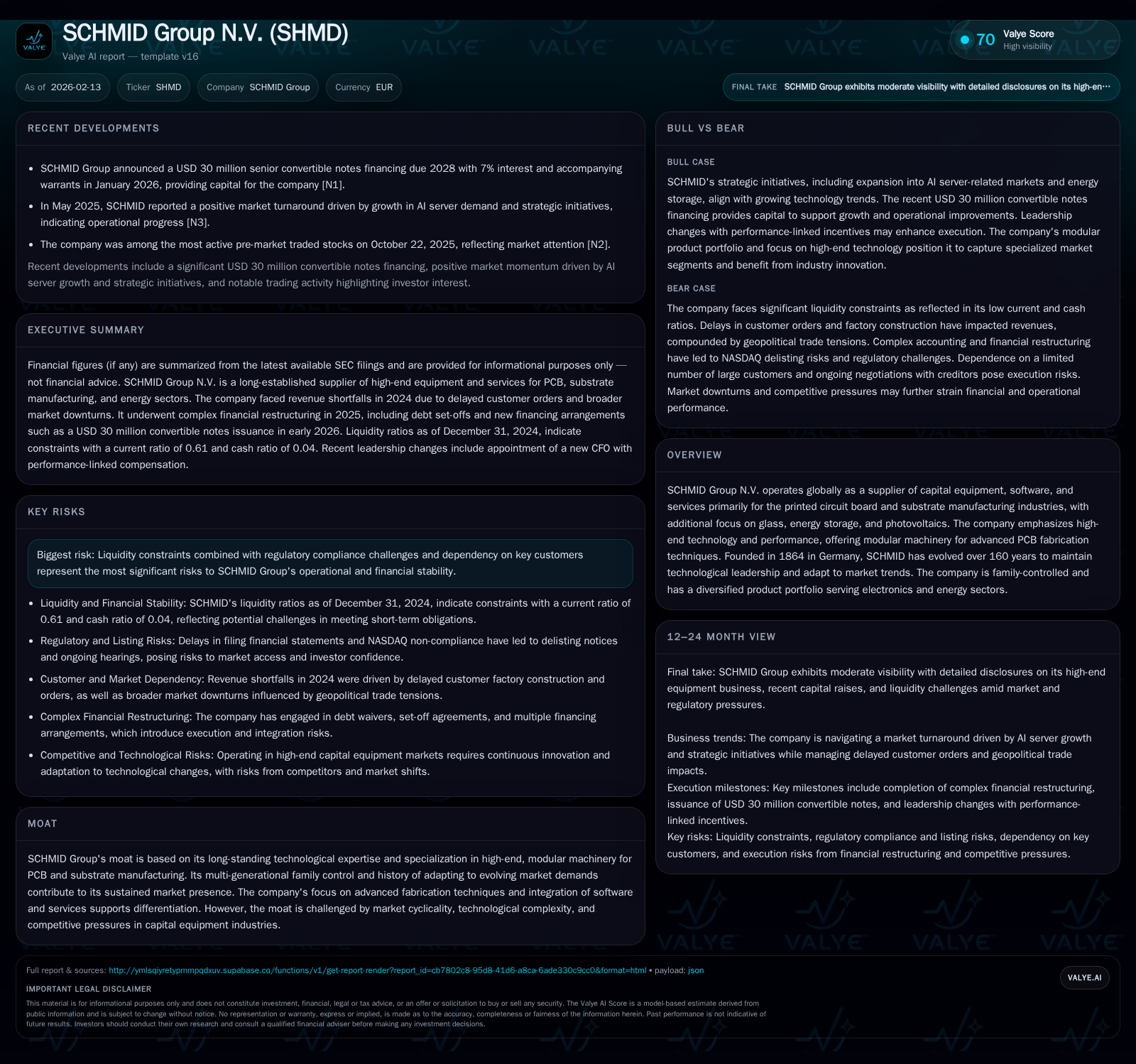
Founded in 1864, SCHMID Group N.V. stands as a fifth-generation family-controlled company specializing in high-end modular equipment for printed circuit board and substrate manufacturing alongside emerging sectors like photovoltaics and energy storage. Despite a rich legacy of innovation and a diversified technology portfolio centered on ET (embedded trace) technology, the company faces significant challenges including liquidity constraints, customer order delays, and regulatory compliance issues threatening its NASDAQ listing. Recent capital raises via convertible notes provide necessary lifelines as SCHMID navigates a complex geopolitical and competitive landscape dominated by Chinese-backed rivals. The company’s sustainability focus and advanced manufacturing solutions position it to capitalize on industry transformations, though the path forward demands agility amid cyclicality and operational risks.
A Legacy Forged Over 160 Years: Roots and Evolution
SCHMID Group N.V. traces its origins back to an iron foundry established in 1864 in Freudenstadt, Germany. Over nearly a century and a half, the company has metamorphosed from industrial roots into a specialized global player supplying capital equipment, software, and services predominantly for printed circuit board (PCB) and substrate manufacturing industries. The continuity provided by multi-generational family control has shaped SCHMID's corporate culture—infusing stability with a persistent commitment to technological leadership.
Historically expanding beyond its original metalworking domain since the 1960s, SCHMID entered the electronics machinery market when printed circuit boards became pivotal in the semiconductor era. The early 2000s saw diversification into photovoltaic solutions as renewable energy gained traction. More recently, energy storage technologies further augmented its portfolio. This evolutionary arc demonstrates SCHMID’s proactive adaptation to shifting market forces while leveraging deep technical expertise honed over decades [S1].
Manufacturing is consolidated across two principal sites—in Germany and China—which enables proximity to major electronics hubs while retaining foundational European engineering heritage. Coupled with sales and service centers spanning North America, Europe, Asia, and partnerships extending to South Korea, SCHMID's footprint melds heritage craftsmanship with global reach.
At the Technological Frontier: SCHMID’s Modular Machinery and Innovation Drive
SCHMID’s reputation rests firmly on delivering highly modular capital equipment tailored for high-end PCB fabrication techniques including traditional subtractive processes alongside semi-additive plating (SAP) and modified SAP (mSAP). These approaches reflect increasing complexity as consumer electronics miniaturize while integrating more functionality.
Embedded trace (ET) technology represents an emerging frontier where circuitry is embedded within substrates—offering performance boosts but requiring novel manufacturing precision. SCHMID has invested heavily in developing dedicated machinery for ET production lines and related processes such as Through Glass Via (TGV) etching systems capable of handling both laboratory scales and high-volume manufacturing environments. Customer co-development initiatives underpin these advances; collaborative R&D projects ensure solutions meet evolving product requirements precisely—a critical advantage given the rapid innovation cycles in the electronics sector [S1].
Modularity within machines enables flexibility to adjust production parameters rapidly without committing entire lines to single configurations—an asset when manufacturers face volatile demand or diversify products frequently. Such adaptability CSL arguably compounds SCHMID's differentiation versus commoditized competitors.
Market Trends Reshaping Demand: ET Technology and Green Manufacturing
Current industry megatrends shape SCHMID's near- to medium-term opportunity landscape significantly. The digital infrastructure boom—driven by 5G rollout, IoT expansion, AI proliferation—fuels demand for compact sophisticated PCBs capable of fast data transmission and robust performance.
Management estimates predict that capital spending for new factories embedding ET technology could shift sharply from approximately 30% up to about 90% of overall equipment investment relative to traditional PCB fablines. This seismic change would elevate SCHMID’s addressable market greatly given their early mover stance in ET solution provision [S1].
Simultaneously, environmental concerns exert increasing influence on manufacturing decisions worldwide. SCHMID’s ET processes reportedly consume notably less energy and water compared to legacy methods—a competitive green edge aligning with customer preferences toward sustainability. Their TGV etching system also promises improved resource efficiency.[S1]
Schmid's ability to capture this confluence of digital transformation and environmental stewardship may define its relevance amid intensifying competition where product differentiation increasingly intersects with corporate social responsibility.
Financial Standing and Liquidity Stress: Navigating Recent Setbacks
Despite operational strengths, SCHMID faces palpable financial headwinds amplified during the fiscal year ending December 31, 2024. The company recorded revenues amounting to approximately €60.8 million but incurred a net loss totaling around €84.1 million—a severe deterioration reflecting multiple stress factors including subdued order book inflows.
A critical blow came from delayed orders tied to the postponed construction of a sizeable customer factory originally scheduled for equipment installation during 2024. Compounding this were broader softness late in the year driven by escalating US-China trade frictions dampening client investments [S1].
These operational challenges translated into strained liquidity metrics: cash & equivalents stood at roughly €3.79 million while current liabilities exceeded €100 million against current assets amounting only to about €60.8 million, yielding a current ratio dangerously low at approximately 0.61 [F1].
Additionally, accounting complexities following SCHMID's recent business combination created delays finalizing audited financial statements which hampered reporting timelines culminating in delinquent Form 20-F filings—triggering NASDAQ non-compliance notices during 2025 [S1]. This interplay of operational delays, accounting hurdles, and capital constraints spotlighted vulnerabilities in executing growth strategies.
Customer Concentration Risks and Competitive Pressure Dynamics
SCHMID’s revenue profile exhibits marked concentration risks: two largest customers accounted for circa 23.5% of sales while the top ten customers collectively generated nearly 58%. This concentration exposes SCHMID to material risks should any key partner reduce engagements or switch suppliers unexpectedly [S1].
The competitive arena is sharply contested—notably by Chinese manufacturers often buttressed by governmental industrial policies aiming at domestic capacity expansion within the electronics equipment space. Such rivals typically operate within commoditized market segments where price pressures erode margins aggravating incumbent operators’ challenges globally.
SCHMID endeavors to insulate itself through technological sophistication focusing on premium modular solutions backed by integrated software services fostering deeper client stickiness via lifecycle support including upgrades, spare parts provision, training across languages, maintenance contracts—and project management assistance [S1].
However, sustaining this differentiation requires relentless innovation investment amid cyclical end-market fluctuations impacting clients’ capital expenditure appetites.
Geopolitical, Regulatory, and Operational Headwinds
Operating globally imparts natural macroeconomic diversification benefits but simultaneously subjects SCHMID to synchronized shocks such as strained US-China relations adversely impacting customer project timelines evident since late 2024 [S1]. These geopolitical frictions complicate supply chains alongside precipitating demand uncertainties.
On regulatory fronts, failure or delay in timely SEC filings related chiefly to audit procedural difficulties tied to contractual negotiation stalemates with investors/creditors on accounting treatments created additional distress culminating in NASDAQ delisting threats [S1][S2]. Regulatory compliance thus occupies significant management attention competing with core business execution priorities.
Operationally managing cross-border manufacturing with facilities in Germany – demanding stringent quality standards – alongside Chinese production entails complexity amid fluctuating trade policies requiring dynamic response capabilities.
Strategic Capital Moves: The $30 Million Convertible Notes Financing
In January 2026 SCHMID announced successfully entering definitive agreements for a $30 million senior convertible notes issuance coupled with warrants sold privately to an institutional investor [N1][S2].
Structured with tranches—initial $15 million funded shortly post-announcement followed by $15 million post-registration statement effectiveness—the notes pay a compounding interest rate of 7% annually with convertible options featuring pricing tied closely (~95%) to volume-weighted average share prices providing downside protection for investors while enabling potential equity conversion upside.
Accompanying warrant instruments further augment investor equity participation rights extending exercisable periods through late-2028.
The notes’ obligations are guaranteed by their German operating subsidiary Gebr. Schmid GmbH subject to local law limitations ensuring credit enhancement for holders—the combined transaction serves as an instrumental financial lifeline addressing near-term liquidity gaps while preserving optionality for pursuing future growth-oriented investments or debt restructuring initiatives [N1][S2].
Outlook: Managing Complexity in a Cyclical, Competitive Landscape
Looking ahead SCHMID faces multifaceted challenges balancing innovation-driven growth ambition against ongoing cyclical dynamics prevalent across electronics capital equipment markets intertwined tightly with semiconductor industry investment cycles.
Successful scaling of ET technology adoption may catalyze renewed revenue momentum although timing depends critically on macroeconomic stability especially easing US-China tensions facilitating customer factory expansions.
Financial resilience remains contingent on prudent working capital management enhanced by fresh capital injection offsetting previous operating losses coupled with strategic creditor negotiations.
Maintaining intimate engagement with concentrated key customers through multilayered service offerings remains vital amidst intensified competition principally from lower-cost Chinese rivals benefiting from policy support.
Meanwhile complexities inherent in multinational operations require sustained focus on regulatory compliance improvements ensuring continued NASDAQ listing compliance avoiding valuation-destructive disruptions.
Ultimately SCHMID's modular platform approach equips it flexibly against disruption however the path forward involves navigating competing demands between short-term financial stabilization needs versus longer term R&D investments sustaining technological leadership [S1].
Sustainability Credentials as a Differentiator in an Evolving Market
Environmental considerations have grown central not only due to regulatory pressure but also shifting end-customer preferences emphasizing green manufacturing credentials—an area where SCHMID demonstrates concrete strengths especially through its embedded trace technology showcasing substantial reductions in energy consumption and water usage relative to traditional PCB fabrication methodologies [S1].
Their TGV etching systems further exemplify efficient resource utilization aligned with stringent eco-standards supporting clients’ decarbonization agendas within semiconductor packaging domains.
This environmental orientation enhances SCHMID’s appeal beyond purely technical merit serving also as risk mitigation against tightening ecological regulations worldwide while differentiating from more commoditized competitors whose offerings may lack comparably explicit sustainability advantages.
In aggregate sustainability is shaping not just corporate responsibility narratives but constituting tangible moats reinforcing long-term competitiveness amidst escalating global environmental imperatives.
This analysis is based solely on publicly available information including recent SEC filings ([S1],[S2]), company press releases ([N1]), and standardized financial data ([F1]). It aims to provide an integrated view reflecting both empirical facts and nuanced interpretation without constituting investment advice or endorsements.
Disclaimer: This is research-only, informational analysis and not investment advice. It may include AI-generated interpretation and general industry context. Always verify important details using primary sources.

Comments