T. Rowe Price: Navigating Legacy and Innovation in a Shifting Asset Management Landscape
A deep dive into T. Rowe Price’s enduring strengths, evolving strategies, and the industry challenges shaping its future.
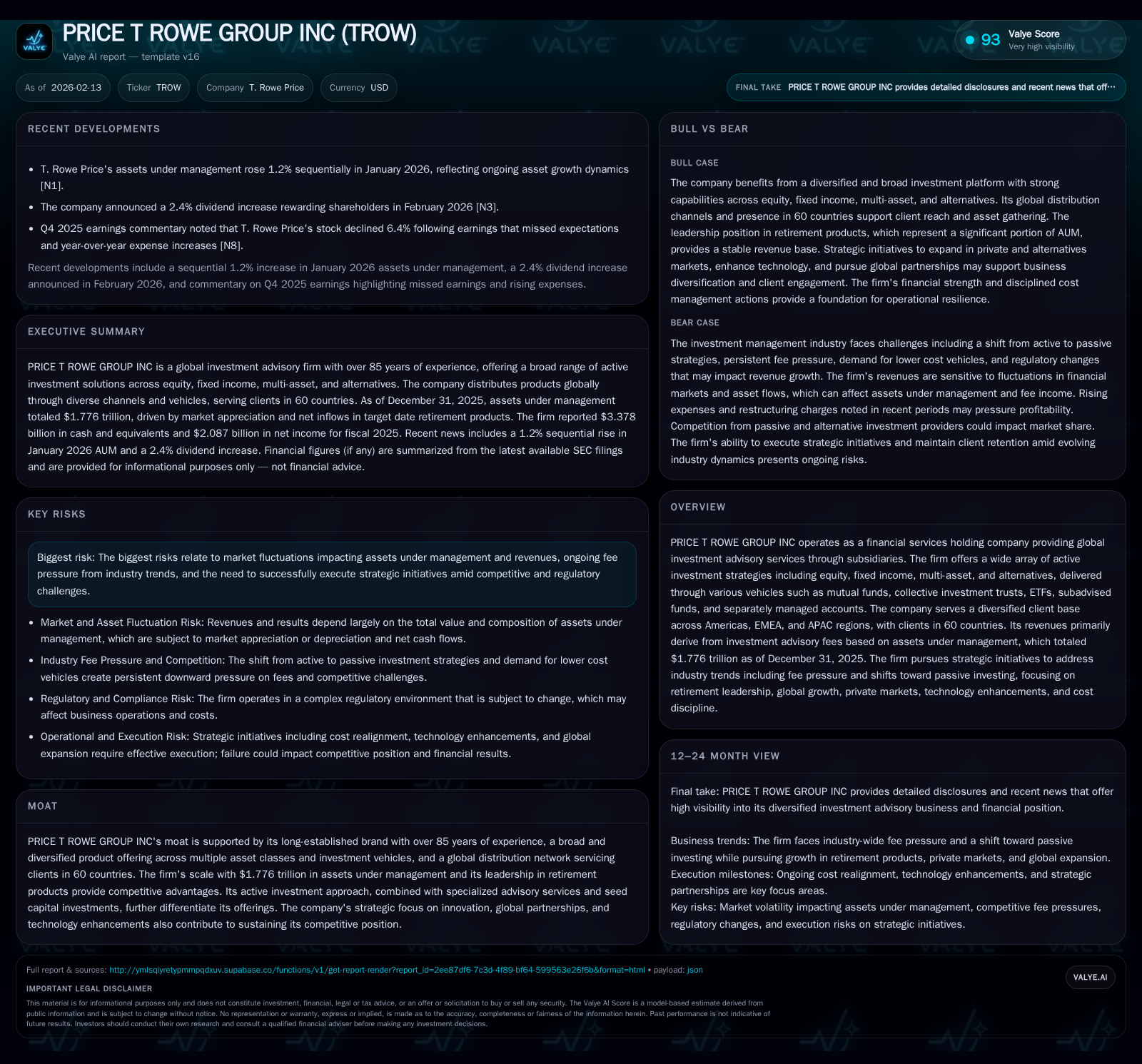
With a heritage spanning over 85 years and $1.776 trillion in assets under management as of year-end 2025, T. Rowe Price Group stands as a formidable global investment firm. Recent market volatility and a Q4 earnings miss tested the firm’s resilience, but strategic initiatives focused on retirement leadership, global expansion, and private markets signal adaptive responses to industry headwinds like fee compression and passive investing trends. Technology enhancements and shareholder-centric moves further illustrate its efforts to sustain competitive advantages amid complex macro risks.
Heritage and Moat: The Foundation of a Global Investment Leader
T. Rowe Price Group Inc. boasts an illustrious legacy dating back to its founding by Thomas Rowe Price, Jr. in 1937 [S1]. This near nine-decade heritage cultivates trust and brand strength that few competitors can replicate. With total assets under management reaching $1.776 trillion at the close of 2025 [F1], the firm commands significant scale that supports its broad competitive moat.
Its product suite spans active equity, fixed income, multi-asset strategies, and alternatives — distributed globally across mutual funds, ETFs, separately managed accounts, collective trusts, subadvised funds, and specialized vehicles [S1]. By serving clients in roughly 60 countries across Americas, EMEA, and APAC regions [S1], T. Rowe Price achieves geographic diversification that mitigates localized market shocks.
This extensive footprint is paired with an emphasis on active management grounded in independent research-driven processes and meaningful client partnerships [S1]. The company also leverages seed capital investments to differentiate offerings further.
Altogether, the firm’s longevity combined with diversified capabilities across multiple asset classes reinforces its strong moat against evolving competitive pressures [S1].
Navigating Market Volatility: Impact on Assets Under Management and Revenue Streams
The firm's revenues are inextricably linked to the value and composition of assets under management (AUM), which fluctuate with market conditions beyond T. Rowe Price's control [S1]. Investment performance relative to competitors determines inflows or redemptions; underperformance can trigger client withdrawals that pressure revenue.
Broader financial market declines directly reduce AUM valuation impacting advisory fees calculated as percentages of these assets [S1]. Investor mobility without significant withdrawal penalties further intensifies AUM volatility risk. Specific market segment concentrations also expose revenues to uneven impacts during sector-specific downturns.
Interest rate uncertainty influences demand primarily for fixed income products while geopolitical risks — including ongoing global conflicts — introduce unpredictability regarding capital flows and portfolio values [S1]. Regulatory disruptions such as U.S. government shutdowns may delay product approvals, obstructing growth initiatives [S1]. These factors collectively contribute to pronounced earnings variability tied closely to external macroeconomic dynamics.
Q4 2025 Earnings Crash and Recovery Signals: Unpacking Financial Performance
February 2026 saw T. Rowe Price shares slide over 6% following a Q4 earnings miss accompanied by year-over-year expense increases [N4][N5]. While net income remained positive at $2.087 billion for 2025 [F1], quarterly pressures exposed operational challenges amidst a turbulent market backdrop.
Management commentary during the Q4 earnings call acknowledged the elevated costs related to strategic investments even as revenue was tempered by lower average AUM levels than anticipated [N6]. The stock’s sharp reaction reflected concerns about sustaining profitability through fee compression while balancing growth spending.
Encouragingly, January 2026 data revealed a sequential AUM increase of approximately 1.2%, indicating potential early stabilization following prior redemption waves [N11]. This uptick aligns with broader market rebounds though sustaining momentum remains contingent on consistent performance execution.
Strategic Initiatives: Retirement Leadership, Global Expansion, and Private Market Ventures
T. Rowe Price is actively deploying multi-year strategic programs designed to both defend core strengths and seize growth opportunities amid structural shifts [S1]. Dominance in retirement products remains a cornerstone with continued innovation around plan sponsor services, participant recordkeeping enhancements, and tailored investment vehicles aiming to solidify leadership.
Global growth targets focus selectively on high-opportunity markets where existing footholds exist — leveraging invested resources in partnerships, marketing amplification, and product adjustments to local preferences [S1].
Private markets represent an expanding arena where T. Rowe Price blends traditional expertise with alternative strategies—using its distribution prowess to widen reach while developing new investment capabilities internally or via alliances [S1]. These bold moves seek to diversify revenue streams beyond public markets increasingly pressured by passive trends.
Fee Pressures and Passive Investing Trends: Challenges to Active Management
Industry-wide fee compression driven by growing investor preference for passive index-based products poses substantial challenges for companies like T. Rowe Price whose earnings hinge largely on active investment fees [S1].
Persistently lower fees exert margin pressure necessitating heightened operational efficiencies or product innovation to maintain viability [S1]. Embracing differentiated active strategies that justify premium pricing remains critical—any slip in perceived value could accelerate fund outflows towards cheaper alternatives.
This fee environment acts as both constraint and catalyst—pushing T. Rowe Price towards broadening offerings including lower-cost vehicles or hybrid approaches while preserving active management integrity at the core [S1].
Technology as a Competitive Lever: Enhancements Driving Client Engagement
The firm's multi-pronged strategy incorporates technology upgrades aimed at elevating client experience through improved digital platforms and data-driven insights [S1]. Such enhancements enable more personalized advisory interactions and streamlined administrative operations vital for retention amid fierce competition.
Investments in technology not only support efficiency gains offsetting margin erosion but also differentiate service quality—key when clients evaluate providers beyond pure investment returns [S1]. In wealth management especially, ease-of-use combined with responsive platforms is a decisive factor influencing loyalty.
Risk Landscape: From Market Fluctuations to Geopolitical Uncertainties
SEC disclosures highlight numerous tangible risks that extend beyond standard market volatility concerns—including geopolitical developments like the Russian invasion of Ukraine or trade disputes impacting portfolio stability [S1].
Government shutdown scenarios exacerbate operational risk by halting regulatory processes vital for new product launches or compliance confirmations; this unpredictability can delay business initiatives or undermine investor confidence simultaneously [S1].
Interest rate swings particularly affect fixed income valuations influencing certain large segments within T. Rowe Price's multi-asset mix adding complexity to revenue forecasting [S1]. Collectively these factor into a risk matrix requiring continuous monitoring alongside strategic flexibility.
Shareholder Value Focus: Dividend Growth Amid Earnings Pressures
Despite near-term earnings headwinds evidenced in late 2025 quarters [N4], T. Rowe Price cemented shareholder confidence through a 2.4% dividend increase announced shortly after year-end results—a notable move signaling robust cash flow expectations and commitment to returning capital [N12][F1].
This increment amidst cost pressures underscores management's conviction in long-term fundamentals rooted in diversified revenue streams underpinned by strategic initiatives offering sustainable growth potential.
Comparative Industry Positioning: Insights from Peers’ Recent Results
Contextualizing T. Rowe Price within broader asset management reveals shared challenges highlighted in recent peer reporting cycles: KKR faced earnings misses despite AUM gains year-over-year; Apollo pursued innovative hybrid income solutions via partnerships; affiliated managers similarly brace for margin squeezes amid competitive fee landscapes & increased operating expenses [N1][N2][N3][N7].
Unlike some peers focusing heavily on alternative credit or private equity niches exclusively, T. Rowe’s hybrid model balancing traditional active strategies with growing private venture stakes illustrates differentiated positioning adapting pragmatically rather than pivoting wholesale away from core competencies.
Hence relative resilience emerges through consistent adaptation layered onto foundational strengths evident through decades-long track record harmonizing stability with incremental transformation.
This analysis synthesizes publicly available information without providing any investment recommendations or forecasts. Readers should consider additional sources before forming conclusions regarding company prospects or sector outlooks.
Disclaimer: This is research-only, informational analysis and not investment advice. It may include AI-generated interpretation and general industry context. Always verify important details using primary sources.

Comments