
British American Tobacco’s Strategic Evolution Amidst Industry Shifts and Global Challenges
Exploring how BAT balances its century-old tobacco legacy with innovation in reduced-risk products amid regulatory and market pressures.
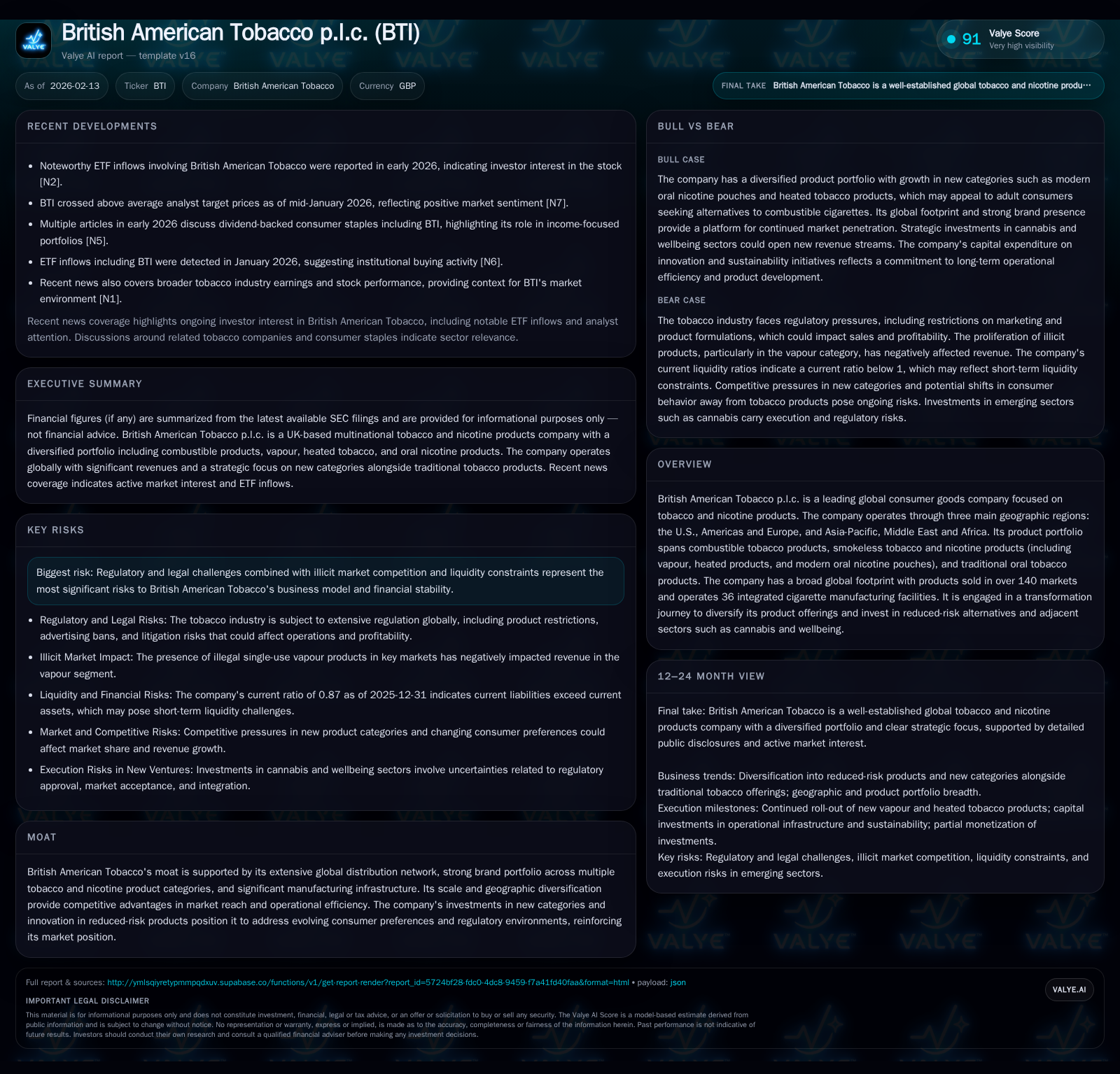
British American Tobacco (BAT) stands at the crossroads of heritage and transformation, leveraging its vast global footprint and manufacturing scale while intensifying focus on new categories such as vapor and oral nicotine. Despite a modest revenue decline reported in sterling due to currency headwinds, the company demonstrated constant currency growth driven by innovation in reduced-risk products. Persistent challenges from illicit trade, stringent regulations, and geopolitical instability complicate the operating environment. Nonetheless, BAT’s diversification efforts into adjacent sectors like cannabis and wellbeing signal a broadening strategic horizon. Investor considerations must navigate a complex balance between reliable dividends, evolving growth engines, and significant regulatory risks.
From Imperial Legacy to Global Industry Leader: BAT’s Historical Footprint
British American Tobacco's story spans well over a century, beginning with its incorporation in 1902 following a joint venture between the Imperial Tobacco Company and the American Tobacco Company. This historical foundation set the stage for rapid expansion into major markets spanning India, East Africa, and Northern Europe early on. Notably, BAT’s entry into the U.S. market came through the acquisition of Brown & Williamson in 1927—an early strategic move anchoring its North American presence [S1].
The subsequent decades saw BAT diversify beyond tobacco under B.A.T Industries p.l.c., venturing into sectors like paper and cosmetics during the mid-20th century before refocusing decisively on tobacco by the late 1990s. The landmark merger with Rothmans International in 1999 consolidated BAT's global reach while acquisitions such as Imperial Tobacco Canada (2000) further cemented its position [S1]. The formation of Reynolds American Inc. via combination with RJR assets highlights BAT’s willingness historically to restructure operations strategically. This layered history not only shapes BAT's current geographic diversification but embeds an identity forged through adaptation.
Anatomy of a Moat: Scale, Reach, and Manufacturing Prowess
BAT maintains one of the tobacco industry's most formidable competitive advantages through its extensive global distribution channels that span over 140 markets. Its portfolio cuts across combustible cigarettes, smokeless tobacco products, vapour devices, heated tobacco systems, and modern oral nicotine pouches [valye_report_excerpt]. Manufacturing scale is another linchpin: operating 36 integrated cigarette manufacturing facilities worldwide allows production efficiencies alongside maintaining regional supply security [valye_report_excerpt,S1].
This scale supports an omnipresence enabling faster go-to-market capabilities than smaller competitors while facilitating local regulatory compliance nuances. Furthermore, BAT's broad product mix diversifies revenue streams across multiple consumer segments globally—a critical strength considering shifting preferences away from traditional smoking.
Financial Pulse Check: Resilience in Revenue and Earnings Amid Currency Volatility
The fiscal year ended December 2025 posed notable challenges for BAT’s financial results primarily tied to foreign currency translation effects stemming from sterling strength. Reported revenue stood at approximately £25.6 billion with net income near £7.75 billion; however, these figures mask underlying operational resilience when adjusted for currency fluctuations [F1,S1]. On a constant currency basis—excluding distortions from fluctuating exchange rates—revenue advanced by 2.1%, with New Categories revenue rising by 7% year-over-year.
Adjusted profit from operations decreased marginally by around 2.7% at reported rates but increased slightly when normalized for currency impact. Adjusted diluted earnings per share fell about 2.9% in sterling terms but would have grown 0.7% using prior year exchange rates [S1]. These results underscore that operational performance remains sound despite macroeconomic headwinds impacting reported metrics.
Transitioning Tobacco: New Categories and Innovation Investment
BAT's strategy reflects an industry-wide pivot towards reduced-risk products (RRPs). The firm's portfolio now includes vapour alternatives, heated tobacco variants, and modern oral nicotine pouches which show robust growth trajectories compared to traditional combustibles [valye_report_excerpt,S1]. This rebalancing is critical as consumer preferences increasingly favor less harmful modalities.
Investment levels in R&D supporting innovation appear consistent with this transition narrative although specific spend figures are not detailed here. New Categories are cited as key drivers of revenue expansion amid declines or slower growth in combustible volume sales [S1]. This trend reinforces BAT's commitment to transformation while preserving core monetization capabilities across legacy categories.
Illicit Trade and Regulatory Headwinds: Persistent Adversaries
The illicit market presents ongoing risks undermining BAT’s legitimate sales and brand strength globally. Driven by economic downturns, rising tax burdens on legal products, enforcement resource constraints, and regulatory measures such as plain packaging or flavor limits, illicit trade thrives as lower-cost counterfeits or smuggled goods proliferate [S1].
This phenomenon not only depresses volumes but potentially erodes pricing power as consumers shift to cheaper alternatives outside regulated channels. Beyond financial impacts, counterfeit versions—including New Categories products—imperil consumer safety reputations that BAT strives to uphold. Penalties linked to product diversion into illicit channels pose material legal risks alongside reputational damage risks given corporate social responsibility frameworks [S1].
Geopolitical Turbulence and Supply Chain Vulnerabilities
BAT operates within a complex geopolitical landscape wherein civil unrest, regime changes, trade policy shifts including tariffs or embargoes pose intermittent threats to smooth operations [S1]. Regional instability can disrupt factory access or supply routes requiring costly contingency actions.
Climate-related factors amplify risk vectors; water shortages or extreme weather events could constrain production inputs or logistics capacity. Specific reference to attacks on critical shipping lanes such as those in the Red Sea illustrates vulnerabilities in globalized supply chains demanding ongoing vigilance and adaptation [S1].
Portfolio Movements & Market Sentiment: ETF Inflows and Analyst Targets
Recent market data suggests heightened investor interest aligned with confidence in BAT’s evolving business model. Noteworthy ETF inflows were observed alongside analysts revising price targets upwards amid robust earnings season momentum [N3,N6,N7,N9]. Such capital movements reflect measured optimism balanced against known sector caution.
These flows are indicative not just of yield-seeking behavior given BAT’s dividend history but also recognition of emerging growth potential from New Categories expansions noted during reporting cycles.
Looking Beyond Tobacco: Diversification into Adjacent Sectors
BAT articulates a clear ambition extending beyond nicotine reliance by investing selectively into cannabis applications and broader wellbeing sectors [valye_report_excerpt]. While detailed disclosures on scale or near-term contribution remain limited here without speculative extrapolation, this diversification forms part of an explicit 'transformation journey' addressing anticipated shifts in consumer health awareness alongside tightening regulation.
This strategic outreach aligns with broader industry moves to identify future growth avenues that reduce dependency on combustible tobacco revenues while capitalizing on adjacent lifestyle trends.
Investor Implications: Navigating Dividends, Risks, and Growth Prospects
From an investment standpoint (without advice), BAT presents an intricate profile balancing dependable dividend distributions against heightened exposure to regulatory/legal complexity including illicit trade challenges [N5,F1,S1]. Currency volatility further complicates reported earnings visibility.
Yield-oriented investors may appreciate cash flow stability underpinned by established operations yet must contend with evolving policy environments posing execution risks. The ramp-up of reduced-risk product lines offers promising avenues for earnings growth though requires monitoring for sustained consumer adoption dynamics.
Future Horizons: Strategic Pathways in a Changing Global Landscape
Looking ahead, British American Tobacco leverages its entrenched global network—a moat built on decades-long brand presence supported by manufacturing depth—to navigate rapidly evolving consumption patterns shaped by regulation inflationary pressures and competitive forces [valye_report_excerpt,S1,N7].
Success rests increasingly upon advancing New Categories penetration whilst mitigating exposure from illicit trade via enhanced controls alongside thoughtful geographic risk management amidst geopolitical flux.
Diversification efforts into cannabis/wellness sectors provide additional optionality though remain supplementary at this juncture versus core tobacco/nicotine franchises which continue generating material cash flows requisite for funding innovation investments.
BAT exemplifies a corporate entity rooted firmly in legacy strengths yet dynamically adapting—a microcosm of the broader industry's struggle to transform sustainably within an uncertain global context.
This analysis synthesizes publicly available company filings and recent news sources without offering investment recommendations. Readers should consider their own objectives alongside complementary research when forming views related to British American Tobacco p.l.c.
Disclaimer: This is research-only, informational analysis and not investment advice. It may include AI-generated interpretation and general industry context. Always verify important details using primary sources.

Comments