
Illinois Tool Works Inc.: A Deep Dive into Its Distinctive Business Model and Operational Resilience
Illinois Tool Works leverages a proprietary business model and decentralized culture to maintain operational excellence across industrial markets worldwide.
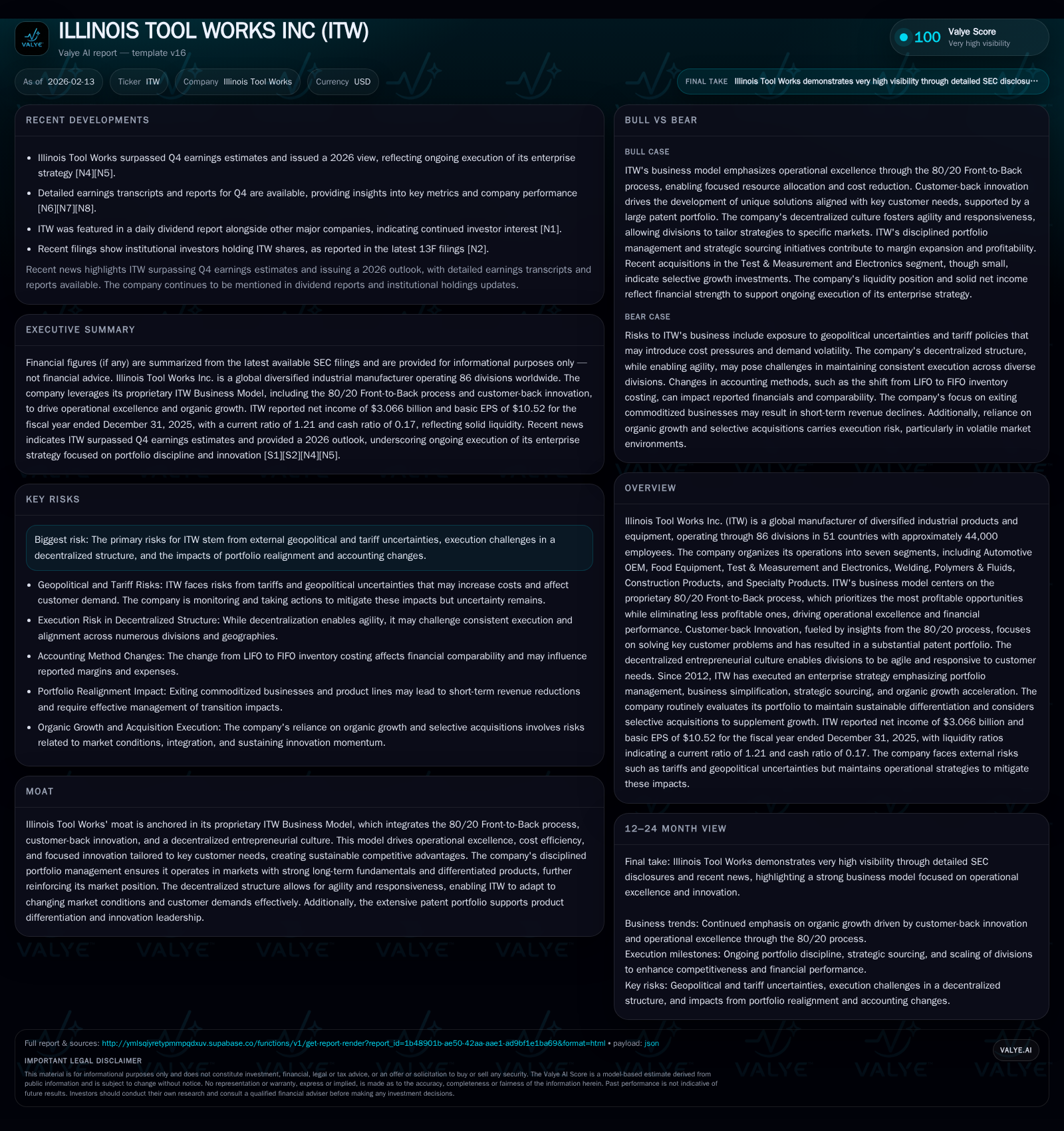
Illinois Tool Works Inc. (ITW) is a diversified global manufacturer operating through 86 divisions across 51 countries. At its core, ITW’s competitive advantage lies in its proprietary 80/20 Front-to-Back process combined with customer-driven innovation and a decentralized entrepreneurial culture. These elements underpin robust operational performance, broad patent coverage, and agile market responsiveness. Despite external risks such as geopolitical uncertainties and tariff impacts, ITW's disciplined portfolio management and strong financial position support its sustained industry leadership.
Company Overview
Illinois Tool Works Inc. (ITW) stands out as a diversified manufacturer whose strength derives not merely from its size but from a distinctive operating philosophy crafted over decades. With approximately 44,000 employees spread across 86 divisions in 51 countries, ITW operates in seven core segments that span various industrial end markets: Automotive OEM; Food Equipment; Test & Measurement and Electronics; Welding; Polymers & Fluids; Construction Products; and Specialty Products. This broad yet focused segmentation enables ITW to capture value from multi-industry exposure while tailoring specialized solutions within each domain.
The ITW Business Model: A Tripartite Competitive Moat
At the heart of ITW’s success is its proprietary business model, woven from three interdependent pillars:
The 80/20 Front-to-Back Process
Originating in the 1980s as a manufacturing efficiency tool, the 80/20 approach has evolved into a comprehensive operating system applied consistently across all divisions globally. The process is based on identifying the "vital few" — the approximately top 80% of revenue or profit contributors — focusing resources on these high-value customers and product lines while systematically reducing costs and distractions associated with the less profitable "trivial many" (the bottom ~20%). This disciplined focus is underpinned by rigorous data analytics that inform go-to-market strategies, inventory management, production planning, and innovation prioritization.
This process drives operational excellence reflected tangibly in superior product availability, uncompromising quality standards, and market-leading service levels. Resultantly, ITW businesses enjoy both cost efficiencies and enhanced customer intimacy that foster strong financial returns.
Customer-back Innovation
Innovation at ITW does not commence abstractly but rather emerges directly from customer insights gleaned via the 80/20 framework. By deeply understanding their prioritized customers’ unmet needs or evolving challenges, ITW’s divisions design bespoke solutions that create differentiation in competitive spaces.
This innovation strategy has led to an expansive patent portfolio exceeding approximately 20,900 granted and pending patents globally — a testament to ITW’s sustained commitment to problem-solving at the intersection of technology and customer application requirements. This intellectual property serves both as a commercial moat and a foundation for future growth initiatives across segments.
Decentralized Entrepreneurial Culture
Unlike large conglomerates burdened by hierarchical bureaucracy, ITW embraces decentralized entrepreneurship as a cornerstone for agility. Individual business units retain significant autonomy within corporate guidelines to customize strategies appropriate to their unique markets and customers.
Such empowerment facilitates rapid decision-making, localized innovation, tailored marketing approaches, and swift responses to shifting industry dynamics or customer demands. Simultaneously, this culture nurtures accountability among division leadership who are directly responsible for performance outcomes.
Strategic Portfolio Management
Since embarking on its strategic realignment starting around 2012, ITW has aggressively managed its business mix to sharpen focus on differentiated products with sustainable growth potential. This involved divesting commoditized or low-margin product lines even within otherwise high-performing divisions.
The net effect is a portfolio concentrated on industries with robust long-term fundamentals rather than fleeting cycles driven by commodity price fluctuations or commoditized competition. Such selective pruning preserves margin integrity while enabling capital allocation towards innovation-enabled growth avenues.
Global Operations Footprint
Reflecting its scale yet complexity, ITW operates roughly 410 plants and offices worldwide — nearly two-thirds outside the U.S., notably in principal industrial economies such as China, Germany, France, and the UK. While none individually dominate company-wide capacity metrics, together they form a flexible network capable of adjusting output via shift modulations or overtime adjustments. The production capacity generally exceeds current utilization levels providing cushion for demand increases without immediate need for major capital expansions.
Financial Highlights
Though not exhaustive here due to lack of full detailed quarterly data disclosure per unit segment (owing largely to decentralized reporting structure), key company-wide metrics indicate solid financial health:
- Net income reached approximately $3.07 billion at end of fiscal year 2025 [F1].
- Current assets stood around $6.2 billion against current liabilities near $5.13 billion yielding a conservative current ratio of approximately 1.21 [F1].
- Cash and cash equivalents totaled $851 million providing liquidity buffers amid macroeconomic volatility [F1].
These financial indicators underscore effective working capital management balancing liquidity needs against operational investments.
Cybersecurity Posture
Heightened risks from cyber threats pose critical challenges for industrial manufacturers reliant on global digital infrastructure. ITW addresses this risk through a comprehensive cybersecurity framework aligned with the National Institute of Standards and Technology (NIST) Cybersecurity Framework.
Key components include annual training programs; frequent phishing simulations; active network monitoring; vulnerability assessments; backup/recovery protocols; and dedicated response teams embedded at divisional levels reporting upward through centralized Cyber Incident Response Team led by an experienced Chief Information Security Officer (CISO).
The Board of Directors maintains oversight through quarterly risk reviews supplemented by Audit Committee briefings ensuring governance rigor around cybersecurity matters [S1]. Importantly, no material cyber incidents impacting operations or finances have been reported during the past three years.
Industry Context Analysis
Based on provided information through early 2026 plus general sector knowledge:
- Industrial equipment manufacturing faces ongoing pressure from global supply chain complexities post-pandemic disruptions alongside geopolitical tensions affecting tariff regimes.
- Customers increasingly demand integrated solutions combining hardware robustness with digital connectivity requiring manufacturers like ITW to continuously invest in R&D capabilities.
- Environmental sustainability trends motivate product innovations targeting energy efficiency improvements especially within automotive OEM and construction products segments where regulatory scrutiny intensifies.
- Market fragmentation favors players with decentralized models offering local customization but backed by global scale platforms — factors well aligned with ITW’s operating ethos.
- Competitor landscape includes other diversified industrial conglomerates competing on both scale economies and technological advancements creating a dynamic environment where differentiation via innovation remains paramount.
Risks Overview
While ITW’s business model engenders operational strengths there remain inherent risks:
- Geopolitical uncertainties can disrupt sales via tariffs or regulatory changes especially given significant foreign operations [S1].
- Decentralized structure necessitates flawless execution across autonomous units which could challenge uniformity in strategic alignment or quality if controls weaken.
- Ongoing portfolio realignments risk transitional disruptions or misallocation if divestitures or acquisitions do not perform as planned [S2].
- Accounting changes related to complex segment reporting impose additional compliance demands potentially leading to transitional ambiguities.
Recent Developments
Recent earnings announcements indicate that Illinois Tool Works surpassed Q4 earnings estimates according to analysis dated February 3rd [N2][N3][N6][N7]. The company also released favorable guidance for fiscal year 2026 reflecting confidence in core operational momentum despite macro headwinds [N8]. This suggests ongoing effective application of their business model principles even amidst elevated market uncertainty.
Conclusion
Illinois Tool Works represents an archetype of how disciplined focus coupled with entrepreneurial spirit can drive consistent industrial leadership globally. By prioritizing profitable customer segments through its unique 80/20 methodology, driving innovation grounded firmly in actual customer needs, and empowering decentralized decision-making structures optimized for responsiveness — ITW creates notable barriers for competitors while sustaining above-market returns.
However, vigilance remains essential given external pressures from geopolitical shifts and internal challenges tied to seamless cross-unit coordination. As market conditions evolve over the coming years alongside technological transformations shaping manufacturing sectors worldwide, ITW’s ability to adapt its proven model while nurturing innovation pipelines will be critical factors determining future trajectories.
Disclaimer: This analysis is based on publicly available information as of February 2026 including company filings [S1][S2], news reports [N2][N3][N6][N7][N8], and known industry context. It does not constitute investment advice or recommendations but aims to provide informed perspective on Illinois Tool Works’ business model, operations, risks, and market positioning.
Disclaimer: This is research-only, informational analysis and not investment advice. It may include AI-generated interpretation and general industry context. Always verify important details using primary sources.

Comments