
Granite Construction Inc: Strategic Positioning and Risk Navigation in U.S. Infrastructure Spending
Granite Construction leverages vertical integration and public funding to cement its role in critical civil infrastructure amid regulatory and economic complexities.
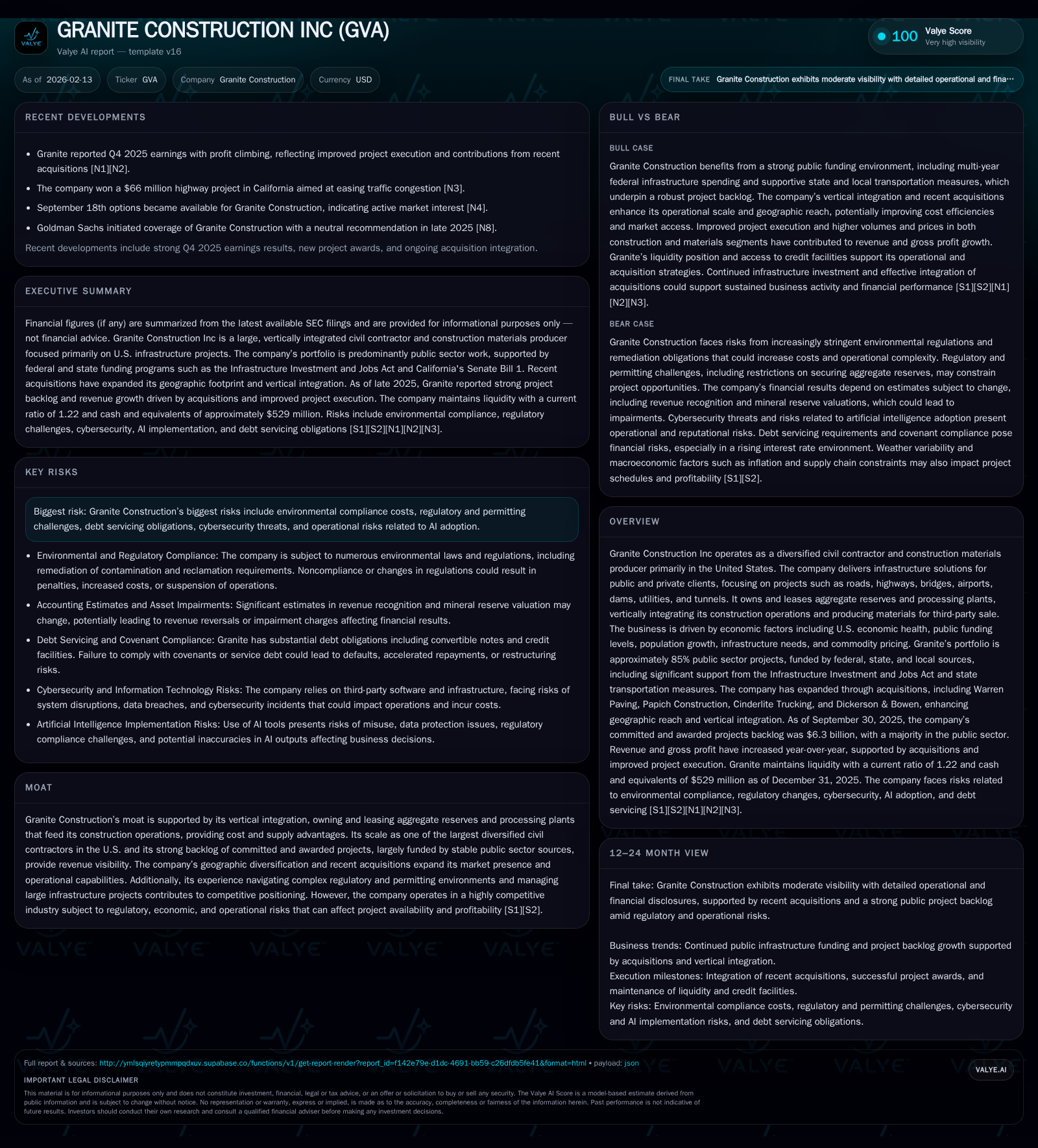
Granite Construction Inc stands as a pivotal player in the U.S. civil contracting landscape through its diversified project portfolio and ownership of key construction materials assets. Its competitive moat is strengthened by vertical integration, providing supply chain control and cost advantages that underpin stable revenue streams primarily supported by public sector funding from federal initiatives like the IIJA. However, the company faces substantial challenges including stringent environmental regulations, permitting difficulties, fixed-price contract risks, and evolving cybersecurity threats. Continued growth is bolstered by acquisitions expanding geographical reach, while legislative uncertainties post-IIJA remain key factors to watch.
Building America: Granite’s Role in U.S. Infrastructure
Granite Construction Inc occupies a central role in America's infrastructure buildout as one of the largest diversified civil contractors focused mainly on the U.S. market [S2]. Their work spans critical infrastructure such as roads, highways, bridges, airports, dams, tunnels, and utilities — projects essential to supporting population growth, economic activity, and national competitiveness [S2]. Alongside delivering construction services to public clients — about 85% of their portfolio — Granite also serves private sector markets with site preparation, mining services, railways infrastructure, energy development, and professional construction management [S2]. This breadth reflects not only operational scale but an ability to navigate complex projects spanning varied technical and regulatory requirements.
Supporting this front-line contracting capability is Granite's vertically integrated business model that tightly couples construction operations with aggregate reserves ownership and processing plants [S1][S2]. This integration ensures ready access to vital raw materials like gravel and stone while enabling cost control and reducing exposure to volatile third-party supplier markets. It also positions Granite to sell materials externally — diversifying revenue channels beyond direct construction contracts [S1]. Such a configuration is particularly valuable given the capital-intensive nature of infrastructure projects where material sourcing can significantly impact timelines and budgets.
Vertical Integration: Competitive Edge or Complex Challenge?
Granite’s moat flows largely from this vertical integration. By owning or leasing aggregate reserves along with operating production facilities for construction materials, Granite locks in supply chains crucial for large-scale infrastructure projects [S1]. This in-house resource control confers pricing power advantages over peers reliant on external suppliers vulnerable to shifts in availability or cost inflation.
However, this model also introduces notable complexity. Aggregate reserve development faces increasing environmental scrutiny alongside permitting hurdles that challenge future expansion opportunities [S1]. Stricter regulations on aggregate extraction not only raise compliance costs but introduce timing uncertainty related to approvals – a critical risk given finite property locations suitable for reserves [S1]. Managing these regulatory demands requires experienced legal and environmental teams alongside effective community relations to maintain operational continuity without reputational damage.
Moreover, ongoing investments in processing plants necessitate capital allocation decisions balancing immediate operational needs against longer-term growth ambitions. The interplay between supply security benefits and added regulatory burden embodies a strategic tension intrinsic to Granite’s integrated approach.
Financial Fortitude and Profitability Trends
Granite's Q4 2025 earnings reveal encouraging signs of financial health amid industry-wide challenges. According to recent reports [N1][N3], net income increased over prior periods reflecting effective cost management despite inflationary pressures affecting labor and materials markets. The company closed the year with approximately $529 million in cash & equivalents supporting liquidity needs [F1]. Its current ratio stood at roughly 1.22 at year-end 2025 indicating reasonable short-term financial flexibility [F1].
Margins remain under pressure consistent with broader civil construction industry trends influenced by rising input costs such as tariffs on steel and fuel along with labor shortages [N3][S1]. Nonetheless, Granite’s scale combined with vertical integration appears to buttress gross profit margins relative to smaller competitors more exposed to supplier volatility.
Capital expenditures directed towards maintaining aggregate reserves and plant capacity continue but are judiciously managed to safeguard returns [S1][N3]. The earnings profile benefits from multi-year contract backlogs providing near-term revenue visibility even as cost challenges persist.
Project Wins and Backlog: Indicators of Future Momentum
Granite’s sustained backlog strength underpins outlook stability. The award of a $66 million highway improvement project in California represents a concrete example of ongoing contract success within key geographies [N5]. Such wins are emblematic of broader trends driven by federal infrastructure spending increases via the IIJA as well as significant state-level transportation initiatives like California’s SB-1 program [S2][N5].
Backlog encompasses a healthy mix of federally funded multi-year contracts complemented by state/local government projects ensuring diversification across funding sources [S1][S2]. This blend fosters resilience against potential disruptions from budgetary delays or political shifts affecting any single level of government.
Moreover, contractual commitments are generally structured with annual appropriations typical for public works programs; hence funding continuation depends on legislative cycles but current visibility extends well into coming years because of the recently enacted Infrastructure Investment and Jobs Act (IIJA) [S2][N5].
Regulatory Crossroads: Environmental and Permitting Challenges
Regulatory risk is a prominent theme in Granite’s operating environment. The company acknowledges significant exposure related to stringent environmental compliance obligations including soil/groundwater contamination remediation liabilities common in heavy civil construction sites [S1]. Violations risk civil/criminal penalties or suspension/termination of contracts — adverse outcomes with clear financial consequences.
Increasingly rigorous permitting processes especially for aggregate reserve development intensify these operational constraints. The finite nature of suitable reserve properties combined with more restrictive land-use policies slows new reserve approvals impacting future material supply capabilities [S1]. Any protracted delays or denials could force reliance on higher-cost external suppliers eroding competitive advantages.
The complexity extends beyond environmental costs alone; evolving health/safety standards along with socio-economic regulatory demands must be continually navigated—demanding proactive compliance frameworks integrated into project planning phases [S1].
Public Funding Dynamics: Riding the Wave of the IIJA
A linchpin underpinning Granite’s portfolio strength lies in its heavy dependence on government-funded infrastructure spending which accounts for about 85% of its revenue base [S2]. The Infrastructure Investment and Jobs Act (IIJA) represents an unprecedented federal infusion - allocating $550 billion incremental funding over five years toward highways, bridges, mass transit, water systems, energy grids, broadband expansion among others—the highest injection seen in over six decades [S2].
The IIJA enhances multi-year programming visibility facilitating earlier contractor engagement and elongated project pipelines benefitting firms like Granite who thrive on backlog predictability. Concurrently at state/local levels numerous voter-approved transportation measures such as California’s SB-1 provide dedicated funding streams immune from sunset provisions ensuring continued capital allocation toward surface transportation enhancements [S2].
Nevertheless fiscal uncertainties linger ranging from potential federal government shutdowns—as witnessed briefly in October 2025—to changing legislative priorities post-IIJA expiry scheduled for late 2026 which may compress future appropriations cycles or compel re-prioritization among competing infrastructure needs [S2]. These factors underscore enduring reliance on political consensus dynamics shaping funding trajectories.
Navigating Industry Risks: From Fixed-Price Contracts to Cybersecurity
Granite operates amid multifaceted risk exposures characteristic of heavy civil contracting firms. Fixed-price contracts form the majority of arrangements binding firms to predetermined bids notwithstanding fluctuations in material prices or labor availability [S1]. Inflation spikes or tariffs—such as those affecting steel or petroleum products—can rapidly erode anticipated margins leading to diminished profitability or outright losses if not managed prudently.
Competitive intensity heightens due both to limited availability of public sector projects versus robust contractor pools wielding varying resource endowments potentially driving down bid prices [S1][S2]. In downturns within residential/commercial sectors seeking similar resources exacerbate this pressure illuminating cyclical vulnerability aspects embedded within Granite’s market segments.
From a corporate governance standpoint debt servicing obligations remain manageable but warrant monitoring given fixed costs inherent in equipment financing alongside capital investment programs tied to aggregate reserve expansions or facility upgrades [S1][N3].
Technological evolution introduces emerging risks surrounding cybersecurity threats targeting operations/control systems supplemented by increased reliance on AI tools whose adoption necessitates careful oversight lest unforeseen disruptions arise impacting productivity or safety protocols [S1][S2]. Mitigating these requires continuous investment elevating operational resilience without markedly compromising flexibility.
Growth via Acquisitions: Expansion and Market Diversification
Granite’s footprint has expanded notably through acquisitive strategies aimed at broadening geographic reach while augmenting service offerings relevant across public/private customer spectrums [S1][S2]. Such growth accelerates access into competitive markets complementing organic backlog build while achieving economies of scale advantageous amidst cost pressures.
Acquisition candidates typically bolster either reserve portfolios or specialized construction capabilities producing complementary integration potential though each entails inherent execution risk particularly around cultural fit plus assimilation of systems/processes impacting near-term efficiencies.
Ultimately these strategic moves reinforce Granite's positioning vis-à-vis peers enhancing bidding depth yet raising complexity requiring capable leadership attention ensuring consistency across operations post-deal close.
Looking Ahead: Contracting Landscape and Legislative Watch
As the IIJA approaches its nominal end circa September 2026 conversations regarding successor legislation intensify fundamentally shaping Granite’s forward-looking environment [S2][N4]. Subsequent federal infrastructure bills will dictate continuity or adjustment of investment rhythms influencing volume/timing patterns across segments served.
Investor attention remains focused on Congressional negotiations pertaining to new funding frameworks amidst broader fiscal debates potentially invoking deficit containment measures that might constrain discretionary spending affecting infrastructure sectors broadly.
Monitoring options market activity provides supplementary insights into sentiment around Granite's price evolution reflecting risk perceptions tied to these macro-policy variables alongside company-specific fundamentals such as backlog conversion rates or contract margin evolution[N4].
Against this backdrop Granite Construction appears well-positioned leveraging intrinsic strengths balancing growth ambitions with risk management sensitivity essential for navigating complex regulatory gastronomy embedded within U.S. public works space.
This analysis is based solely on publicly available information as cited herein without regard to any individual investment objectives or risk tolerances. It does not constitute investment advice nor an offer or solicitation for any security transactions.
Disclaimer: This is research-only, informational analysis and not investment advice. It may include AI-generated interpretation and general industry context. Always verify important details using primary sources.

Comments