
Smart Digital Group's Bold Pivot: From Software Roots to Internet Media and Cryptocurrency Ambitions
Navigating rapid strategic shifts, financial volatility, and emerging risks while pursuing growth in digital media, consulting, and crypto.
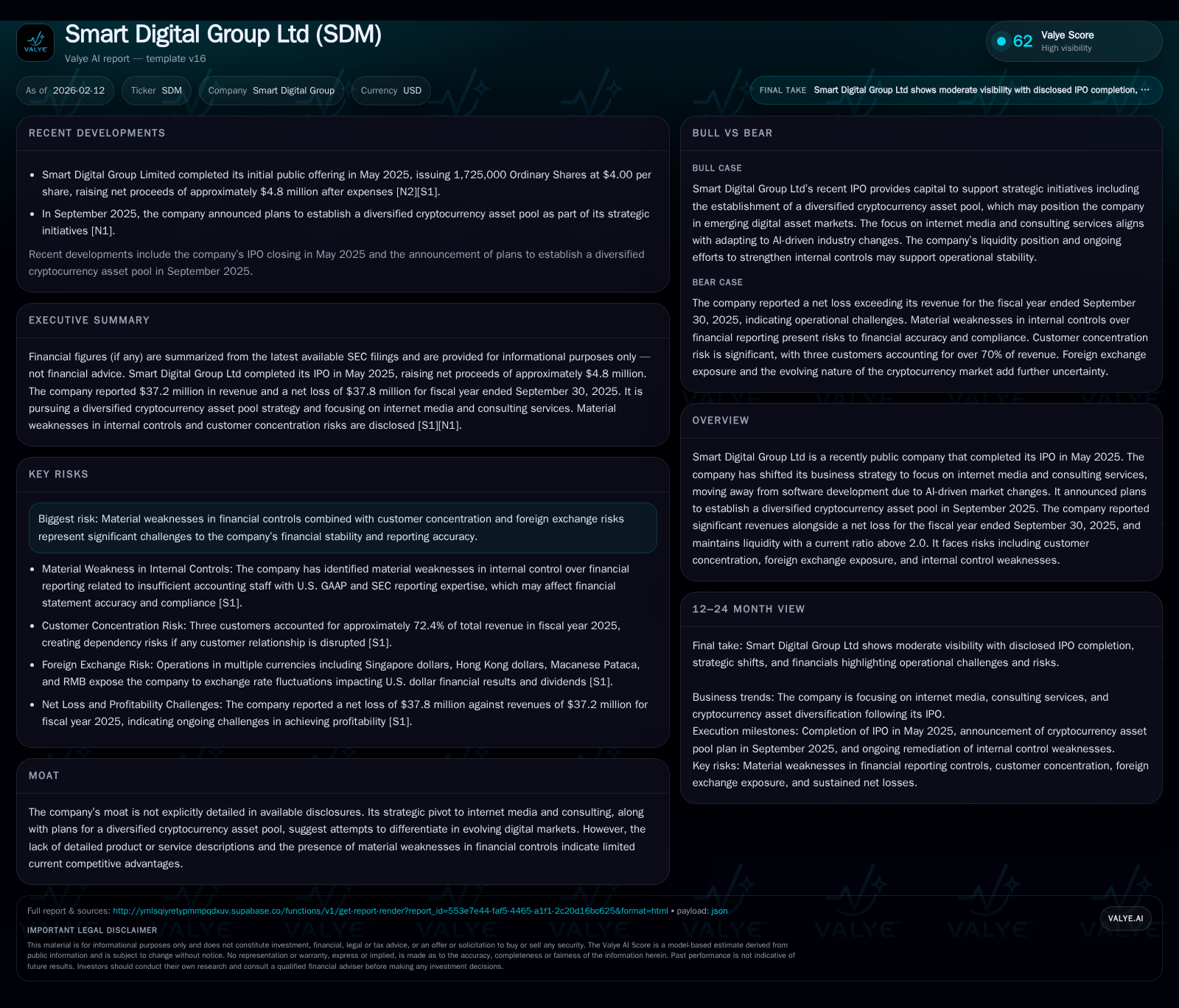
Smart Digital Group Ltd (SDM) embarked on a dramatic transformation post its May 2025 IPO, shifting away from legacy software development towards internet media and consulting, with a new initiative to build a diversified cryptocurrency asset pool. The company achieved strong revenue growth but recorded a substantial net loss driven by rapidly escalating expenses, notably share-based compensation. While SDM’s evolving business model aims to capture dynamic digital market opportunities, it faces significant challenges from internal control weaknesses, customer concentration, currency exposure, and intense competition. These factors cast an uncertain outlook as the firm strives to establish competitive footing in its new arenas.
From IPO to Internet Media: A Corporate Rebirth
Smart Digital Group Ltd’s recent public offering in May 2025 marked a pivotal juncture not only financially but also strategically. The company decisively shifted its operational focus away from its traditional foundation in software development towards a more pronounced emphasis on internet media services and consulting. This transition reflects both an adaptive response to the seismic shifts wrought by AI technologies in software markets and an ambition to capitalize on burgeoning digital media consumption trends. Alongside these service pivots, SDM’s organizational footprint spans multiple jurisdictions—Singapore, Macau, Mainland China—underscoring its multinational structure yet posing complex operational challenges [S1]. This period of reinvention is fundamental to understanding the company's current positioning and prospects.
Business Model in Transition: Services Breakdown and Revenue Streams
The company's service portfolio outlines four key segments: event planning and execution; internet media services; software customization (formerly prominent); and business planning plus consulting services. Notably, fiscal year data reveal dramatic volume shifts—software customization revenue has shrunk from 9.6% of total sales in 2023 to effectively zero by 2025, while internet media surged from a modest 21.5% up to commanding 91.3% of revenues within two years [S1]. Concurrently, event planning's contribution declined sharply as did business consulting’s portion of total sales, indicating prioritization towards scalable internet-based offerings.
This reallocation evidences SDM's efforts to align with higher growth verticals that leverage the digital marketing boom in Asia-Pacific regions where it operates. However, the absence of detailed descriptions regarding proprietary content or technology platforms suggests nascent maturity in these areas. The erosion of once core software services hints at structural displacement propelled by AI’s commoditizing effects on traditional software customizations.
The Crypto Diversification: Promise or Peril?
In September 2025, Smart Digital Group publicly unveiled intentions to develop a diversified cryptocurrency asset pool—an aggressive foray into digital asset management paralleling broader industry trends toward blockchain investment diversification [F1][valye_report_excerpt]. This move aligns conceptually with the firm's shift into digital media realms but encounters inherent uncertainties.
Notably absent from disclosures are detailed parameters such as asset allocation strategy, risk mitigation frameworks, or governance around crypto holdings. Given the volatile nature of cryptocurrencies—vulnerable to regulatory crackdowns, price swings, technological disruptions—this venture represents dual-edged potential: opening avenues for substantial upside while amplifying balance sheet risk profiles. The scant transparency thus far renders evaluation speculative but underscores SDM’s appetite for bold innovation amid transition.
Financial Snapshot: Growth Amidst Profitability Challenges
Fiscal year ending September 30, 2025 data lays bare contrasting narratives of scale expansion alongside deepening losses. Revenues swelled by approximately 72.9%, reaching $37.2 million compared to $21.5 million prior year [F1][S1]. However, gross profit margin gains (+28%) were dwarfed by disproportionate climbs in operating expenses.
Operating costs ballooned by more than fortyfold principally owing to an extraordinary $35 million share-based compensation expense introduced during this period—a decision presumably aimed at incentivizing management through equity participation post-IPO [F1]. General and administrative expenses jumped over sevenfold and selling expenses nearly quadrupled. These surging outlays eclipsed gross profits culminating in net losses nearing $38 million versus modest profits reported previously.
Despite losses, the company maintained liquidity sufficiency evidenced by a current ratio exceeding 2.1 based on near-term assets versus liabilities [F1]. This suggests careful working capital management amidst expansion but raises questions about pathway back to sustainable profit margins.
Risk Radar: Internal Controls, Concentration, and Currency Exposure
Of significant concern are documented material weaknesses in internal financial controls potentially impairing reliability and timeliness of financial reporting [valye_report_excerpt][S1]. As Smart Digital transitions business lines rapidly while scaling operations across varied jurisdictions with distinct regulatory landscapes (Singapore dollar, Hong Kong dollar, Macanese Pataca, RMB functional currencies), these control deficiencies amplify operational risks.
Customer concentration compounds vulnerability—with three key customers comprising roughly 73% of total revenues—and any disruption in their relationship could materially impact results. Foreign exchange volatility also poses direct threats given multi-currency exposures affecting USD reporting values and dividend prospects.
Together these factors contribute substantive uncertainty around earnings quality and forecast reliability challenging external stakeholder confidence.
Competitive Landscape: Battles with Established Giants and New Entrants
The domains Smart Digital now pursues—internet media marketing and consulting—are crowded arenas teeming with well-entrenched competitors possessing deeper experience bases, extensive client rosters, technological superiority, and economies of scale [S1]. These incumbents’ pricing power pressures margins while potentially limiting SDM’s client acquisition rates.
Furthermore, SDM’s limited operating history constrains leverage against rivals adept at bundling services or deploying cross-platform analytics capabilities fundamental to modern digital marketing efficacy. Steep investment needs coupled with rapid innovation cycles necessitate cautious resource allocation strategies.
Governance Under the Microscope: Audits, Controls, and Compliance
A positive step was establishment in 2025 of an audit committee staffed with financial experts meeting Nasdaq independence standards [S1]. Their mandate includes pre-approval oversight for audits and non-audit services provided by independent auditor Enrome LLP amid filing obligations under Form 20-F.
Nonetheless, Smart Digital’s classification as an "emerging growth company" affords regulatory leniencies such as exemption from auditor attestation under Sarbanes-Oxley Section 404 regarding internal control over financial reporting [S1]. This relief may ease compliance burden short-term but leaves lingering governance questions particularly given acknowledged material control deficiencies.
Corporate ethics codes exist but enforcement effectiveness remains opaque without public incidents or whistleblower activities disclosed so far.
Market Positioning and the Elusive Moat
Despite strategic attempts at repositioning through diversification into digital media sessions and nascent cryptocurrency ventures that could create experiential differentiation,[valye_report_excerpt] no explicit competitive moat emerges presently from disclosures or observable metrics.
Absence of proprietary technology platforms or unique intellectual property alongside strong reliance on external platforms for content distribution implies low switching costs for clients susceptible to competitor poaching.
Thus SDM currently occupies a precarious foothold amidst fluid market conditions where scale economies favor bigger players able to innovate faster or consolidate client contracts domestically across Asia-Pacific regions they serve.
Looking Ahead: Strategic Risks, Opportunities, and Market Signals
Looking forward paints a picture steeped equally in opportunity and cautionary signals. SDM harnesses tailwinds from increased digitization worldwide particularly leveraging its shift towards internet-based marketing services where growth remains robust globally.
However significant execution risks persist stemming from volatile crypto investment pursuits absent clear strategy articulation; unmitigated internal control gaps that could undermine investor trust; concentrated clientele exposure risking topline shocks; currency mismatch hazards impacting financial stability; plus competitive intensity compounded by limited operating heritage restraining expansion velocity [S1][valye_report_excerpt].
Management disclosures accentuate prudence underscoring unpredictable external factors including regulatory evolutions around cryptocurrencies which could reshape business economics abruptly.
Investors monitoring SDM must watch closely how future quarters balance growth ambitions against rigorous cost controls and how governance frameworks mature responding to identified weaknesses.
Disclaimer: This analysis summarizes available company filings and public disclosures without offering investment advice or recommendations. Readers should conduct further due diligence before forming opinions about Smart Digital Group Ltd’s prospects or risks.
Disclaimer: This is research-only, informational analysis and not investment advice. It may include AI-generated interpretation and general industry context. Always verify important details using primary sources.

Comments