
Polaris Inc. (PII): Navigating Competitive Terrain in Powersports and Marine Industries
Polaris Inc. remains a market leader in powersports and marine segments but faces profitability pressures amid competitive and operational challenges.
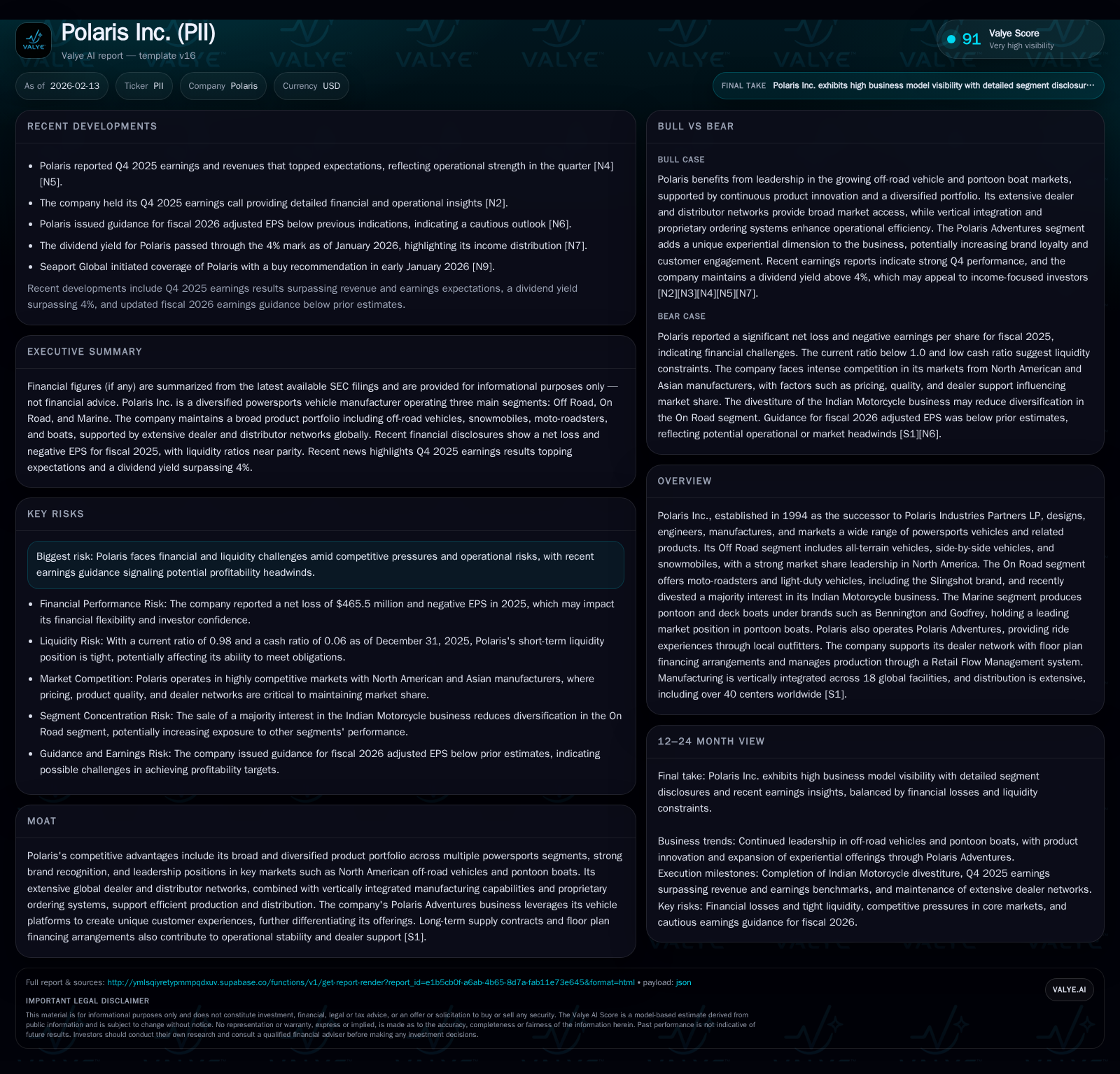
Polaris Inc., a well-established designer and manufacturer of powersports vehicles and marine boats, holds dominant market positions in North American off-road vehicles and pontoon boats globally. The company benefits from a diversified product portfolio, robust brand recognition, and an extensive dealer network supported by proprietary production systems and financing arrangements. However, recent financial disclosures reveal operational strains resulting in a net loss for 2025 and guidance signaling potential earnings headwinds. Strategic moves such as divesting the Indian Motorcycle business aim to streamline focus, while continuing innovation in Off Road products sustains Polaris’s leadership amidst evolving industry dynamics.
Company Overview and Segments
Polaris Inc., founded as the successor to Polaris Industries Partners LP in 1994 but with roots dating back to 1954, is an established leader designing, engineering, manufacturing, and marketing powersports vehicles alongside marine products [S1]. Its operations are segmented into three main business divisions: Off Road, On Road, and Marine.
The Off Road segment features a suite of all-terrain vehicles (ATVs), side-by-side utility vehicles (UTVs), and snowmobiles. Polaris maintains market leadership in North America within this category, driven by key product lines such as the RZR sport side-by-side, the RANGER utility vehicle, GENERAL crossover models, and Sportsman ATVs. The segment’s approximately 90 model offerings cover multiple consumer groups — youth through premium performance enthusiasts — providing diversified access points across recreational and utility use cases [S1].
The On Road segment includes moto-roadsters such as Slingshot vehicles. Notably, Polaris exited a majority ownership position in its Indian Motorcycle brand recently, focusing its strategic efforts on other core areas [S1]. Meanwhile, the Marine segment produces pontoon and deck boats primarily under Bennington and Godfrey brands; it enjoys a leading market position globally for pontoon boats.
Market Position & Distribution Network
Polaris sustains an extensive global distribution footprint comprised of roughly 2,400 independent dealers in North America plus over 1,500 international dealers across more than 90 countries served through subsidiaries and distributors [S1]. This network supports omnichannel sales complemented by online retailing.
A key competitive advantage lies in Polaris's proprietary Retail Flow Management system that aligns production volumes with real-time dealer demand signals. Coupled with floor plan financing programs offered to dealers—providing necessary working capital—these systems aim to stabilize supply chains and optimize inventory levels [S1].
Competitive Moat & Brand Equity
According to regulatory filings [S1], Polaris’s moat stems from several interlinked advantages: its broad and diversified product portfolio spanning adjacent forms of powersports; strong brand recognition deeply embedded in North American outdoor recreation culture; vertically integrated manufacturing capabilities ensuring quality control; plus technology-enabled order management systems enhancing supply chain efficiency.
The Polaris Adventures business creates experiential value by leveraging vehicle platforms to offer guided ride experiences via local outfitters—a move that differentiates the company by tapping into outdoor lifestyle trends beyond mere hardware sales.
Recent Financial Performance: Strengths & Challenges
Despite operational strengths reflected in market share gains and successful product launches (e.g., new RANGER 500 midsize side-by-side introduced in 2025) [S1], Polaris reported a net loss of $465.5 million for the full year ending December 31, 2025 [F1]. While fourth quarter earnings beat analyst revenue estimates illustrating resilience in demand [N3][N4], persistent cost pressures affected overall profitability.
Liquidity metrics highlight current assets just shy of current liabilities (current ratio approx. 0.98), indicating tight near-term working capital conditions [F1]. Cash on hand stood at $138 million at year-end—a modest buffer given scale of operations.
Guidance issued post-Q4 results forecast adjusted earnings per share for fiscal 2026 below consensus expectations—suggesting ongoing margin compression amid competitive intensity and macroeconomic uncertainties [N9].
Strategic Moves: Portfolio Focus & Workforce Optimization
Polaris continues reshaping its portfolio by divesting the majority interest in Indian Motorcycle—a premium on-road motorcycle brand—indicating a tilt toward consolidating leadership in core Off Road and Marine markets [S1]. The divestiture also contributed to workforce reduction; as of end-2025 about 14,500 full-time employees remained globally, down following efficiency initiatives [S1]. Nearly half (47%) are located outside the U.S., reflecting international scope.
The company emphasizes human capital through programs fostering engagement, leadership development (e.g., Polaris Leadership Development Programs), financial wellness education for employees navigating inflationary environments, plus safety campaigns targeting zero injuries—a cultural differentiation factor underpinning operational excellence [S1].
Industry Dynamics & Growth Drivers
Sector-wide dynamics feature sustained consumer enthusiasm for recreational off-road vehicles fueled by innovations enhancing utility versatility and increasingly personalized driving experiences. Estimated North American ORV retail sales hovered near historic highs with over 780,000 units sold in 2025 including approximately 255k ATVs and over 525k side-by-sides [S1]. Globally ORV sales reached nearly one million units.
Pontoon boats remain popular leisure vessels with demand growth influenced by expanding boating demographics; Polaris’s Marine unit leverages its strong brand loyalty and dealer relationships here.
Risks & Operational Headwinds
Reflecting industry competition intensity combined with cost inflationary pressures (raw materials, labor), Polaris faces noteworthy risks that weigh on near-term financial stability. These include compressed margins amidst pricing pressure from competitors; supply chain disruptions impacting components availability; seasonal fluctuations affecting inventory management; plus geopolitical factors influencing international trade flows [S1].
Furthermore, investor scrutiny has increased following adjusted EPS guidance misses despite solid revenue trends. Persistent losses necessitate vigilant balance sheet management.
Conclusion
Polaris Inc. remains deeply entrenched as a recognized leader across multiple powersports categories with substantial brand equity supported by an integrated dealer/distributor model enhanced by proprietary operational tools. Innovation pipeline progress continues to stimulate consumer engagement particularly within Off Road platforms.
Nevertheless, current financial headwinds coupled with market competition challenge near-term profitability metrics. Strategic divestitures aim to refocus resources on higher-growth verticals while human capital investments underpin talent retention critical for sustaining innovation momentum.
Industry context suggests that continued execution discipline alongside adaptive marketing will be paramount as Polaris contends with both evolving recreational preferences and broader economic cycles.
Disclaimer: This analysis is provided solely for informational purposes based on publicly available data as of February 13, 2026. It does not constitute investment advice or recommendations regarding buying or selling securities of Polaris Inc. or any other entity.
Disclaimer: This is research-only, informational analysis and not investment advice. It may include AI-generated interpretation and general industry context. Always verify important details using primary sources.

Comments