
C.H. Robinson: From Century-Old Legacy to Lean AI-Powered Logistics Leader
A comprehensive exploration of C.H. Robinson’s strategic transformation leveraging Lean AI amidst global logistics challenges.
C.H. Robinson Worldwide, Inc. has evolved from a traditional logistics provider with a 1905 foundation into a modern powerhouse defined by its Lean AI capabilities and expansive global network. The company’s proprietary technology, rigorous operating model, and diversified service segments enable it to adapt fluidly to economic cycles and competitive pressures. While risks tied to spot market dependence and industry fragmentation persist, C.H. Robinson’s scale, innovation pipeline, and entrenched customer-carrier relationships create meaningful barriers to competition.
From Legacy to Lean: Evolution of a Logistics Giant
C.H. Robinson Worldwide, Inc., with origins stretching back over a century to 1905, embodies an intriguing juxtaposition of tradition and innovation in the logistics industry. While the company’s foundation rests on time-tested freight brokerage services that have supported generations of shippers, its recent trajectory is defined by a revolutionary embrace of Lean principles fused with advanced artificial intelligence — what the company calls "Lean AI." This transformation has not merely been cosmetic; it represents a fundamental reimagining of supply chain orchestration underpinned by disciplined operational rigor.
The company’s history reveals steady adaptation rather than static legacy. Historically reliant on human-driven freight coordination across trucks, railroads, oceans, and air networks, C.H. Robinson today integrates machine learning at the heart of daily operations. This melding of human insight with algorithmic precision drives faster decision-making, sharper cost management, and enhanced customer responsiveness—even as global supply chains face increasing volatility [S1].
Lean principles serve as the backbone for this evolution. By embedding continuous improvement—eliminating wasteful processes while maintaining agility—CHRW fosters an organizational culture marked by discipline coupled with invention. The "Robinson Operating Model" codifies this approach as central strategic architecture enabling both accountability and adaptability across all levels of the business [S1].
Harnessing Data and AI: The Tech Backbone of Market Leadership
Central to C.H. Robinson's current identity is its proprietary platform Navisphere — a technology nexus connecting approximately 75,000 customers with an expansive network of around 450,000 contract carriers spanning motor carriers, railroads, ocean liners, and air freight providers worldwide [S1]. This dataset represents one of the largest global repositories of shipment transactions and carrier profiles.
Applied through their Lean AI methodology, this data powers enhancements in key logistical functions including dynamic pricing models that adjust rapidly to market conditions; hyper-customized load recommendations that optimize carrier utilization; and precise appointment scheduling that minimizes delays [S1]. These improvements translate directly into expanded operating margins by smoothing cost variability amid fluctuating fuel prices or capacity constraints.
Moreover, generative and agentic AI initiatives innovate further by automating tasks previously resistant to technology interventions — freeing employees from routine workflows to focus on high-value problem-solving [S1]. This dual leverage of data scale plus intelligent automation creates sustainable differentiation by addressing both service quality and cost efficiency simultaneously.
A Deep Dive into the Robinson Operating Model: Discipline Meets Innovation
Execution at C.H. Robinson is steered by the "Robinson Operating Model," an internal framework rooted firmly in Lean management doctrines but adapted for a high-tech era [S1]. The model institutionalizes continuous measurement against strategic KPIs paired with accelerated decision cycles.
This disciplined approach fosters rapid identification of operational bottlenecks or shifting customer needs allowing nimble course corrections without sacrificing quality or increasing overhead costs. It also encourages iterative innovation where AI-powered tools are tested pragmatically before widescale rollout — reducing risk commonly associated with tech adoption in legacy industries.
The model further ensures expense management aligns tightly with fluctuating market demands—a crucial capability given transportation services’ inherent volume cyclicality [S1]. Together these facets form a virtuous cycle: continuous improvement feeds better technology deployment which in turn drives stronger financial outcomes.
Segment Spotlight: North American Surface Transportation vs. Global Forwarding
C.H. Robinson operates primarily through two key segments which together balance revenue diversity and modal breadth:
North American Surface Transportation (NAST): This segment dominates truckload and less-than-truckload (LTL) logistics within North America — the company’s core arena historically known for high volume yet pricing sensitivity. Its multimodal offering extends also to cross-border trucking solutions complementing domestic freight.
Global Forwarding: Encompassing ocean freight forwarding, air cargo services, rail shipments outside North America plus customs brokerage and trade compliance support worldwide. This segment grapples more directly with international trade complexities but offers higher margin potential through value-added services.
Modal diversification here is not just tactical but strategic: it cushions CHRW against regional disruptions (e.g., port congestion or regulatory shifts) while enabling tailored end-to-end solutions for customers [S1][S2]. Freight consolidation capabilities across segments augment efficiency further — reducing empty miles traveled or redundant handling.
Robinson Fresh and Diversification: Sourcing Beyond Freight
Robinson Fresh represents a compelling diversification strand where CHRW applies its logistics expertise beyond mere transportation coordination into global sourcing of fresh produce [S1].
This business unit leverages supply chain insights to facilitate procurement that meets stringent freshness standards intertwined with complex cold chain requirements—delivering added value distinct from traditional logistics outsourcing.
Such vertical integration showcases CHRW’s ability to expand its footprint into adjacent markets while capitalizing on existing operational strengths—mitigating risk exposure from pure freight brokerage dependency.
Revenue Streams, Margins, and Financial Health Under Microscope
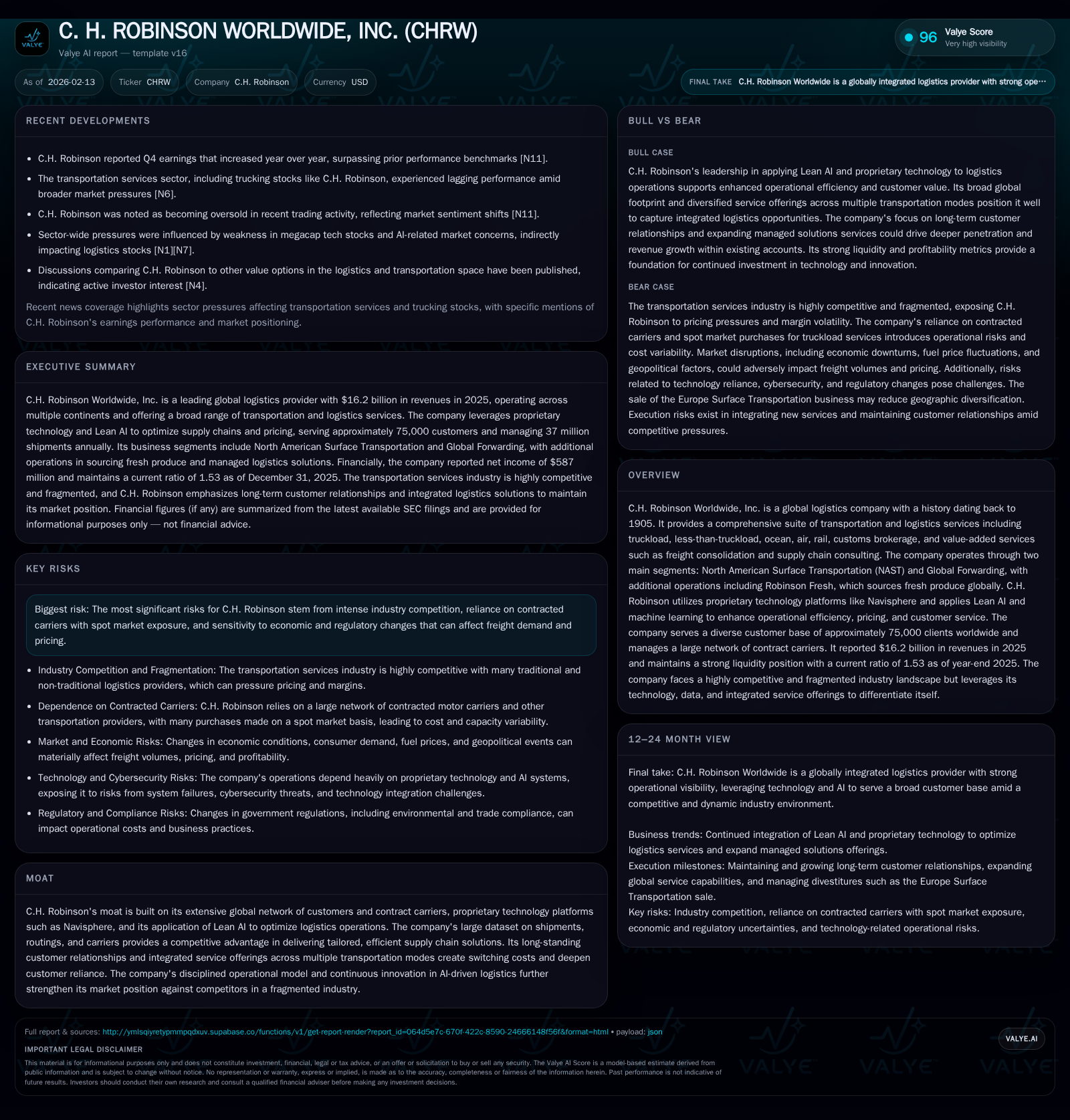
Financially, C.H. Robinson posted robust results in fiscal 2025 reporting $16.2 billion in revenues alongside $587 million net income — reflecting both scale advantages and margin improvement via technology deployment [F1][N2][S1].
Operating margins have visibly benefited from AI-enhanced dynamic costing models which optimize contract pricing relative to fluctuating carrier costs—offsetting pressures from higher fuel prices or wage inflation seen industry-wide [S1][S2].
Liquidity remains solid with $161 million cash on hand against current liabilities near $1.8 billion yielding a healthy current ratio around 1.53—adequate for ongoing investment into innovation pipelines [F1].
This financial strength enables continued R&D investment in AI development alongside strategic acquisitions or expansions supporting long-term growth objectives.
Navigating Economic Cycles and Spot Market Reliance Risks
Amplifying industry cyclical volatility are risks linked to spot market freight volumes—which comprise significant transactional exposure within CHRW’s network [S1]. Economic downturns or trade disruptions can sharply depress shipment frequency hurting top-line growth.
Additional factors include credit risk if customers delay payments during downturns or trader instability triggers counterparty failures impacting working capital. Furthermore, reliance on third-party contracted carriers exposes CHRW to risk if capacity shrinks unexpectedly due to bankruptcies or regulatory limits on driver hours/vehicle availability [S1][S2].
These dynamics underscore the importance of operational agility embedded in their operating model alongside diversified modal mix providing some stability during unfavorable macroeconomic currents.
Competitive Landscape: Positioning in a Fragmented Global Industry
The global logistics sector remains markedly fragmented with numerous small-to-mid-tier brokers vying alongside multinational integrators like CHRW partial exposure routed through independent contractor networks [S1][N11].
However, CHRW’s holistic technological ecosystem paired with broad multimodal capabilities provides defensive moats that smaller competitors typically cannot replicate easily—particularly given switching costs induced by deep integration into customers’ supply chains.
Regulatory complexity at borders adds entry barriers favoring incumbents capable of orchestrating compliant international shipments seamlessly while adapting pricing dynamically—a domain where CHRW's AI advancements prove critical [valye_report_excerpt][N11].
Customer and Carrier Ecosystem: The Moat Rooted in Relationships
The breadth of relationships harnessed is remarkable: service contracts span roughly 75,000 customers worldwide matched via proprietary tech with about 450,000 contract carriers across transportation modes [S1][valye_report_excerpt].
This network effect generates significant data feedback loops enhancing forecasting accuracy and tailor-made solutions—deepening customer reliance while heightening switching friction due to embedded operational linkages.
Long-standing partnerships bolster resilience during industry shocks as trust cultivated over years eases negotiation tension even when market pricing shifts dramatically.
Future Outlook: Opportunities, Challenges, and Growth Catalysts
Looking ahead, C.H. Robinson stands poised at an inflection point where scaling its Lean AI innovations could unlock new efficiencies unparalleled in traditional logistics providers [N2][N12][S1]. Initiatives involving generative AI promise faster response times across customer service touchpoints while expanding autonomous decision frameworks for load allocations remain top priorities.
Yet headwinds loom: macroeconomic uncertainty could tighten freight demand; intensified competition pressures require continual tech reinvestment; evolving regulations globally impose compliance burdens potentially inflating costs [S2][N11]. Balanced against these challenges is sentiment reflecting recent oversold conditions contrasted with strong quarterly earnings beats suggesting underlying robustness despite external noise [N2][N12]. Strategic vigilance will remain essential as CHRW navigates these complexities while leveraging its technological moat to grow thoughtfully.
Disclaimer: This analysis is intended for informational purposes only without any recommendation regarding securities trading or investment decisions.
Disclaimer: This is research-only, informational analysis and not investment advice. It may include AI-generated interpretation and general industry context. Always verify important details using primary sources.

Comments