
Dauch Corp’s Strategic Rebirth and Operational Challenges Amid Automotive Electrification
Dauch Corp’s acquisition-fueled transformation confronts legacy supply dynamics and innovation demands within a cyclical automotive landscape.
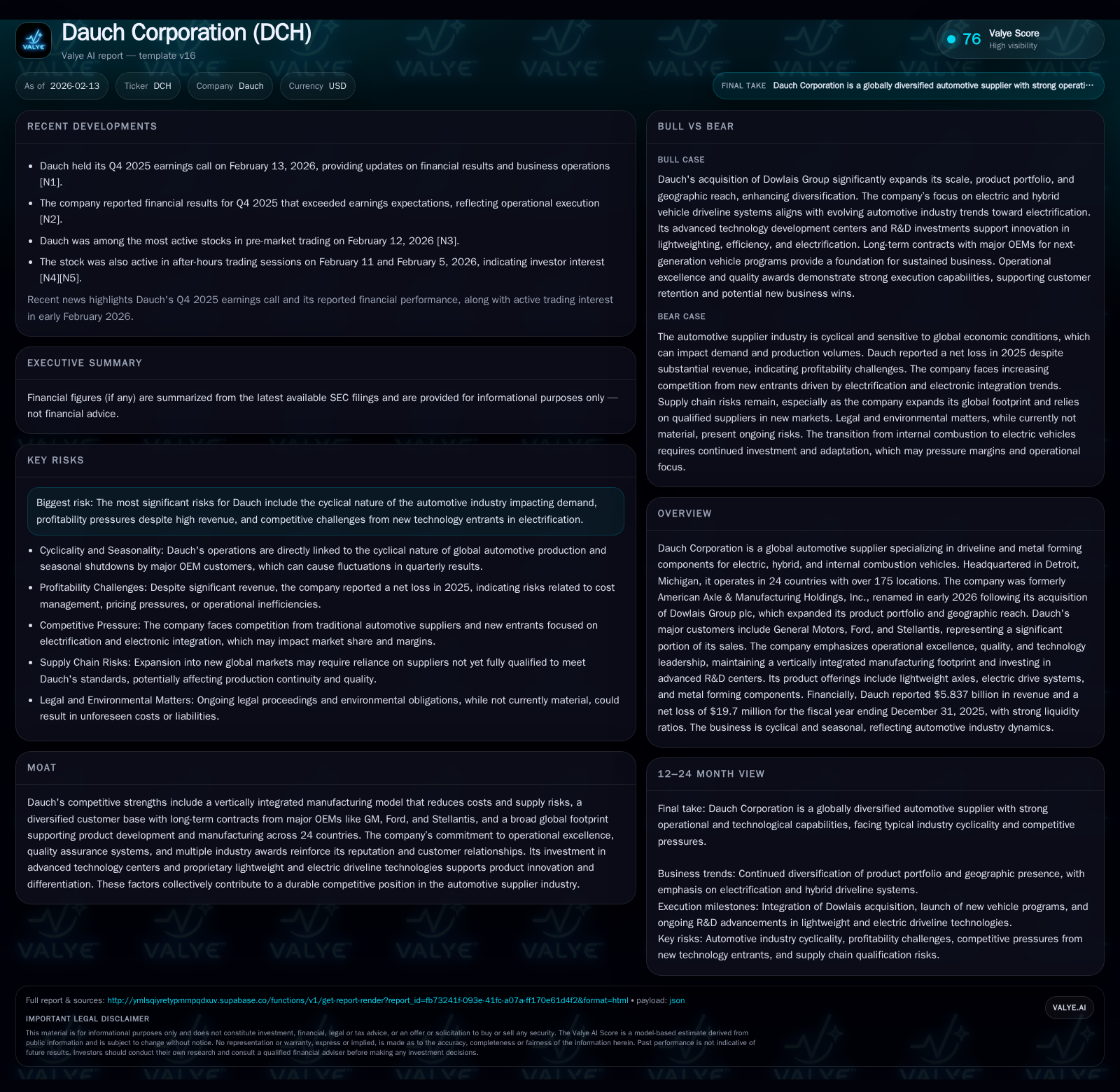
Emerging from the shadow of its former incarnation as American Axle, Dauch Corp has redefined itself through the $1.7 billion acquisition of Dowlais Group, creating a diversified and powertrain-agnostic supplier platform. Despite a stable gross margin and firm customer relationships with dominant OEMs like GM, Ford, and Stellantis, the company faces margin compression due to rising restructuring and integration costs, raw material price volatility, and labor challenges concentrated at its Guanajuato complex. Balancing a commitment to advanced driveline technologies with prudent cost management will be pivotal through 2026 as Dauch navigates integration complexities and shifting market demand pressures.
From American Axle to Dauch: A Strategic Transformation
Few corporate reinventions capture the essence of industry transformation quite like Dauch Corporation’s rebirth. Formerly American Axle & Manufacturing Holdings, Inc., the firm rebranded in January 2026 immediately following its landmark acquisition of Dowlais Group plc for approximately $1.7 billion [S1]. This decisive step marries American Axle’s historic strengths in driveline technology with Dowlais's complementary metal forming expertise under a single umbrella. The transaction not only broadens Dauch’s product portfolio across electric, hybrid, and internal combustion vehicles but also propels it into new geographic markets, weaving agility into its operational DNA.
The synchronized emergence of Dauch signals more than just a name change; it represents a proposed powertrain-agnostic shift tailored for the automotive sector's accelerating electrification trend [valye_report_excerpt]. Leadership now steers a more diversified supplier capable of bridging legacy combustion platforms and next-generation electric drivetrains—a response to evolving customer demands and competitive pressures.
A Diverse Global Footprint Anchored by Guanajuato
Dauch's worldwide manufacturing footprint extends across 24 countries with over 175 sites—a scale that offers both operational flexibility and complexity [valye_report_excerpt]. Key among these is the Guanajuato Manufacturing Complex (GMC) in Mexico, which underpins a substantial share of the company’s net sales, profitability, and cash flows [S1]. However, this concentration imposes nuanced risks: regulatory reviews slated for 2026 related to trade agreements between Mexico and other jurisdictions could reshape sourcing economics or impose compliance burdens.
Beyond regulatory uncertainty, Guanajuato faces labor market constraints that occasionally challenge capacity utilization rates. Shortages of qualified hourly workers create production volatility that dents efficiency metrics while inflating labor costs [S1]. Given GMC's outsized contribution to operational results, safeguarding continuity here remains a critical priority.
Customer Foundations and Concentration Risk
The trio of General Motors, Ford Motor Company, and Stellantis dominates Dauch's sales mosaic—accounting collectively for about 72% of revenues in 2025 [S1][F1]. GM alone represents about 44%, with Ford at 15% and Stellantis approximately 13%. While longstanding relationships with these OEMs anchor revenue stability, they concurrently heighten sensitivity to shifts in their respective production plans or market share fluctuations.
For instance, any reduction in GM's output for rear-wheel-drive light trucks or SUVs directly compresses Dauch’s sales volumes given its role as primary driveline supplier for these segments. Similar dynamics apply to select Ford models like Bronco Sport or Escape where Dauch participates via its driveline and metal forming products. The company's challenge lies in mitigating headwinds from such concentration while pursuing successor programs amid industry transitions [S1].
Financial Health: Navigating Declining Margins and Growing Costs
Financially, Dauch delivered $5.84 billion in revenues for 2025—a decline of roughly 4.7% year-over-year primarily attributed to lower vehicle production volumes and divestiture of its Indian manufacturing operation mid-2025 [S1][F1]. Gross profit contracted nearly 5%, yet impressively gross margin held steady at 12.1%, reflecting operational efficiencies offsetting volume declines.
However, beneath top-line steadiness lurk margin pressures. Operating income tumbled almost by half—from $241 million down to $112 million—largely driven by escalating restructuring and acquisition-related expenses that ballooned from $18 million in 2024 to more than $113 million in 2025 [S1]. These charges illustrate the heavy upfront cost burden tied to integration efforts post-Dowlais acquisition alongside broader cost structure optimization programs.
Meanwhile, interest expense expanded from $186 million to over $201 million amid new debt issuances financing the deal; management forecasts even higher servicing costs in 2026 approaching $340-$360 million [S1]. The bottom line swung decisively negative with a net loss of $19.7 million despite preserving liquidity levels—cash and equivalents topped $700 million year-end [F1]. This juxtaposition underscores near-term profitability strains despite ostensibly manageable capital positions.
Synergies and Challenges Arising from the Dowlais Acquisition
Integration ambitions accompany notable financial outlays: restructuring charges are expected between $100 million - $140 million throughout 2026 incorporating both ongoing Dauch-specific programs and costs linked to Dowlais operations consolidation [S1]. Additionally, acquisition-related professional fees hover around an estimated $60 million - $70 million while IT systems modernization and consulting engagements add roughly $100 million - $125 million in integration spend.
This amalgamation poses dual-edged complexity. On one hand, combining complementary engineering know-how across driveline electric systems and metal forming portfolios promises medium-term synergies—cost rationalization opportunities alongside innovation ramp-ups. On the other hand, these benefits rest on flawless execution in areas prone to cultural friction, disparate IT architecture environments, and operational re-alignments within global supply chains.
Failing seamless integration risks diluting customer confidence or missing cost savings targets—both critical as Dauch contends with tightening margins amid intensified competitive landscapes [S1].
Supply Chain and Raw Material Volatility: Operational Risks
Supply chain disruption looms as an ever-present specter heightened by reliance on few suppliers providing essential components such as steel alloys or electronic materials integral to driveline assembly. Metal prices contribute roughly one-third of material cost swings; fluctuations related to inflationary pressures or geopolitical events could exacerbate input cost volatility beyond contractual pass-through limits [S1].
Furthermore, frictions stemming from freight capacity constraints or regional labor shortages intensify risks around timely delivery schedules impacting inventory levels or production continuity. Material shortages may prompt production downtime incurring opportunity costs; simultaneously passing additional expense downstream challenges customer pricing agreements thus compressing margins further.
Dauch acknowledges these vulnerabilities candidly with explicit recognition that securing reliable sources while containing resultant cost impacts will be crucial safeguards against profitability erosion [S1].
Investment in Innovation: Balancing R&D with Cost Constraints
In an environment marked by margin stresses, maintaining technological edge demands balancing rigorously managed research budgets without sacrificing innovation vitality. R&D expenditures slipped moderately from approximately $159 million in 2024 down to about $147 million during 2025 reflecting conscious cost control efforts [S1][valye_report_excerpt].
Yet product differentiation through lightweight axle designs and bespoke electric driveline systems remains foundational to long-term competitiveness—both reinforcing customer retention and addressing emerging tailwinds favoring electrification support components over traditional powertrain parts.
This tension highlights strategic prioritization where resource allocation choices will define whether innovation output keeps pace with rapidly evolving OEM needs or falls behind newer entrants aggressively targeting electrified mobility sectors.
2026 Outlook: Restructuring, Integration, and Market Pressures
Looking ahead management anticipates continued elevated expenses including restructuring charges within the previously noted range alongside sustained high interest burden reflective of increased indebtedness post-acquisition [N1][S1]. Market demand remains uncertain amid broader automobile industry cyclicality influenced by consumer trends toward electrified vehicles counterpoised against legacy internal combustion volume tapering.
Margin recovery timelines are thus expected extended; operational agility coupled with stringent cost containment initiatives form the cornerstone of management's approach toward stabilizing profitability while progressing on synergy realization goals articulated during earnings commentary [N1].
Valye Perspective: Is Dauch Positioned to Drive Forward?
Dauch builds upon credible competitive moats rooted in vertically integrated manufacturing, global scale supporting innovation diffusion across continents plus longstanding OEM partnerships vital for sustaining volume streams through industry cycles [valye_report_excerpt][S1][N2]. Nonetheless these strengths face tangible headwinds tied predominantly to execution risks around integrating Dowlais assets while simultaneously navigating high-cost environments exacerbated by raw material volatility and labor issues.
Future success hinges on deftly maintaining core customer relationships imperative given sales concentration alongside delivering promised merger synergies without undermining operational quality or R&D momentum required for electrification leadership.
Ultimately Dauch embodies an automotive supplier grappling visibly yet proactively with transformation imperatives inherent in shifting mobility paradigms; its trajectory will depend substantially on management’s ability to reconcile growth ambitions alongside disciplined stewardship under persistent sectoral challenges.
This report was prepared solely for informational purposes based on publicly available filings including the company’s Form 10-K dated February 13, 2026 [S1], recent earnings call transcripts [N1], market reports [N2], and Valye proprietary research excerpts. It does not constitute investment advice nor an endorsement of any security discussed herein.
Disclaimer: This is research-only, informational analysis and not investment advice. It may include AI-generated interpretation and general industry context. Always verify important details using primary sources.

Comments