
Snap-on Inc: Navigating Tariffs and Industry Shifts with Innovation and Franchise Strength
Snap-on leverages its integrated innovation and unique franchise model to maintain industry leadership despite tariff challenges and global headwinds.
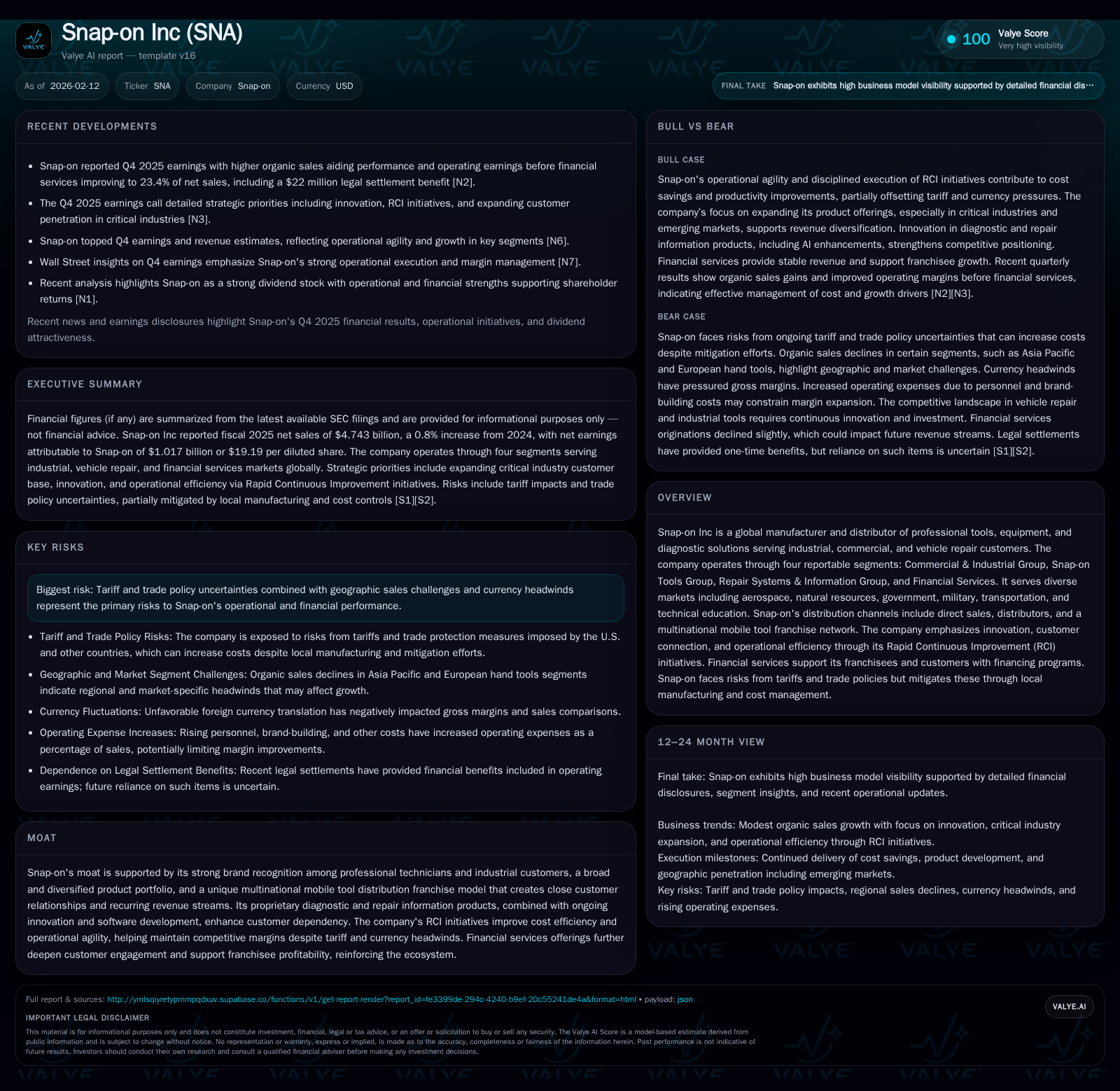
Snap-on Inc, a global leader in professional tools and diagnostic solutions, demonstrated resilience through modest organic sales growth amid tariff pressures in fiscal 2025. Anchored by a distinctive franchise network and diversified product segments, the company offsets geopolitical risks via local manufacturing and ongoing operational efficiency initiatives like Rapid Continuous Improvement (RCI). Financial services play a crucial role in deepening customer relationships and stabilizing revenue streams, supporting Snap-on’s strategic priorities of growth, innovation, and operational agility for 2026.
Unpacking Snap-on’s Brand Equity and Franchise Network
At the core of Snap-on Inc’s enduring competitive advantage lies a distinctive amalgamation of strong brand recognition and a unique multinational mobile tool distribution franchise system. Unlike many tool manufacturers relying solely on wholesale or retail channels, Snap-on engages technicians directly via an expansive network of franchisees—professional mobile distributors who not only sell but service customers on-site. This close customer connection fosters loyalty uncommon in industrial supply chains, translating into steady recurring revenue streams and deep product dependency [S1][F1][N8].
The company's product portfolio spans general hand tools to advanced diagnostic devices, catering to diversified markets including aerospace, natural resources, government, military, transportation, and technical education [S1]. The ability to customize offerings based on customer-specific workflows distinguishes Snap-on from commodity tool makers. This is bolstered by proprietary repair systems and diagnostic software that embed the company further into the operational fabric of its users.
Importantly, the franchise model also integrates a financial services dimension that underpins franchisee stability through tailored financing programs—a symbiotic setup reinforcing brand loyalty and economic alignment across the distribution chain [S1][N2]. Such vertical integration enhances Snap-on’s moat beyond mere product innovation.
Financial Performance Highlights: Growth Despite Global Headwinds
Fiscal year 2025 proved another testament to Snap-on's resilience amid challenging macroeconomic conditions marked by rising tariffs. Consolidated net sales edged up by $35.8 million or 0.8%, reaching roughly $4.74 billion. This growth was driven by a modest $16.5 million organic increase complemented by a $19.3 million favorable effect from foreign currency translation [S1][F1][N1].
Operating earnings before financial services declined slightly from $1.069 billion to $1.046 billion year-over-year while operating margin as a percentage of net sales contracted from 22.7% to 22.1%. These results reflect the partial absorption of tariff-related cost pressures partly offset by gains stemming from the company's Rapid Continuous Improvement (RCI) initiatives focused on operational efficiencies [S1][N3].
Net earnings attributable to Snap-on approximated $1.02 billion for 2025 or $19.19 per diluted share factoring in after-tax benefits from legal settlements totaling approximately $16 million [S1][N3]. The company maintains a strong liquidity position with cash plus equivalents of approximately $1.62 billion against current liabilities of under $920 million—yielding a robust current ratio near 4.8 indicating comfortable short-term financial flexibility [F1].
Quarterly trends echoed these themes with Q4 delivering an earnings beat driven by higher organic sales volumes despite margin compression pressures [N1][N6]. The management narrative emphasizes continuous cost control initiatives alongside strategic investments in growth-oriented innovation.
Segment Deep Dive: Commercial & Industrial vs. Mobile Tool Dynamics
Breaking down Snap-on’s performance reveals divergent trends across its principal reporting segments:
Commercial & Industrial Group: Serving critical industries worldwide such as aerospace and government/military sectors primarily through direct and distributor channels, this division saw net sales decline by 1.3% or $19 million mostly due to a 2.1% organic decrease compounded by mid-single-digit drops in Asia Pacific operations and low-single digit declines in European hand tools. Favorable foreign currency impacts partially offset these headwinds [S1][N2]. Operating income contracted from $242 million to approximately $218 million reflecting the top-line softness.
Snap-on Tools Group: Focused principally on vehicle service technicians engaged via the mobile tool franchises, this group experienced a slight overall net sales dip of about $24 million or 1.2%, where weak U.S. volumes counterbalanced low-single digit international market gains [S1][N2]. Operating earnings declined commensurately but efforts remain laser-focused on enhancing franchisee commercial health through improved productivity programs.
Both groups align their 2026 strategic imperatives with revenue expansion in critical industries (Commercial & Industrial) alongside sustained franchise profitability (Snap-on Tools), underscoring a calibrated approach attuned to shifting end-market dynamics [S1][N2].
Innovation as a Revenue Driver: Tools, Diagnostics, and RCI Initiatives
Innovation at Snap-on transcends periodic product launches; it operates as a structural revenue engine combined with efficiency enhancement mechanisms such as RCI—a systemized methodology driving leaner operations across multiple geographies [S1][S2][N6].
RCI is pivotal in absorbing inflationary cost pressures including those arising from tariffs by eliminating wasteful steps and optimizing supply chain flows—preserving margins amidst external adversity.Heavy emphasis on proprietary diagnostics products extends customer dependency beyond tools alone—embedding software-driven solutions that integrate deeply into vehicle repair workflows [S1][N6]. This dual focus on hardware-software integration alongside process improvement sustains high-value differentiation.
Management has regularly highlighted these initiatives during earnings calls as essential counterweights against input cost spikes while enabling incremental product-market expansions driven by emerging technological needs within their diverse customer base [N2].
Navigating Tariffs and Trade Policy Risks with Operational Agility
Tariff impositions throughout 2025 posed significant risks for industrial manufacturers globally—including Snap-on—which confronts duties levied both inbound into the U.S. as well as reciprocal tariffs in other jurisdictions [S1][S2]. However, Snap-on’s operational structure offers meaningful insulation:
- Manufacturing primarily occurs within or near key markets reducing import exposure.
- Localized production hubs enable swift adaptation to evolving trade policies.
- Currency translation benefits have partially cushioned underlying cost impacts.
- Ongoing RCI initiatives systematically lower structural costs mitigating tariff inflation effects.
While management transparently acknowledges geopolitical uncertainties around U.S.-China-EU trade relations as persistent risks, these layered strategies collectively temper exposure—allowing sustained investment in growth rather than defensive retrenchment alone [S1][S2].
Financial Services' Role in Expanding Customer Loyalty and Stability
Accounting for roughly one-quarter (~26%) of total revenues[ S1], Snap-on’s Financial Services segment undergirds the broader ecosystem by providing tailored financing solutions to its franchisees—and indirectly their customers—thereby enhancing commercial viability.
This unit delivers consistent earnings contribution ($426 million operating income from tools vs ~$218 million from Commercial & Industrial), smoothing cyclical swings inherent in manufacturing-dependent segments [S1][N2]. More importantly, financial services deepen customer engagement well beyond transactional tool sales by reinforcing franchisee profitability—which directly supports the mobile distribution model's resilience.
Such embeddedness exemplifies strategic foresight; financing arrangements foster stickiness among independent operators whose prosperity depends on access to capital facilitating inventory turnover and business expansion [N2]. This mutually reinforcing cycle underpins Snap-on’s ecosystem strength.
Strategic Priorities for 2026: Growth, Efficiency, and Market Expansion
Looking forward into fiscal year 2026, Snap-on sets forth multi-pronged priorities centering on:
- Expanding penetration within critical industry verticals leveraging deep understanding of work practices across sectors like aerospace and power generation.
- Enhancing franchisee productivity through commercial health programs aimed at profitability uplift.
- Broadening bespoke offerings incorporating customer-driven innovation targeted at specific workflow challenges.
- Continuing aggressive pursuit of structural cost reductions via RCI tactics coupled with operational improvements across global manufacturing footprints.
- Leveraging investments in emerging markets designed to bolster growth trajectories outside mature economies [S1][N2].
These priorities collectively signal an orchestrated focus balancing top-line enhancement with disciplined margin management grounded in process optimization—a sophisticated response calibrated for evolving market dynamics.
Dividend Appeal and Stockholder Considerations Amid Market Volatility
In an environment marked by macroeconomic volatility impacting industrial equities broadly, Snap-on distinguishes itself as "a great dividend stock" characterized by steady cash flow generation underpinning reliable payout capacity [N8].
Dividend yields hovering around 2.7% can be significantly augmented through options strategies—as detailed in recent market analyses demonstrating how investors might enhance income potential up to approximately 14.5% without altering core ownership positions [N11].
Analysts cite sustained free cash flow conversion coupled with disciplined capital allocation policies that prioritize shareholder returns alongside reinvestment for growth as key merits underpinning retention rationale during turbulent periods [N10].
Overall, Snap-on blends operational stability with attractive yield attributes—creating compelling total return prospects relative to peer industrials even absent explicit price forecasts.
This analysis synthesizes publicly available information without offering investment advice or recommendations regarding any securities mentioned herein.
Disclaimer: This is research-only, informational analysis and not investment advice. It may include AI-generated interpretation and general industry context. Always verify important details using primary sources.

Comments