
Getty Realty Corp: Navigating Automobility Trends with Specialized Net Lease Assets
Getty Realty’s focused portfolio of automotive and convenience retail properties illustrates how consumer mobility shapes durable real estate cash flows amid sector risks.
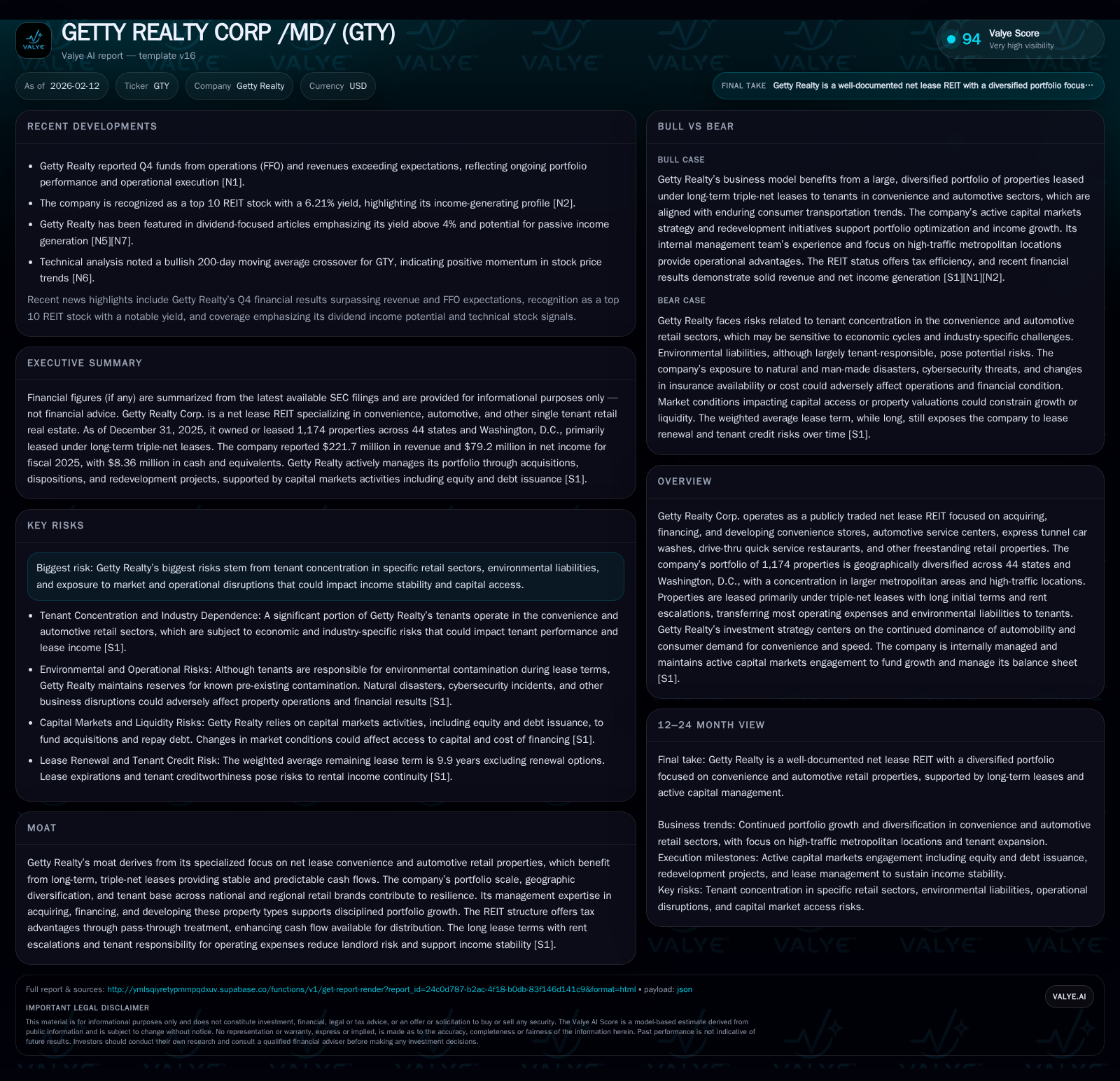
Getty Realty Corp stands out as a net lease REIT deeply embedded in the U.S. automobility and convenience retail landscape, managing over 1,170 properties under long-term triple-net leases. Its portfolio scale and lease structure deliver predictable income while minimizing landlord risk through tenant-operated expenses and environmental liability allocations. Recent financial results show resilience with FFO and revenue exceeding expectations, supported by disciplined capital markets engagement. However, sector-specific risks such as tenant concentration in automotive-related businesses and environmental exposures remain key considerations for operational stability.
Niche Leadership in Automobility-Driven Real Estate
Getty Realty Corp operates at an intriguing crossroads of real estate investment and evolving American consumer behavior centered around automobility. The company's specialized focus on net leased assets such as convenience stores, automotive service centers, express tunnel car washes, and drive-thru quick service restaurants captures facets of daily life where mobility intersects with speed and convenience. Founded in 1955 and internally managed since inception, Getty has refined its expertise into a moat that rests not only on property ownership but also on tenant relationships aligned closely with the enduring American penchant for car-based commerce [S1]. This strategic specialization leverages cultural trends favoring personal vehicles even as urban transit experiments proliferate — underscoring a defensive yet opportunistic posture securing steady demand fundamentals.
Analyzing Getty Realty’s Portfolio: Scale, Diversity, and Lease Structure
At year-end 2025, Getty's portfolio totals 1,174 properties spread across 44 states plus Washington D.C., strategically positioned in highly trafficked intersections or convenient highway adjacencies typical of its tenant types [S1]. The owned properties (1,145) combined with leased estates (29) reflect a broad yet concentrated footprint heavily weighted to metropolitan hubs. The centerpiece of their revenue model is the triple-net lease—covering nearly all tenants—which effectively transfers operating expenses including property taxes, insurance, repairs, and crucially environmental liabilities onto tenants’ shoulders [S1]. These typical leases lock in initial terms of 15-20 years plus options for renewal terms up to another two decades. Rent escalations built into contracts provide predictable income growth streams alongside a weighted average remaining lease term close to 10 years — metrics emblematic of landlord risk mitigation through contractual rigor [S1][F1].
Financial Performance Deep Dive: Resilience and Growth Signals
Fiscal year 2025 delivered $221.7 million in revenues complemented by $79.2 million net income affirming Getty's earnings resilience [F1]. Capital deployment was robust with $273 million invested across various asset categories: specifically 28 quick service restaurants featuring drive-thru models repositioned for post-pandemic demand patterns; 24 convenience stores; 15 automotive service centers; and nine express tunnel car washes [S1]. Quarterly updates reinforce momentum—Q4 adjusted funds from operations (FFO) along with revenues exceeded analyst consensus reflecting strategic execution amid competitive real estate dynamics [N2]. While capital expenditure intensity rose with volume acquisitions, efficiency in funding mechanisms balanced earnings dilution risks. This underscores Getty's ability to scale without significant degradation of income quality or cash flow stability — essential criteria for sustaining distributions inherent to REITs.
Tenant Dynamics and Exposure Risks: Concentrations and Environmental Liabilities
Getty's core tenant base comprises operators largely within petroleum distribution networks, convenience retail brands, automotive repair chains, and quick service restaurant franchises [S1]. This concentration introduces exposure vectors tied to industry cyclicality—fuel price volatility or shifts toward electric vehicles could disrupt traditional petroleum-focused customers. Environmental liabilities pose another intricate facet given that tenants assume responsibility not just for ongoing contamination but also for pre-existing conditions discovered later during their lease terms [S1]. Such clauses reduce Getty’s direct remediation expenses yet introduce reputational risks should historical contamination issues surface unexpectedly.
Importantly, management’s active oversight includes comprehensive cybersecurity risk management governed by the Audit Committee reporting quarterly on threat landscape evolution—a recognition that IT disruptions could impair tenant interactions or internal operations [S1]. This proactive stance signals awareness that traditional real estate risks now intertwine inseparably with digital security imperatives.
Capital Markets Strategy: Funding Growth and Navigating Balance Sheet Discipline
Getty’s capital strategy reflects a calibrated approach blending equity forward sales agreements executed previously with continuing ATM (at-the-market) equity issuance programs alongside targeted senior unsecured note offerings [S1][N6]. This multilayered capital access enables financing of property acquisitions without overstretching leverage ratios or undermining shareholder return profiles. The balance between equity dilution control versus prudent debt utilization illustrates sophisticated financial stewardship underpinning growth ambitions while maintaining flexibility to respond to market fluctuations.
Governance and Operational Controls with a Cybersecurity Focus
Governance structures at Getty incorporate layered frameworks explicitly assigning cybersecurity risk oversight to the Audit Committee which regularly receives detailed reports from executive management including incident updates regardless of severity potential [S1]. The full Board is likewise periodically briefed enhancing director awareness amidst evolving threat contexts. This strategic embedding elevates cyber risk beyond merely technical domains into enterprise governance—a best practice increasingly vital for REITs managing dispersed digital assets supporting tenant leasing platforms or operational monitoring.
Market Positioned or At Risk? Interpreting Recent Earnings Versus Expectations
Comparisons against sector peers reveal Getty often posting better-than-expected quarterly FFO and revenue figures even as some competitors report softer results amid macroeconomic headwinds impacting retail spaces generally [N1][N2]. This outperformance partly owes to Getty's stringent lease structures insulating it from short-term tenant distress alongside selective geographic allocation favoring markets demonstrating stronger consumer spending on fuel and ancillary automotive services. Meanwhile dividend yields hovering near 6.21% further boost investor perception positioning Getty as a stable income source during market volatility episodes [N3]. Such data points suggest sustained positioning combining growth potential tempered by real estate defensive qualities.
Income Stability Through Triple-Net Leasing: Dividend Appeal and Investor Perspective
Triple-net leases form the backbone of Getty’s consistent income generation framework by shifting almost all property-level expense volatility onto tenants while embedding inflation hedges via contractually mandated escalations [S1]. Combined with favorable REIT status conferring pass-through tax efficiencies that avoid double taxation on distributed earnings this makes dividends from Getty particularly attractive to fixed income oriented shareholders seeking dependable cash flows from real assets insulated from corporate tax drag [N3][N5][N7]. The combination of portfolio specialization in automobility-aligned retail sectors matched against strong governance-driven risk management culminates in creating what some market observers term a "passive income gold mine" suited for investors prioritizing steady yield over speculative appreciation.
This analysis synthesizes publicly available SEC filings alongside recent market commentary to present an integrated view of Getty Realty Corp’s business model dynamics without offering investment advice. Market conditions evolve rapidly; readers should supplement this review with up-to-date research before forming conclusions.
Disclaimer: This is research-only, informational analysis and not investment advice. It may include AI-generated interpretation and general industry context. Always verify important details using primary sources.

Comments