Gartner Inc: Financial Fortitude Amidst Rapid Industry Disruption and Competitive Shifts
Analyzing Gartner’s robust financial standing and strategic challenges as it navigates a transforming technology research landscape.
Gartner Inc. holds a solid cash reserve and maintains a balanced liquidity profile, underpinning its resilience in a highly competitive industry facing rapid technological evolution. Recent earnings reflect cautious optimism despite mounting pressures from AI-driven disruptions and changing client demands. The company’s ability to innovate timely and manage debt maturities are critical to sustaining its market position. Vigilant risk management around operational credibility, financing, and regulatory factors will shape Gartner's near-term trajectory.
Gartner's Financial Resilience in a Shifting Market
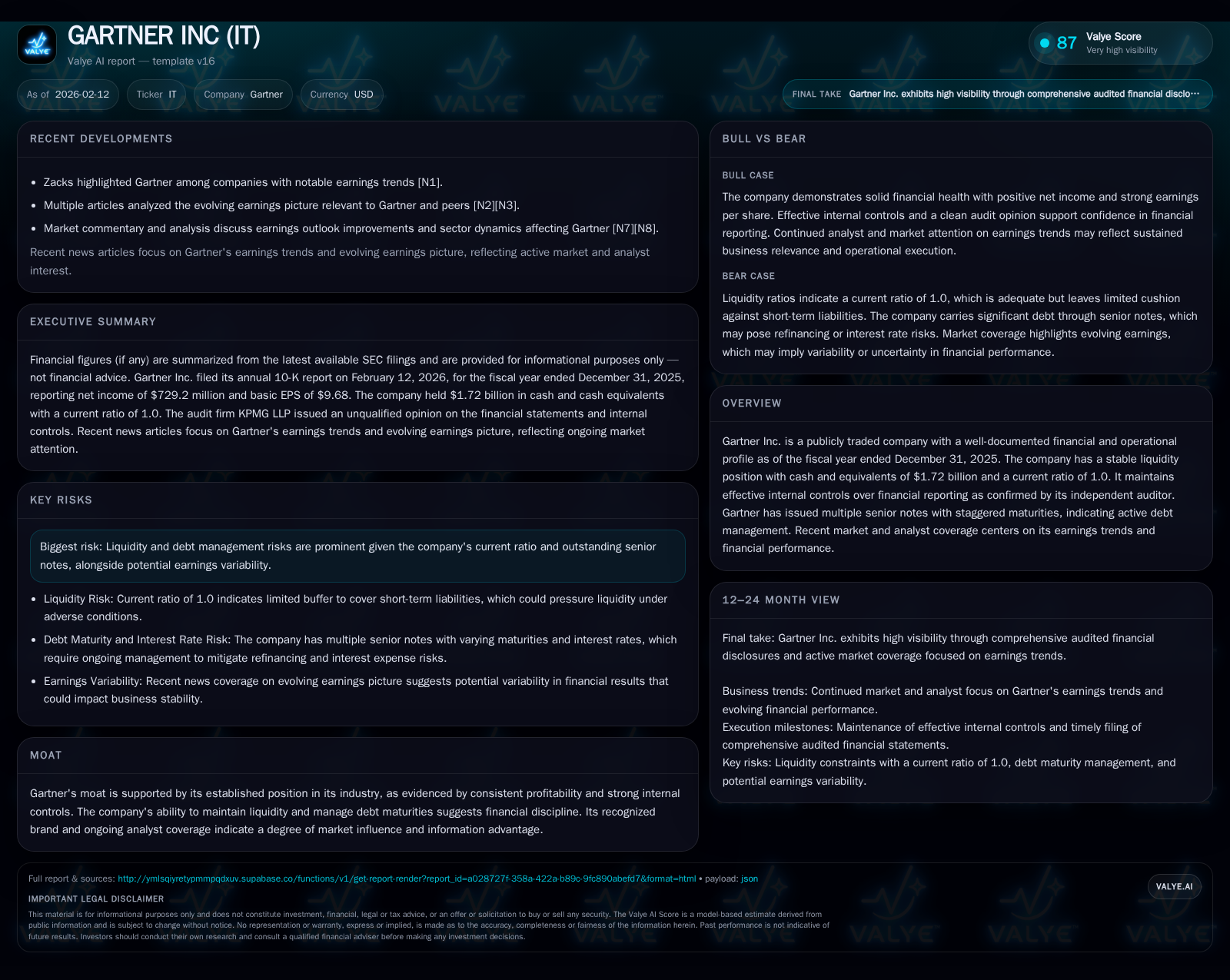
Gartner Inc.'s most recent financial disclosures paint the picture of a company fortified with considerable liquidity resources. At year-end 2025, Gartner reported cash and equivalents totaling approximately $1.72 billion alongside current assets of $4.07 billion, neatly matched by current liabilities of $4.07 billion yielding a current ratio of 1.0 [F1][S1]. While this ratio suggests a tight balance between liquid assets and short-term obligations, the substantial absolute dollar figure of cash provides an important buffer in an unpredictable macroeconomic environment.
Crucially, Gartner’s capital structure benefits from actively managed debt instruments, including multiple tranches of senior notes with staggered maturities stretching through 2030 [S1]. This staggered approach helps mitigate refinancing risk and affords operational flexibility as revenue streams evolve amid shifting client demand patterns.
Considering the quickly evolving software research sector combined with global economic fluctuations, Gartner’s prudent liquidity and debt positioning underscore its readiness to navigate financial pressures without compromising strategic agility.
Interpreting Recent Earnings Trends: Insights from Latest Analyst Coverage
Market analysts have recently offered nuanced perspectives on Gartner’s latest earnings performance relative to peers such as Adobe and Accenture [N1][N6]. Earnings results have traversed mixed terrain—some quarters reflect stability and growth sustaining investor confidence, while others reveal margin pressures linked to investment spend on innovation initiatives.
Zacks highlights indicate a cautiously optimistic outlook driven by steady recurring revenues but tempered by competitive cost dynamics [N7][N8]. Comparatively, the software services sector experiences volatility tied closely to AI adoption trends, influencing expectations for companies specializing in technology research insights.
Investor reception has been measured rather than exuberant; though fundamentals remain solid, market participants emphasize ongoing vigilance around Gartner’s ability to translate innovation efforts into tangible revenue gains.
Strategic Imperatives and the Innovation Pipeline
A defining challenge for Gartner lies in continually refreshing its offerings to meet rapidly changing client needs amid accelerating technology advancement [S1]. The company underscores in its regulatory filings that maintaining high-quality, credible insights is foundational to preserving reputation—a single misstep risks material client attrition.
Innovation cycles in this domain are demanding; product development entails complex coordination across research rigor, digital delivery methods, and pricing strategies aligned with market acceptance timing [S1]. Failure or delay in launching new solutions tailored for emerging technical landscapes could significantly impair Gartner’s competitive standing.
Thus, the firm's strategy hinges on balancing legacy product enhancements with accelerated introduction of services leveraging artificial intelligence capabilities, all while controlling operational expenses in inflationary contexts.
Competitive Landscape: Responding to AI and Disruption
Artificial intelligence stands at the forefront of sector disruption impacting Gartner's operating environment [S1][N10][N11][N13]. The incorporation of AI-driven analytics by competitors threatens to dilute traditional advantage derived from human-led expert research analysis.
This technological upheaval pressures Gartner not only to integrate similar capabilities into its frameworks but also to differentiate through trusted interpretative insights—combining machine-speed data processing with vetted human expertise. Failures here could lead to erosion of market share as clients pivot toward more technologically advanced alternatives.
Moreover, recent market turbulence linked to AI fears underscores heightened sector volatility constraining discretionary spending among enterprise clients [N11][N13]. Effectively navigating this wave requires agile strategy execution and continual assessment of emerging AI tools’ impact on revenue models.
Liquidity Management and Debt Structure: Balancing Stability and Risk
Gartner's senior notes issuances represent a deliberate strategy to spread refinancing obligations over multiple years [S1]. The $800 million notes due in 2028 at 4.5% coupon rate paired with $800 million at a 3.75% rate maturing in 2030 enable the firm to avoid concentration risks while locking in historically favorable interest costs during prior low-rate environments.
Financial controls remain robust with independent audits affirming effective oversight over reporting processes [S1], reducing risk associated with financial misstatement. Yet the near parity between current assets and liabilities points to an imperative for continued disciplined working capital management especially under earnings variability conditions noted in analyst discussions [N2][N3].
The sizeable cash reserve complements this structure by supporting ongoing investment programs without immediate reliance on external capital markets amidst industry unpredictability.
Risk Spectrum: Operational, Market, and Regulatory Challenges
Gartner operates within a nexus of intertwined risks outlined comprehensively in its SEC filings [S1]. Strategic risks revolve around sustaining product quality; lapses or perceived biases in published analyses could erode long-term client trust irreparably.
Economic downturns or geopolitical disruptions represent macro-level headwinds that might depress IT spending budgets among corporate clients—a catalyst for revenue variability [S1]. Additionally, regulatory uncertainty concerning data privacy, intellectual property rights for digital content delivery, or trade barriers could introduce compliance complexities impacting costs.
Operationally, maintaining up-to-date electronic delivery platforms tailored for global accessibility serves as another critical challenge amid inflationary cost pressures. These multifaceted risks require integrated mitigation approaches blending technological investments with prudent governance oversight.
Looking Ahead: What Investors Should Watch
As the technology research services landscape evolves at an accelerated clip driven by AI integration and shifting market priorities, several watchpoints emerge for stakeholders evaluating Gartner’s prospects. First is the trajectory of earnings growth relative to peer benchmarks—steady top-line expansion validated by margin management will be key signals [N1][F1].
Second is progress within the innovation pipeline: timely release of updated or new products demonstrating credible advantages against AI-enabled competition will influence market positioning profoundly. Third lies within financing strategies—monitoring debt maturity schedules alongside liquidity maintenance offers insight into financial discipline amidst external uncertainty.
Lastly, attentiveness towards risk factor developments encompassing operational integrity and regulatory compliance will further clarify sustainability contours going forward. Collectively these elements frame an environment where diligence coupled with adaptive management defines resilience.
This analysis synthesizes publicly available financial data and risk disclosures alongside contemporaneous analyst commentary. It aims to provide a detailed understanding of Gartner’s strategic context without offering specific investment recommendations.
Disclaimer: This is research-only, informational analysis and not investment advice. It may include AI-generated interpretation and general industry context. Always verify important details using primary sources.

Comments