PG&E Corp: Navigating Wildfire Risks and Regulatory Complexities in California’s Utility Landscape
An in-depth analysis of PG&E’s operational strategies, financial health, and regulatory environment amid persistent wildfire challenges.
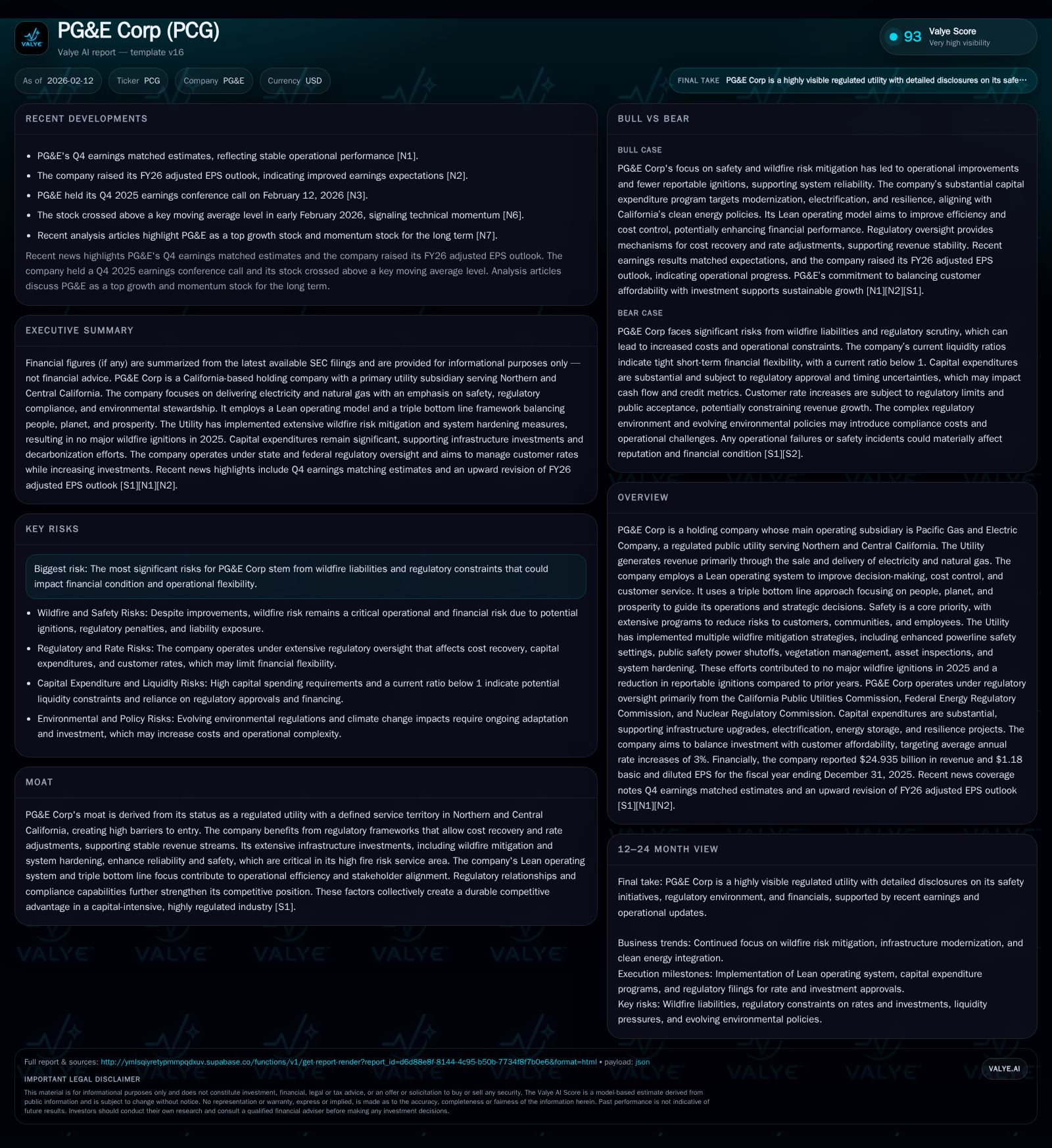
PG&E Corp occupies a pivotal role as a regulated utility serving Northern and Central California, leveraging its monopoly status alongside stringent wildfire mitigation efforts. The company’s recent financial results signal steady operational performance with adjusted EPS in line with estimates and an optimistic FY26 outlook. However, PG&E contends with a challenging liquidity profile and ongoing wildfire liabilities that underscore the delicate balance between growth and risk management. Strategic initiatives such as the Lean operating system and a triple bottom line focus enhance efficiency and stakeholder alignment, while regulatory frameworks including AB 1054 and SB 254 impart both protections and constraints on financial flexibility.
PG&E's Role and Reach in California's Energy Sector
PG&E Corp is fundamentally anchored as a holding company whose primary operating subsidiary is Pacific Gas and Electric Company, serving Northern and Central California. As a regulated public utility with a defined service area monopoly, PG&E enjoys high barriers to entry resulting from extensive capital investments in infrastructure and a regulatory framework that underpins its revenue stability through cost recovery mechanisms [S1][F1]. This territorial exclusivity shapes the company’s moat, granting it an effectively captive customer base reliant on its electricity and natural gas delivery services.
The service territory encompasses diverse regions prone to challenges such as wildfire risk — a central operational consideration unique to California’s utility landscape. These environmental dynamics necessitate sustained investment into system reliability and safety upgrades to minimize service interruptions and hazards. Consequently, PG&E’s capital intensity reflects not only growth but persistence in infrastructure hardening against increasingly complex risks.
Quarterly Performance Highlights: Meeting Expectations Amid Challenges
In its Q4 2025 earnings release, PG&E reported adjusted earnings per share (EPS) that aligned precisely with analyst expectations, reinforcing confidence in operational execution amid ongoing sector headwinds [N1][N6]. With annual revenues reaching approximately $24.9 billion in 2025 [F1], the company successfully navigated cost pressures while maintaining service levels.
Notably, PG&E raised its FY26 adjusted EPS outlook — an indication of management’s commitment to improving profitability despite external pressures including inflationary costs and regulatory constraints [N6]. This performance suggests effectiveness of internal controls as well as adaptive pricing mechanisms permitted under regulatory oversight.
While headline figures show growth stability, underlying complexities such as wildfire exposure inject layers of uncertainty that temper unalloyed optimism.
Fire Risk Management: From Recent Track Records to Strategic Mitigations
The shadow of wildfires looms large over PG&E’s operating environment. Yet, the company’s recent track record marks an important milestone with no major wildfire ignitions attributed to its equipment or operations in 2025 [valye_report_excerpt][S1]. This outcome stems from multifaceted mitigation tactics including enhanced powerline safety settings designed to reduce electrical faults during high-risk weather conditions.
Vegetation management programs systematically manage tree trimming cycles around power lines to diminish ignition sources. Additionally, rigorous asset inspections enable preemptive identification of vulnerabilities before seasonal fire threats escalate. System hardening efforts—such as insulating wires or deploying covered conductors—further bolster resistance against fault-induced fires.
Integral to these technical measures is the company’s maintenance of an OEIS (Office of Energy Infrastructure Safety) Safety Certification. This certification not only embodies compliance excellence but also translates into critical financial protections under laws like AB 1054 and SB 254; without it, PG&E would forfeit liability caps on catastrophic wildfires, exposing it to potentially unlimited financial repercussions [S1].
Collectively, these initiatives spotlight safety culture as paramount within PG&E’s corporate governance framework.
Financial Health Snapshot: Navigating Tight Liquidity and Capital Demands
Examining PG&E’s balance sheet reveals a nuanced liquidity picture. As of year-end 2025, the company held $713 million in cash and equivalents alongside total current assets of approximately $15.8 billion [F1]. However, this is offset by current liabilities reaching $16.3 billion—the result being a current ratio marginally below unity at 0.97 [F1]. Such a ratio indicates near-term operating liquidity pressures.
This tight liquidity must be understood within the context of ongoing capital needs driven by regulatory mandates for infrastructure modernization and wildfire mitigation expenditures. Fire-related liabilities remain significant uncertainties impacting financial flexibility; although mitigated partially by statutory instruments like the Wildfire Fund continuation accounts established under AB 1054/SB 254 [S1].
Moreover, managing working capital efficiently through the Lean operating system aids navigating this constrained environment but does not eliminate inherent structural financing demands tied to large-scale utility operations.
Lean Operating System and Triple Bottom Line: Embedding Efficiency with Purpose
True differentiation lies not solely in asset scale but also process excellence. PG&E employs a Lean operating model explicitly designed to streamline decision-making pathways, minimize inefficiencies, and enhance responsiveness to both internal challenges and customer needs [S1][valye_report_excerpt]. By reducing bureaucratic hurdles within day-to-day workflows, Lean fosters agility essential for addressing emergent situations like potential fire threats or cyber incidents.
Complementing operational improvements is the company’s adoption of a triple bottom line perspective—balancing people (workforce safety and customer engagement), planet (environmental stewardship including emissions reduction), and prosperity (financial sustainability) [S1]. This integrated framework informs strategic decisions ensuring social responsibility aligns tightly with governance standards without compromising economic viability.
In practice, this translates into proactive safety culture campaigns encouraging employees at every level to identify risks early while integrating ESG considerations seamlessly into business plans sanctioned by regulators.
Regulatory Environment: Balancing Compliance, Liability Caps, and Safety Certifications
California's rigorous regulatory landscape profoundly shapes PG&E’s business model. The enactment of AB 1054 alongside SB 254 introduced mechanisms designed to shield utilities from uncontrollable wildfire liability burdens — chiefly through establishing claims funds (Wildfire Fund) financed partly by contributions from utilities [S1].
However, eligibility for these protections hinges critically on maintaining OEIS Safety Certification accompanied by approved Wildfire Mitigation Plans (WMPs). Failure here can elevate risk dramatically; absent certification means losing presumption of prudency when seeking cost recovery before the California Public Utilities Commission (CPUC), thus exposing PG&E to disallowance of costs deemed unjustified [S1]. Furthermore, if utility actions reflect gross negligence or willful disregard prior to ignite events—as adjudicated—liability caps do not apply.
On governance fronts, specialized committees oversee cybersecurity risk management vital for safeguarding critical infrastructure underpinning operations [S1]. The Safety and Nuclear Oversight Committees conduct regular reviews encompassing policy updates, threat assessments, incident responses, ensuring continuous alignment between operational safeguards and evolving digital threat landscapes.
Such regulatory interplay requires constant vigilance balancing proactive compliance with safeguard-driven capital expenditures amidst potentially shifting legislative frameworks.
Future Outlook: EPS Growth Guidance Versus Wildfire and Regulatory Risks
PG&E projects adjusted EPS growth for fiscal year 2026 above prior estimates bolstered by continued operational efficiency gains yet underscored by caution due to residual wildfire exposure risks [N6][S1]. While prudent capital planning coupled with revenue adjustments facilitates margin preservation on one hand, regulatory scrutiny remains intense—any failure in safety certifications or new liability events may produce substantial adverse financial impacts disrupting earnings trajectories.
Analysts must weigh this duality carefully; upside is evident through demonstrated mitigation success paired with growing demand for clean energy solutions. Conversely, the specter of future catastrophic wildfires combined with rapid changes in regulatory policies could introduce volatility beyond standard utility sector norms.
Investor Sentiment and Market Signals in Early 2026
Market behavior through January-February 2026 reflects an evolving investor calculus balancing fundamentals against legacy concerns. Technical indicators place PCG shares above key moving averages for the first time since late 2025 suggesting positive momentum building among traders [N7]. Option market activity—with increased volume in April expiration contracts—hints at growing speculative interest possibly anticipating post-earnings catalysts or further guidance clarity [N12].
Concurrently, cautionary tones persist given historical wildfire liabilities keeping institutional investors vigilant despite improvements highlighted by recent no-ignition season performance [N11][N14]. The dichotomy between perceived value opportunity versus latent operational risks manifests itself across equity flows placing PG&E among top-ranked utility stocks by valuation metrics while remaining sensitive to evolving risk narratives.
This analysis synthesizes available data through February 12, 2026 without projecting investment recommendations. Readers should consider sector-specific uncertainties inherent in regulated utilities especially those exposed to environmental hazards affecting both operational continuity and financial outcomes.
Disclaimer: This is research-only, informational analysis and not investment advice. It may include AI-generated interpretation and general industry context. Always verify important details using primary sources.

Comments