
Genvor Inc: AI-Driven Peptide Innovations for Sustainable Agriculture Challenges
Genvor leverages proprietary artificial intelligence to develop novel peptide technologies addressing crop health and environmental sustainability.
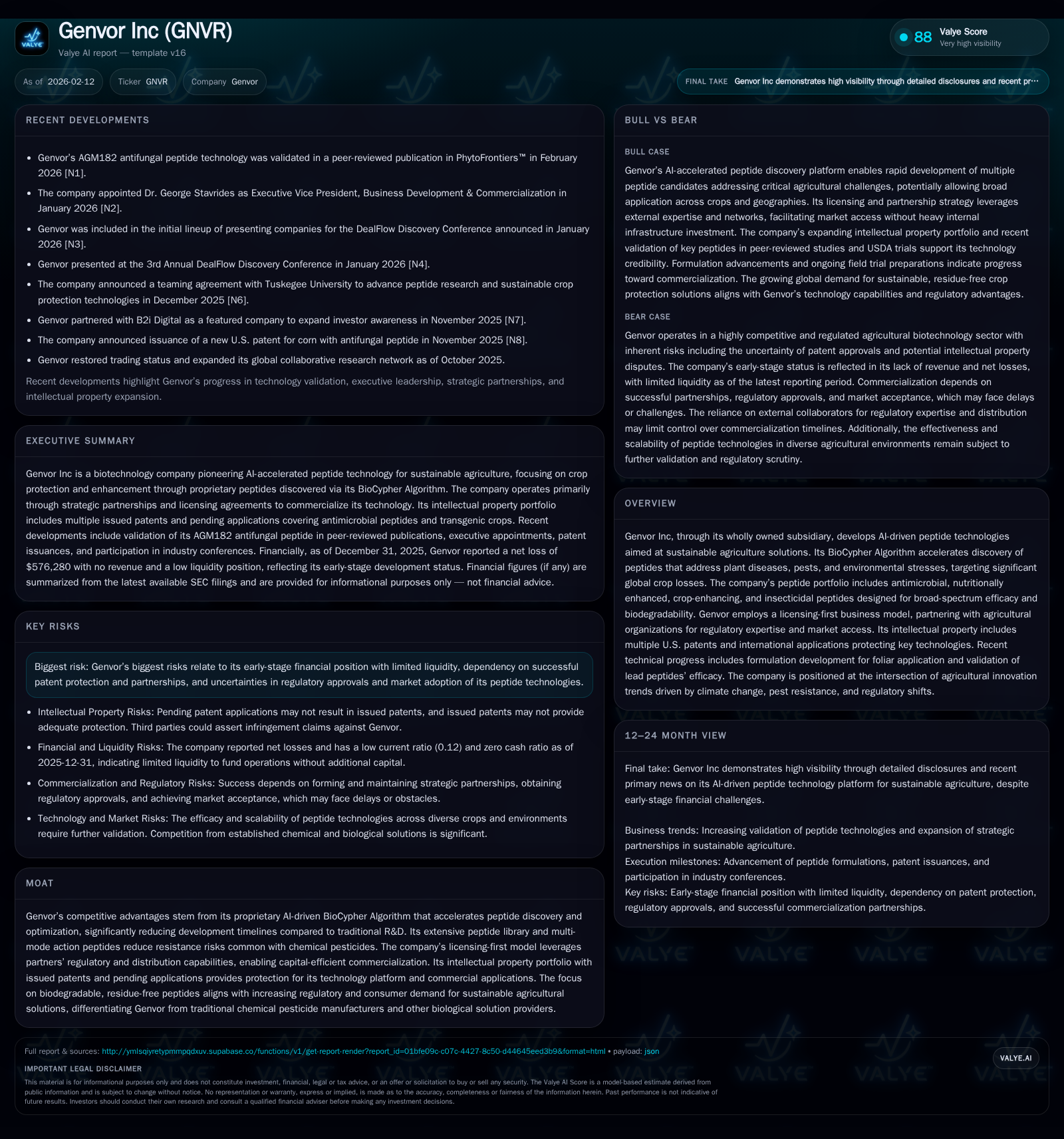
Genvor Inc is an early-stage biotech company focused on sustainable agricultural solutions through AI-accelerated peptide discovery and development. Utilizing its BioCypher Algorithm, the company creates multifunctional peptides targeting plant diseases, pests, and stressors that cause billions in global crop losses annually. Its capital-efficient licensing business model pairs cutting-edge science with strategic partnerships for regulatory navigation and market access. However, Genvor faces significant risks related to early financial constraints, patent protections, and uncertain regulatory pathways. Recent validations and leadership additions reflect progress in technology credibility and commercialization efforts.
Company Background and History
Genvor Inc was originally incorporated as "Allure Worldwide, Inc." in Florida in 2018 before redomiciling to Nevada in 2019. The company adopted the Genvor name in mid-2022 following a complex series of acquisitions culminating in Old Genvor becoming its wholly owned subsidiary by merger [S1]. Genvor Inc itself was established initially as Nexion Biosciences in Delaware in 2019 before rebranding. Early on, the firm acquired Nexion Biosciences LLC to consolidate its peptide technology assets. This lineage reflects a strategic pivot toward becoming a pioneer in AI-driven peptide technologies focused on sustainable agricultural solutions.
Technology Platform: The BioCypher Algorithm
Central to Genvor's competitive edge is its proprietary BioCypher Algorithm — an AI-powered platform that accelerates the exploration and engineering of peptides tailored for agricultural applications [Valye Report]. Traditional R&D approaches to discovering functional peptides are often time-consuming and costly; Genvor’s AI capabilities significantly truncate these timelines by computationally identifying peptide candidates with desirable traits such as broad-spectrum antimicrobial activity or insecticidal properties.
The company offers multiple classes of peptides:
- Antimicrobial Peptides (AMPs): Target fungal, bacterial, viral pathogens threatening crops globally.
- Nutritionally Enhanced Peptides (NEPs): Improve nutrient uptake efficiency reducing reliance on fertilizers.
- Crop-Enhancing Peptides (CEPs): Boost plants' tolerance to environmental stressors like drought or heat.
- Insecticidal Peptides: Provide targeted pest control with minimal environmental residue.
These peptides are designed for biodegradability aligning closely with rising consumer demand for environmentally sound agricultural inputs [S1].
Intellectual Property and Moat
Genvor holds multiple issued patents domestically with several international patent applications pending. This IP portfolio safeguards their core platform innovations and commercial product candidates, creating barriers against competitors relying solely on chemical pesticides or competing biological agents. The multi-modal mechanism of action inherent in some peptides helps mitigate the risk of target pest resistance development—a common issue with traditional agrochemicals.
The company's moat extends beyond patents; it includes the synergy between AI-enabled accelerated discovery, a vast proprietary peptide library, and the alignment with sustainability trends worldwide — bolstering differentiation from legacy pesticide firms [Valye Report].
Business Model: Licensing-First Strategy
Genvor opts for a capital-efficient licensing-first approach that partners with established agricultural entities possessing regulatory expertise and distribution networks. This strategy limits upfront commercialization expenditures while leveraging partners’ strengths to navigate complex global agrochemical regulatory frameworks—often a major hurdle for novel biocontrol agents.
Such collaborations presumably enable more rapid market access across geographies than a solo direct sales effort would permit. The model also reduces capital dilution risks typical of early-stage biotech companies aiming to build out large go-to-market infrastructures themselves [Valye Report].
Recent Developments Supporting Scientific Validation & Commercialization Efforts
On February 11th, 2026, Genvor announced that its AGM182 antifungal peptide technology had been validated via a peer-reviewed publication in PhytoFrontiers™, reinforcing scientific community endorsement of its efficacy claims [N1].
Earlier that month, Dr. George Stavrides joined as Executive Vice President for Business Development & Commercialization—a clear signal of intensified focus on forging partnerships and advancing market introduction activities [N2].
Additionally, Genvor’s inclusion as a presenting company at key industry conferences such as the DealFlow Discovery Conference highlights ongoing efforts to raise visibility among potential collaborators and investors [N3][N4].
Market Context: Addressing Global Crop Losses & Sustainability Demands
Global crop losses due to pests, diseases, and abiotic stresses total an estimated $220 billion annually—a substantial addressable market for innovative solutions like Genvor’s peptides [S1]. Traditional chemical pesticides face increasing scrutiny over environmental persistence, human health concerns, and resistance buildup among pests.
Consequently, demand for biopesticides and sustainable crop production enhancers is growing rapidly worldwide. Regulatory landscapes are also evolving to favor biologically derived inputs when efficacy can be demonstrated safely. Genvor’s technology aligns well within this structural shift toward more eco-friendly agriculture practices.
Financial Position & Risks
Despite promising technology progress, Genvor remains financially constrained at this stage. The most recent filings report net losses totaling approximately $576K for FY2025 without any recorded revenues as of Q3 2022 [F1]. Current assets stood at roughly $146K compared with current liabilities exceeding $1.2 million resulting in a challenging current ratio near 0.12—indicative of tight liquidity conditions unlikely to support extensive internal commercialization without significant additional capitalization or partnership funding [F1][S2].
Key risks persisting include:
- Dependency on successful patent prosecution to maintain technological exclusivity.
- Reliance on external partners’ ability to navigate regulatory approvals globally.
- Market adoption uncertainties driven by competitive pressures from established agrochemical players.
- Potential delays or failures during field trials or scale-up formulations.
- Early-stage financial sustainability without near-term revenue generation.
While these challenges are inherent to innovative biotech ventures especially targeting regulated markets like agriculture inputs, they underscore the need for prudent execution of strategic partnerships and continuing technological validation.
Strategic Outlook & Considerations
Genvor stands at a compelling intersection of artificial intelligence applied to biotechnology aimed at solving acute problems faced by modern agriculture—crop loss mitigation coupled with sustainability requirements. Its proprietary algorithm-driven platform differentiates it technologically from conventional R&D practices dominating peptide discovery today.
The effectiveness of its licensing-first commercial strategy will be critical for translating discoveries into widespread use while managing capital intensity. Progress reflected by peer-reviewed validation publications combined with enhanced commercial leadership suggests positive momentum toward bridging lab-scale innovation through regulatory pathways into market-ready products.
Nonetheless, financial fundamentals remain tight requiring careful balance between pursuing cutting-edge research developments versus securing stable licensing income streams or partnership deals essential for longer-term viability.
Conclusion
Genvor Inc exemplifies an early-stage synthetic biology company leveraging AI innovation to tackle longstanding agricultural challenges sustainably—with a scientifically robust platform backed by intellectual property assets. Its journey forward is marked by opportunities enabled through collaboration but equally challenged by typical biotech financial constraints and execution risks endemic to highly regulated bio-agrochemical sectors. Tracking upcoming regulatory milestones, partnership announcements, scientific validations, and financial updates will be important indicators of progress towards commercialization amidst dynamic industry trends favoring greener crop protection alternatives.
This analysis is provided solely for informational purposes without any investment recommendation or advice.
Disclaimer: This is research-only, informational analysis and not investment advice. It may include AI-generated interpretation and general industry context. Always verify important details using primary sources.

Comments