
American Electric Power’s Franchise Model Amid Regulatory and Capital Challenges
How AEP’s regulated utility model underpins steady returns while navigating transformative energy sector pressures.
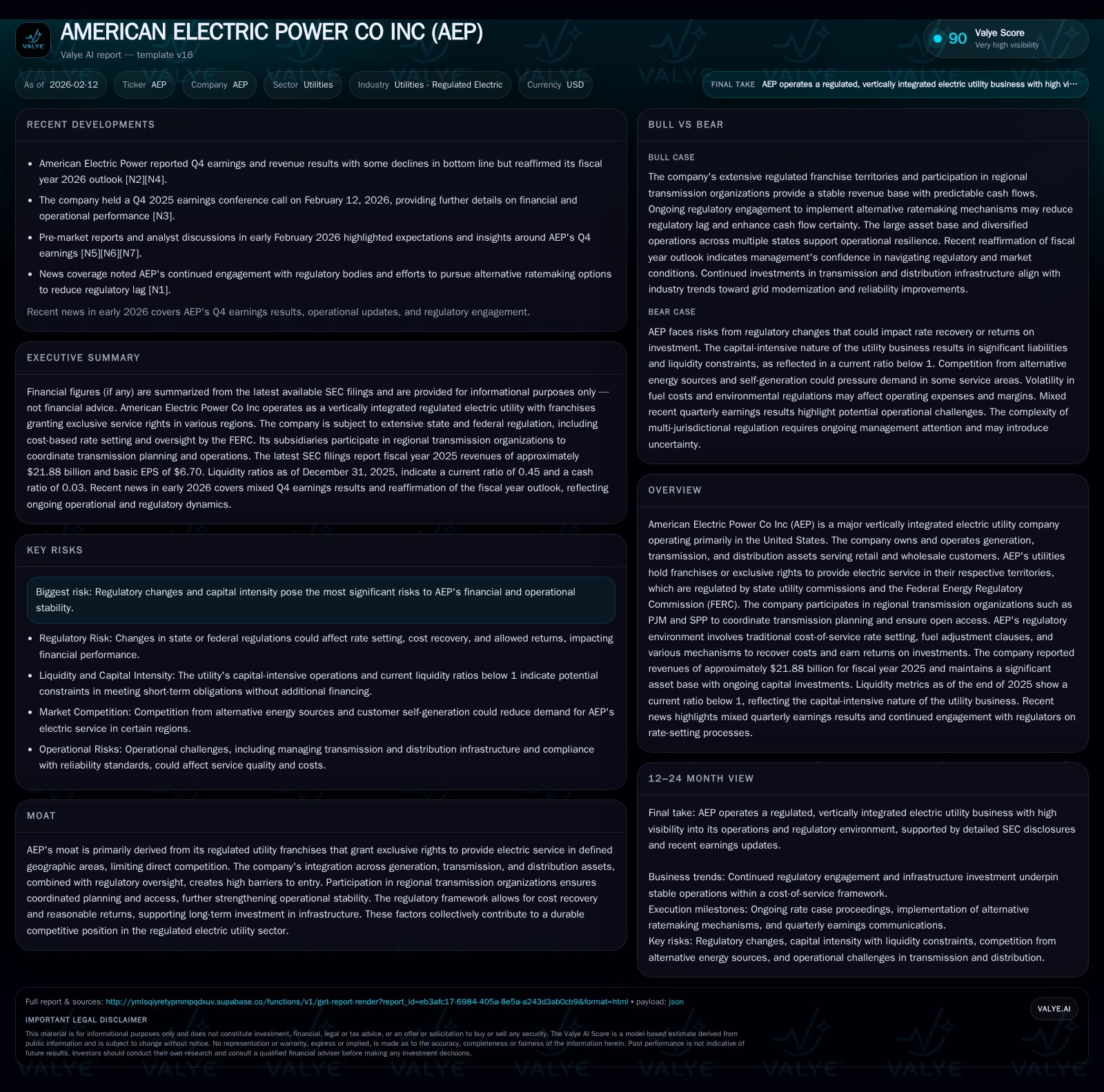
American Electric Power Co Inc (AEP) operates as a vertically integrated utility with exclusive regulated franchises across multiple U.S. regions, anchoring a durable moat that limits competition and ensures stable cash flows. Its ownership of generation, transmission, and distribution assets combined with participation in regional transmission organizations like PJM and SPP facilitates operational coordination and compliance with open access mandates. Recent financials reveal solid revenue of nearly $21.9 billion for FY 2025, although net income dynamics remain sensitive to regulatory shifts, cost recovery mechanisms, and capital intensity. Looking ahead, AEP faces mounting challenges from evolving regulatory frameworks and significant infrastructure investment demands essential for grid modernization and sustainability goals.
AEP’s Regulated Franchise: Foundation of a Durable Moat
American Electric Power’s business rests firmly on its constitutionally or legislatively granted franchise rights to serve defined geographic territories. These exclusive service areas, governed by state utility commissions, effectively shield AEP from direct retail competition within these regions [S1]. The regulatory backbone supporting these franchises relies predominantly on cost-of-service rate setting — a mechanism designed to allow recovery of prudently incurred costs plus a reasonable return on invested capital. This traditional model fosters predictability in revenue streams and investment stability.
These franchise rights vary by subsidiary within AEP’s vertically integrated utility structure. However, the collective effect is a patchwork of monopoly privileges that create significant entry barriers for competitors. The company itself regards these franchises as adequate for ongoing operations and fundamental to sustaining its customer base [S1]. Inherent vertical integration further cements this moat: owning generation resources alongside transmission and distribution assets enables end-to-end control over power delivery.
This arrangement differentiates AEP markedly from unregulated merchant generators by reducing exposure to volatile spot market pricing. It also buffers the company from the competitive pressures typical in deregulated markets where multiple suppliers vie for customer contracts. In essence, the franchise model converts infrastructure investments into regulated asset bases earning reliable returns under FERC-sanctioned oversight.
Vertical Integration and Regional Transmission: Coordinated Strengths
Beyond the franchise shield, AEP leverages its comprehensive footprint spanning generation plants through transmission networks down to distribution systems. This vertical integration underpins operational efficiencies by allowing coordinated maintenance schedules, demand forecasting, fuel procurement strategies, and unified system planning [S1].
Integral to this framework is AEP’s active membership in two regional transmission organizations (RTOs): PJM Interconnection (PJM) serving several subsidiaries including Appalachian Power Company (APCo) and Indiana Michigan Power Company (I&M), and Southwest Power Pool (SPP) covering entities like Public Service Company of Oklahoma (PSO). These FERC-approved RTOs operate independent grid management functions facilitating reliable bulk power transfers while ensuring open access for all participants [S1].
Within these RTOs, AEP subsidiaries engage in agreements such as the Transmission Agreement (TA) for PJM members and the Transmission Coordination Agreement (TCA) for SPP participants [S1]. These contracts govern revenue sharing from transmission services sold under the Open Access Transmission Tariffs (OATTs), risk allocation, coordinated planning efforts including reliability studies, and interaction with system operators.
Such coordination not only optimizes asset utilization but also aligns with federal mandates removing discriminatory practices over transmission usage. It favors transparency while distributing cost responsibilities among involved parties — a crucial factor supporting both operational reliability and financial predictability amidst increasingly complex grid demands.
Regulatory Environment: Safety Net or Constraint?
Operating within a heavily regulated domain naturally imparts both protective cushions and growth constraints for AEP. State utility commissions primarily oversee retail rates through cost-of-service regulation permitting recovery of operating expenses plus an approved return on invested capital [S1]. Fuel adjustment clauses further enable timely adjustments reflecting fluctuating commodity prices without prolonged rate case processes.
At the federal level, FERC supervises wholesale power transactions and transmission tariffs grounded in the Federal Power Act’s provisions. Additional oversight includes compliance with provisions of the Energy Policy Act of 2005 administered by FERC — influencing infrastructure development incentives alongside environmental regulations [S1].
While this tightly controlled regulatory scaffold safeguards earnings against competitive incursions and volatile pricing shocks, it also imposes procedural burdens that may hinder swift adaptation to emerging technologies or market reforms. Rate cases can be protracted with contentious outcomes affecting timing or magnitude of allowed returns.
The balance is delicate: regulators aim to protect consumers from excessive charges while enabling utilities sufficient incentives to invest in grid modernization initiatives critical to decarbonization strategies. This regulatory push-pull often surfaces as an inherent risk highlighted in AEP disclosures — whereby adverse changes in policy interpretations or rate proceedings could compress margins or defer capital recoveries [valye_report_excerpt].
Recent Financial Performance vs. Market Expectations
For fiscal year 2025 ended December 31, American Electric Power reported revenues of approximately $21.88 billion [F1]. This top-line figure reflects stable demand patterns across its broad service territories supported by regulated pricing structures.
Quarterly earnings narratives provide additional granularity. In Q4 2025, while revenues slightly exceeded analyst expectations per Nasdaq reports [N1][N2], net income showed declines against prior quarters prompting cautious reaffirmations of FY26 outlooks [N3][N12]. The bottom-line softness correlates with heightened operational costs including fuel volatility influences despite existing adjustment mechanisms.
Moreover, capital spending pressures weigh on short-term profitability metrics given upfront cash outlays before full rate recovery is achieved through regulatory proceedings. Analyst commentary preceding earnings underscored these competing forces: strong foundational cash flows tempered by cost inflation and evolving policy uncertainties [N6][N7][N9].
Taken together, these dynamics illustrate the interplay between the company’s inherent franchise advantages yielding steady revenue growth and near-term margin volatility arising from external cost inputs plus regulation cadence.
Capital Intensity & Infrastructure Investment: Funding the Future Grid
Electric utilities universally require substantial capital investments to maintain safe operations while upgrading aging infrastructure amidst accelerating technological change. AEP is no exception; its vertical integration necessitates capital deployment across generation fleet renewal, transmission line modernization, distribution automation upgrades, energy storage integration, and cybersecurity enhancements [S1][valye_report_excerpt].
Estimated capital expenditures often run into multi-billion-dollar annual outlays given federally mandated reliability standards plus state-level clean energy targets driving renewables deployment or coal plant retirements [valye_report_excerpt]. Maintaining high system availability concurrently requires routine maintenance programs consuming working capital.
Financially, AEP’s liquidity profile reveals current assets at roughly $6.05 billion compared to current liabilities around $13.3 billion leading to a current ratio near 0.45 [F1]. This low coverage intimates tight short-term liquidity conditions shaping prudential treasury management priorities especially amid increasing debt-funded infrastructure spending.
Successful navigation hinges on strategic financing approaches optimizing debt issuance timing balanced against equity considerations — all under continuous scrutiny by regulators who influence allowed rates on equity impacting weighted average cost of capital (WACC).
Grid modernization investments align with longer-term horizons benefiting customers through improved reliability yet impose interim earnings headwinds requiring transparent communication with stakeholders to sustain confidence.
Risks on the Horizon: Regulatory Changes and Market Pressures
Despite structural protections offered by its franchise model, AEP explicitly flags key risks centering on evolving regulation impacting financial stability [valye_report_excerpt]. Potential scenarios include unfavorable outcomes in rate cases reducing authorized returns or delays in recovering large capital expenditures dragging on earnings.
Policy volatility tied to shifting governmental energy agendas poses uncertainties regarding timelines or scope for renewables integration mandates or carbon emission reduction targets potentially raising compliance costs beyond initial projections [S1]. Wholesale market rule changes enacted by FERC or RTO committees could alter transmission cost allocation or capacity constructs influencing revenue streams from ancillary services.
Market pressures such as fuel price inflation ripple through operating expenses despite adjustment clauses due to timing lags; similarly inflationary wage pressures affect maintenance costs. Additionally, technological disruption risks like distributed generation adoption or electrification pace challenge load growth assumptions underpinning forecasts.
Mitigating factors include diversified subsidiary footprints moderating localized regulatory impacts plus active participation in planning forums maximizing early engagement with policymakers.
Comparative Industry Context: How AEP Stacks Up
Within a utilities universe witnessing intensified renewable asset additions — exemplified by peers like WEC Energy achieving recent earnings beats alongside commitment expansions toward clean energy portfolios [N8] — AEP maintains a comparatively traditional profile emphasizing regulated franchise stability coupled with measured transition steps.
Investor sentiment fluctuations manifesting via notable fund outflows from sector ETFs including State Street Utilities Select Sector SPDR ETF underscore mixed confidence levels in legacy utilities faced with disruptive transformation needs [N13]. Nonetheless, AEP's scale combined with vertically integrated operations affords resilience relative to less diversified regional players more exposed to market swings or technology shifts.
AEP must therefore balance maintaining core regulated earnings advantages while advancing toward decarbonization aligned infrastructure investments to stay competitively relevant without sacrificing financial discipline.
Summarizing AEP’s Long-Term Investment Thesis
American Electric Power’s fundamental strength derives from its regulated utility franchises granting exclusive service rights backed by cost-of-service regulation ensuring predictable returns over long investment cycles. Its vertically integrated presence across generation through distribution combined with membership in major RTOs supports efficient grid operation consistent with open access principles fostering regulatory goodwill.
The company reported compelling revenues nearing $22 billion yet continues encountering margin constraints influenced by escalating capital expenditures needed for modernizing infrastructure under evolving regulatory regimes that inject uncertainty regarding timing and sufficiency of cost recoveries.
Liquidity measures invite caution requiring judicious funding approaches amid expansive capex programs incentivized partly by policy drivers addressing climate change concerns while safeguarding reliability. Adverse shifts in regulation or wholesale market conditions represent meaningful risks necessitating proactive stakeholder dialogue.
In sum, AEP exemplifies a classic moated utility balancing steady regulated cash flows alongside increasing complexity imposed by transformative energy sector dynamics—a scenario demanding ongoing vigilance but grounded in durable structural advantages.
Disclaimer: This analysis does not constitute investment advice or recommendations but aims to provide an informed company- and industry-level perspective based on publicly available information.
Disclaimer: This is research-only, informational analysis and not investment advice. It may include AI-generated interpretation and general industry context. Always verify important details using primary sources.

Comments