
Black Hills Corporation's Strategic Merger and Stable Utility Foundations in 2026
Black Hills Corp shows solid financial momentum while navigating a transformative merger poised to reshape its regional utility presence amid sector headwinds.
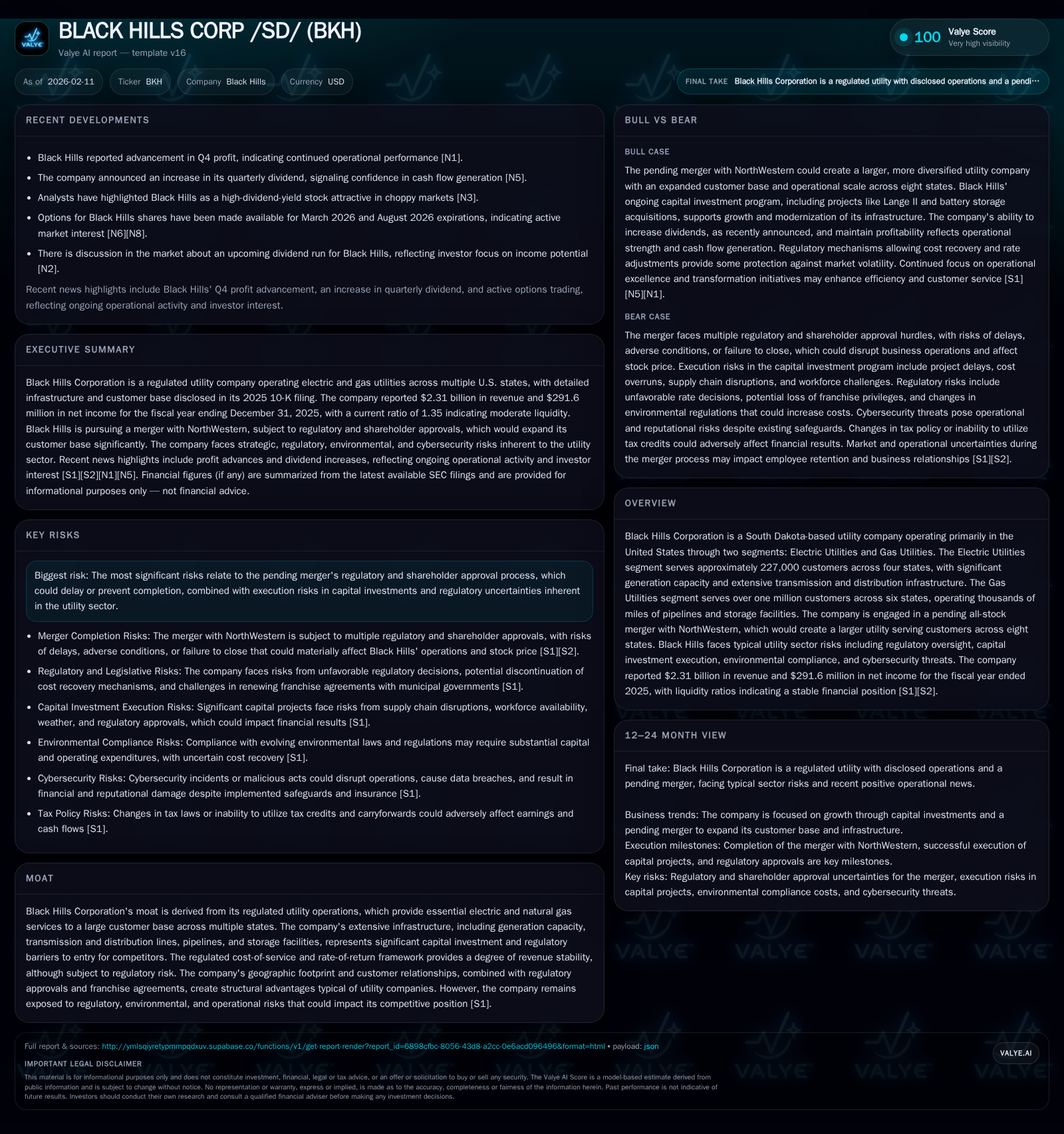
Black Hills Corporation reported steady revenue growth and net income improvements in fiscal 2025, highlighted by a recent dividend increase that underscores operational confidence. At the heart of its strategic agenda lies an all-stock merger with NorthWestern, intended to create a larger, multi-state utility powerhouse with broadened customer reach and operational scale. This transformation occurs against a backdrop of complex regulatory approvals and capital-intensive infrastructure investments, as Black Hills manages transition risks including environmental compliance and cybersecurity threats. The company’s regulated business model continues to provide a moat bolstered by extensive assets and rate recovery mechanisms, though significant uncertainties remain around merger execution and evolving market conditions.
Navigating Consistent Utility Strength: Earnings & Dividend Momentum
Black Hills Corporation closed its fiscal year ending December 31, 2025, with revenues totaling approximately $2.31 billion and net income improving to $291.6 million [F1]. This incremental financial growth marks a continuation of operational efficiency within their core regulated businesses—a trend buoyed by disciplined cost management and steady demand across their service territories. Crucially, management’s decision to increase quarterly dividends early in 2026 underscores confidence in their cash flow generation capacity [N5], writing a narrative of shareholder-friendly returns grounded in predictable utility fundamentals.
The dividend uptick follows positive commentary from analysts highlighting Black Hills among high-dividend-yield utilities that remain attractive despite general market volatility [N3]. This dividend momentum dovetails with the company’s sustained earnings trajectory reported in the fourth quarter results [N1], positioning Black Hills as a stable operator even as it contemplates strategic transformation.
The Scope and Scale of Black Hills’ Utility Footprint
Black Hills operates through two main segments: Electric Utilities and Gas Utilities [S1]. Its Electric Utilities serve roughly 227,000 customers situated in Colorado, Montana, South Dakota, and Wyoming. These operations encompass a substantial generation capacity of 1,386 MW alongside ownership of nearly 9,500 miles of transmission and distribution lines.
Meanwhile, the Gas Utilities segment commands an expansive network spanning six states—Arkansas, Colorado, Iowa, Kansas, Nebraska, and Wyoming—with more than one million gas utility customers. This segment’s physical asset base includes over 4,500 miles of intrastate pipelines coupled with an extensive system of distribution mains totaling approximately 44,840 miles plus compression facilities and natural gas storage sites [S1].
This dual-segment presence not only supports diversified revenue streams but also establishes a deep capital-intensive moat typical of regulated utilities: extensive infrastructure coupled with regulated return frameworks create formidable barriers for entrants. Regulatory commissions across multiple states oversee Black Hills’ service territories ensuring cost recovery subject to prudence reviews—a key stabilizer against abrupt earnings variability [S1].
Unpacking the Strategic Allure and Complexities of the NorthWestern Merger
Announced in August 2025, the pending all-stock merger between Black Hills and NorthWestern represents a pivotal expansion effort aimed at scaling operations across eight states [S1,S2]. Post-combination, the enlarged entity expects to serve approximately 0.7 million electric customers alongside roughly 1.5 million gas customers—substantially broadening the footprint from Black Hills’ current ~1.4 million gas plus electric customer count.
Strategically, this transaction aspires to deliver enhanced operational synergies through scale efficiencies and increased geographic diversification across electric and gas markets—a critical advantage given varying state regulatory environments. Yet the deal structure—being all stock—injects complexity regarding valuation alignment, dilution considerations for existing shareholders, and sensitivity to market fluctuations during the pending approval period [S2].
While integration promises long-term benefits linked to optimized capital deployment and consolidated regulatory engagement, inherent uncertainties remain palpable given the intricacies surrounding closing conditions.
Regulatory Landscape: Risks and Approvals that Could Make or Break the Deal
The merger’s completion hinges on navigating a labyrinthine regulatory approval process involving multiple federal and state entities [S2]. Key prerequisites include clearance under the Hart-Scott-Rodino Antitrust Act (HSR), Federal Energy Regulatory Commission (FERC) consent, approvals from state public service commissions (e.g., South Dakota Public Utilities Commission (SDPUC), Montana Public Service Commission (MPSC), Nebraska Public Service Commission (NPSC)), plus Federal Communications Commission (FCC) consent for certain aspects.
Each regulator scrutinizes potential impacts on competition, ratepayer protections, service reliability, environmental compliance commitments, among others—any adverse or delayed ruling could stall or derail the transaction [S2]. Moreover, there is risk from municipal governments potentially contesting franchise renewals or exercising condemnation powers over facilities located within their jurisdictions—a longstanding latent threat for utilities that could complicate post-merger integration [S1].
Legal challenges or political opposition could surface throughout regulatory reviews or during shareholder voting seasons further compounding uncertainty around timeline finalization or deal terms adjustments.
Capital Commitment: Financing Growth While Managing Operational Challenges
Central to Black Hills’ strategic priorities is its aggressive capital investment program scheduled over the next five years aiming to sustain growth while transitioning toward cleaner energy sources [S1]. Noteworthy among projects is the Lange II initiative complemented by acquisition plans for battery storage facilities aligned with Colorado’s Clean Energy Plan goals.
These investments target upgrading aging infrastructure, fulfilling evolving safety standards, expanding capacity to meet rising demand amid tightening reserve margins, and complying with mounting environmental regulations [S1]. However, execution risks loom large as factors such as commodity price inflation, supply chain disruptions impacting availability/cost of construction materials, labor shortages including specialized contractors exert pressure on project timelines and budgets.
Effective capital allocation will directly influence future rate cases since utilities rely on regulatory endorsement of cost recovery via rate base additions; delays or overruns could compress margins if regulators discount costs deemed imprudent or excessive.
Environmental and Operational Vulnerabilities in a Transitioning Energy Sector
Black Hills identifies transformation as one of four strategic pillars reflecting its ambition to evolve into a "simple and connected company" while advancing renewable resource use [S1]. Nonetheless, navigating increasingly stringent environmental standards exposes it to risks related to emissions controls compliance alongside potential penalties for breaching mandates.
Moreover, cybersecurity threats targeting utility infrastructure represent an intensifying concern articulated in filings. As utilities become more digitally interconnected through sensors and automation systems for grid management or pipeline monitoring; safeguarding data integrity becomes paramount—failures here could lead to operational disruptions or reputational damage.
Utility sector-wide technology shifts impose further adaptation demands ranging from integrating distributed energy resources (DERs) to managing customer expectations around sustainability initiatives—all within politically dynamic frameworks that sometimes yield conflicting policy signals.
Financial Metrics Reflecting Stability Amidst Transformation
Financial resilience remains well-grounded as shown by Black Hills’ liquidity snapshot at fiscal year-end: cash and cash equivalents stood near $183 million supplementing current assets approximating $996 million versus current liabilities near $740 million—yielding a comfortable current ratio around 1.35 [F1].
This strong short-term liquidity position enables continued operational funding including capital expenditure commitments without immediate financing strain—critical given pending merger-related uncertainties that might affect access or pricing in capital markets.
Stable profit generation paired with prudent working capital controls strengthens Black Hills’ ability to withstand episodic economic or regulatory shocks while positioning it favorably for strategic investments post-merger close.
Investor Sentiment and Market Positioning Around Upcoming Catalysts
Market participants have grown increasingly attentive to Black Hills as it balances dividend reliability against transformational corporate moves. Analysts featured it recently among preferred high-dividend-yield plays persisting even through choppy broader equity markets emphasizing defensive qualities inherent in utilities [N2,N3].
The initiation of March options trading has introduced new speculative vehicles allowing investors nuanced exposure strategies around expected merger outcomes or earnings releases [N6]. Such derivative liquidity signals elevated anticipation ahead of regulatory decision timelines slated for latter half of 2026.
While uncertainty remains about definitive merger success or timetable fluctuations driven by multi-jurisdictional reviews—the overarching narrative frames Black Hills as a fundamentally sound utility poised at an inflection point merging stable returns with prospective scale economies.
Disclaimer: This analysis is intended solely for informational purposes rooted in publicly available data sources up to February 2026. It does not constitute investment advice or recommendations regarding Black Hills Corporation securities.
Disclaimer: This is research-only, informational analysis and not investment advice. It may include AI-generated interpretation and general industry context. Always verify important details using primary sources.

Comments