
Voip-pal.com Inc: Navigating the Patent Enforcement Landscape in VoIP Innovation
Voip-pal.com Inc leverages a broad VoIP patent portfolio through litigation to sustain its niche presence amid financial and operational constraints.
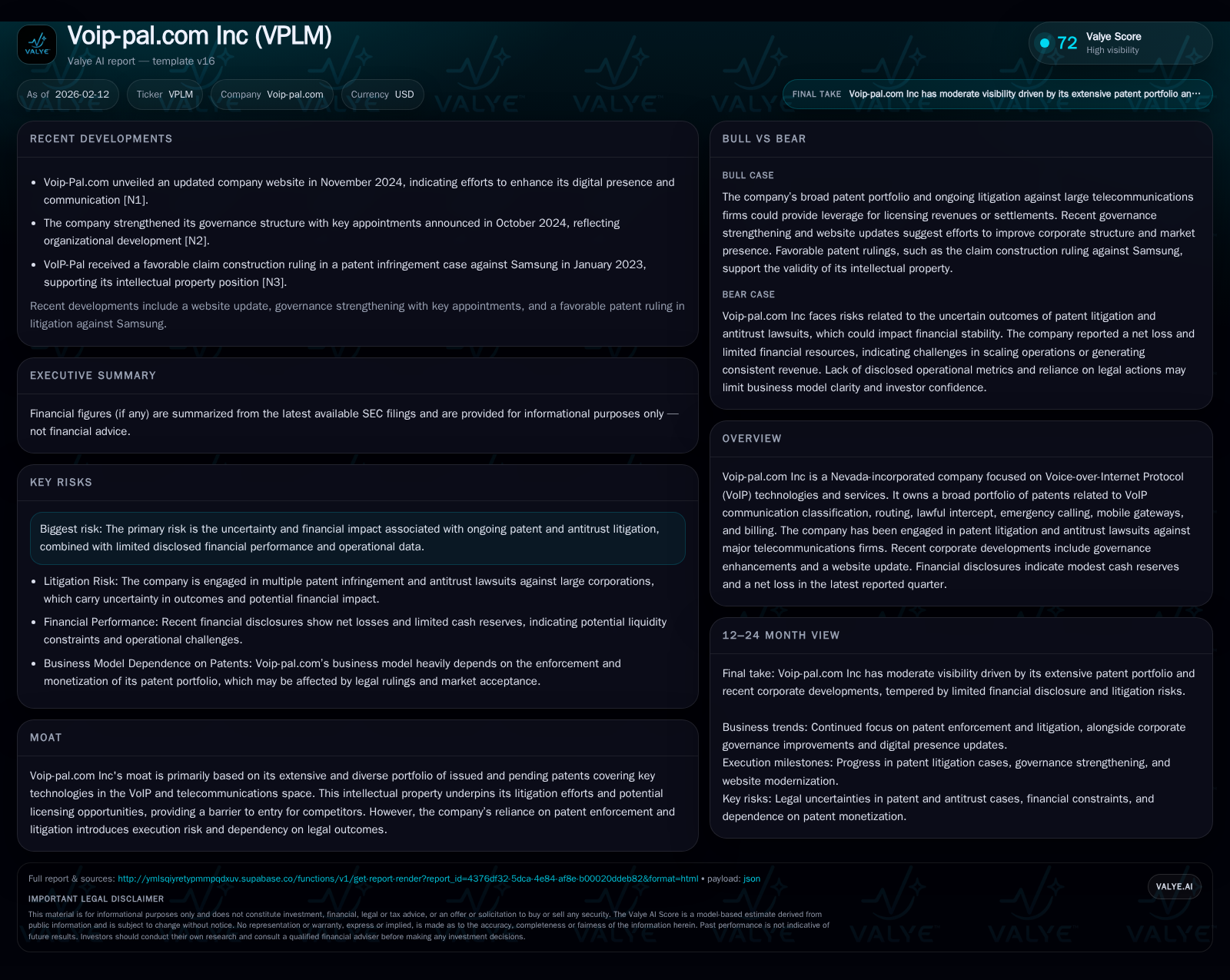
Voip-pal.com Inc, originally founded as a casting company in 1997 and pivoting into VoIP technology, holds a globally diverse portfolio of issued and pending patents spanning key areas such as classification, routing, lawful intercept, emergency calling, mobile gateways, and billing. Its primary strategy revolves around enforcing these patents via ongoing litigation against major telecommunications firms, seeking licensing revenue while battling antitrust claims reflective of industry tensions. Despite robust cybersecurity and recent governance updates, the company exhibits modest financial resources with net losses and limited cash reserves, underscoring execution risks tied to legal outcomes and operational transparency.
Historic Roots and Evolution into VoIP Innovation
Voip-pal.com Inc traces its corporate lineage back to September 1997 when it was incorporated in Nevada under the name All American Casting International, Inc. The shift from casting towards internet telephony began earnestly in the early 2000s: the company rebranded as VOIP MDU.com in 2004 and then to its current identity by 2006. Early ambitions included operating as a VoIP reseller and developing proprietary transactional billing platforms targeted at niche markets such as frequent flyer programs. This initial phase involved an exploratory approach to leveraging internet communication innovations.
A pivotal moment arrived with the acquisition of Digifonica International Limited (DIL) in 2013. Founded in 2003 by seasoned engineers with deep expertise in Linux and Internet telephony protocols, Digifonica developed a suite of software applications addressing core connectivity challenges over IP networks. It also constructed production nodes across Vancouver, London, and Denmark to rigorously test these solutions under real-world conditions. Crucially, Digifonica pursued patent protection on these inventions through the USPTO.
These patents became the cornerstone of Voip-pal's intellectual property arsenal—a global portfolio encompassing issued and pending patents centered on broadband VoIP technologies. Henceforth, Voip-pal recalibrated its strategy firmly around this IP base rather than direct telecom services. This transition reflects a broader industry pattern where entities morph from service providers into patent aggregators or enforcers to capture value from underlying technological innovation[S1].
Anatomy of VoIP Patent Holdings: Strengths and Scope
Voip-pal’s intellectual property portfolio represents its strategic backbone. The patents cover multiple interrelated technology domains critical to next-generation telecommunications:
Classification and Routing of Communications: Patents with U.S. issuance covering mechanisms for efficiently classifying communications crossing heterogeneous network architectures and geographically distributed nodes.
Lawful Intercept: Technologies enabling authorized monitoring of communications consistent with regulatory requirements without disrupting service continuity.
Enhanced Emergency Calling Support: Innovations related specifically to E911 systems ensuring that emergency calls are accurately routed with location data intact.
Mobile Gateways: Systems facilitating seamless transitioning between different network access points or modalities for mobile endpoints.
Uninterrupted Transmission During Endpoint Changes: Methods ensuring no packet loss or call drops occur when user devices switch network endpoints dynamically.
Metering and Billing: Capabilities including support for “white label” telecom services resale models that track usage metering down to granular levels[S1].
This comprehensive technological footprint creates substantial potential barriers for new entrants or existing players wishing to circumvent patented methods without licensing agreements. Given that these capabilities underpin fundamental aspects of VoIP communications — from routing algorithms to compliance features — the patent portfolio offers competitive leverage not easily replicated without infringement risk.
Litigation Frontlines: Patent Enforcement and Antitrust Actions
Voip-pal has actively deployed its patents through litigation against a swath of Fortune 500 telecommunications companies. These patent infringement lawsuits are centralized in Waco, Texas—a known venue favored by patent holders—where it alleges unauthorized use of patented technologies integral to internet-based communications networks.
Beyond pure infringement claims, Voip-pal has expanded legal action into antitrust domains via two lawsuits: one independent filing by Voip-pal itself and another within a class action framework where it acts as lead plaintiff. Both suits assert that several major telecom firms engage in conduct restricting fair competition in violation of antitrust statutes. The aggressive posture underscores a dual strategy — leveraging both intellectual property rights protection mechanisms and competition law enforcement—to seek redress and financial recovery[S1].
While such litigation can yield licensing settlements or damages awards that materially enhance revenue streams for patent holders, they carry pronounced downside risks including protracted legal costs, uncertain judicial outcomes, reputational impacts, and strain on management focus. For smaller entities like Voip-pal particularly reliant on successful enforcement gains to sustain operations revenue-wise, the stakes remain high.[S1]
Financial Health: Reading Between Sparse Disclosures
Available financial data reveal a picture typical of many specialized technology patent holding entities operating predominantly through enforcement rather than product sales or recurring services.[F1][S2] As of December 31, 2025, Voip-pal reported a net loss amounting to approximately $919K—a continuation of operating deficits amidst ongoing litigation expenses.
Cash availability stood at roughly $1.9 million as of mid-2023 with current assets reported near $1.87 million at fiscal year-end 2024. The capital structure suggests limited cushion relative to potentially significant legal defense costs and administrative overheads inherent in asserting intellectual property rights globally.
The company qualifies as a smaller reporting entity under SEC rules which affords relief from certain disclosure obligations but simultaneously limits external insight into operational metrics or segment performance.[S1][S2] Thus, stakeholders must navigate inherent opacity while assessing sustainability given negative earnings trends that highlight pressures on long-term viability absent successful monetization events.
Governance and Cybersecurity in a Small Reporting Entity
Despite its modest scale, Voip-pal articulates commitment to robust governance practices underscored by recent enhancements presumably intended to buttress organizational resilience triggered by intensified scrutiny accompanying litigation activity.[S1]
Cybersecurity stands out as an integrated element within overall enterprise risk management rather than an isolated discipline. The firm actively manages cybersecurity risks via comprehensive frameworks embedding security considerations at every decision-making layer.
Third-party provider oversight is stringent: all vendors undergo initial security assessments before engagement alongside continuous monitoring protocols including annual SOC report reviews complemented by supplementary controls.[S1] Such diligence aims to protect sensitive intellectual property data from breach or compromise—a critical defensive posture given the intangible asset base underpinning company valuation.
Notably, no material cybersecurity incidents affecting business strategy or financial condition were identified during or before fiscal year end September 2025,[S1] signaling effectiveness albeit within limited disclosure..
Risks Lurking Behind Legal Battles and Market Position
Legal dependency sharply frames risk exposure here—outcome uncertainty from pending infringement suits introduces substantial volatility impacting prospective cash flows. The dual reliance on both patent enforcement revenues plus resolving antitrust allegations adds complexity as adverse rulings on either front could impair financial stability or future licensing prospects.[S1][S2]
Moreover, scant operational transparency complicates external ability to appraise execution capacity or market traction beyond litigated claims.
Additional risks arise from potential shifts in telecommunications standards or regulatory regimes that might narrow enforceable patent scopes or heighten burdens on proof thresholds required in court, raising questions about durability of asserted monopoly positions[S1].
The Moat: Intellectual Property vs. Execution Challenges
Voip-pal’s moat rests squarely on its intellectual property portfolio’s breadth across multiple value chain segments within VoIP communications coupled with global reach targeting multiple jurisdictions.[valye_report_excerpt]
However, this moat is not impermeable — successful monetization is tightly coupled with victory in enforcement actions or negotiated licensing agreements which remain inherently uncertain owing to judicial discretion or opposing party countermeasures.
The litigation-centric business model necessitates sustained capital deployment into legal avenues detracting focus from potential complementary initiatives such as direct product development or expanding service footprints. Consequently, trade-offs persist between exploiting legal strength versus broadening operational foundations.
Strategic Outlook: Potential Catalysts and Threat Vectors
Recent governance updates alongside website refreshes indicate organizational attempts at signaling renewal or stabilization amid ongoing contentious proceedings.[valye_report_excerpt][S1][S2] Although no new public developments have surfaced relating directly to case progress since these filings, cautious monitoring remains prudent given lawsuit timelines often encompass months or years before resolution.
Financial runway constraints imply that material settlements or licensing deals constitute necessary catalysts for improved sustainability absent fresh capital raises or debt arrangements.[valye_report_excerpt]
On the macro front, accelerating reliance on IP protections within evolving telecom ecosystems sustains relevance for companies like Voip-pal possessing foundational patents; however, technological convergence towards unified communication platforms could compress claim scopes demanding adaptive legal strategies going forward.
This analysis is grounded solely on publicly available information including SEC filings dated December 2025 through February 2026 along with company facts snapshots current as of mid-2023. It does not offer investment advice but aims to provide clarity on operational posture, intellectual property positioning, financial conditions, governance measures, risk profiles, and future outlook pertinent to understanding Voip-pal.com Inc’s unique standing within the telecommunications patent landscape.
Disclaimer: This is research-only, informational analysis and not investment advice. It may include AI-generated interpretation and general industry context. Always verify important details using primary sources.

Comments