
Corning Inc.: A Materials Science Powerhouse Driving Optical and Specialty Innovation
With a 175-year legacy in glass and optical physics, Corning leverages deep expertise to serve diversified technology markets including optical communications and life sciences.
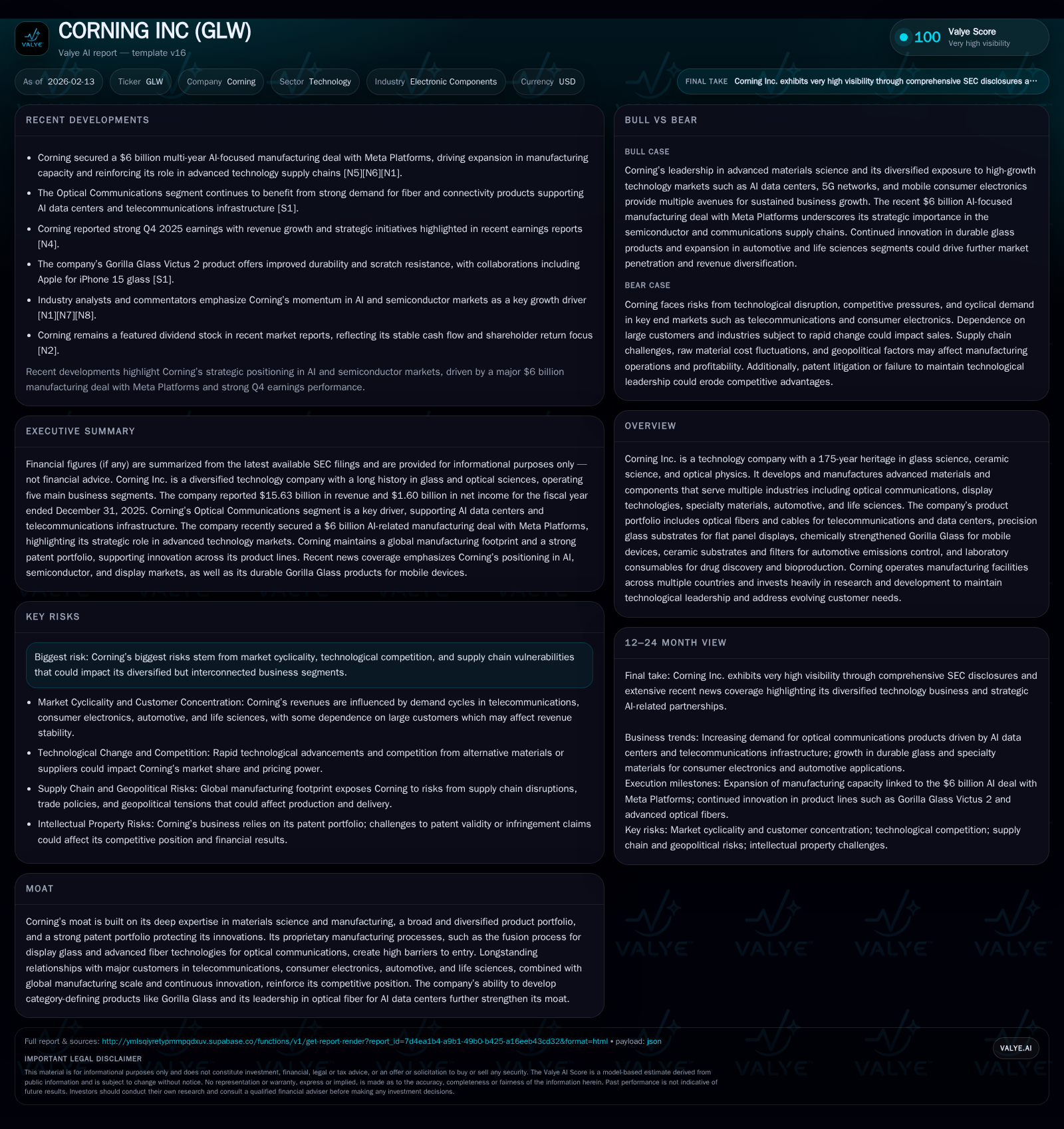
Corning Inc. (GLW) remains a global leader in advanced materials and components, built on unmatched expertise in glass science, ceramics, and optical physics. Its broad product mix spans critical tech sectors such as telecommunications networks, consumer electronics (notably Gorilla Glass), automotive technologies, and life sciences. The company’s competitive moat rests on proprietary manufacturing processes and a robust patent portfolio, buttressed by longstanding customer relationships. Despite facing cyclicality and supply chain risks, recent strategic wins—like the multi-year $6 billion AI-focused deal with Meta—illustrate Corning’s capacity to capitalize on secular growth trends in AI data centers and high-speed connectivity.
Company Overview
Corning Inc., established originally as a glass business in 1851 and incorporated in 1936 under its current corporate structure, stands as a storied technology company rooted deeply in materials science — principally glass and ceramics — complemented by optical physics expertise. Over its long history exceeding 175 years, Corning has transformed these foundational sciences into groundbreaking products that have reshaped numerous industries.
Business Segments & Products
Corning operates through five key reportable segments: Optical Communications, Display, Specialty Materials, Automotive, and Life Sciences. As of January 1, 2025, Macro segment changes merged Automotive Glass Solutions with Environmental Technologies to form a cohesive Automotive segment.
Optical Communications: This segment underscores Corning’s pioneering role since inventing the world’s first low-loss optical fiber in 1970. With continued advances in fiber, cable, and connectivity solutions such as Vascade® subsea fibers and LEAF® metropolitan network fibers, Corning serves telecommunications carriers globally amidst the ongoing migration from legacy copper networks to high-capacity optical infrastructure. The acceleration of artificial intelligence workloads boosts demand for optical products inside massive data centers where fiber interconnects are mission-critical.
Display: Supplies precision glass substrates for flat panel displays including advanced formulations tailored for next-generation screens.
Specialty Materials: Produces chemically strengthened Gorilla Glass—the durable cover glass ubiquitous in billions of smartphones and mobile devices worldwide—as well as other specialty glass components.
Automotive: Focuses on ceramic substrates and filters instrumental for emissions control systems supporting increasingly stringent environmental regulations.
Life Sciences: Provides laboratory consumables facilitating drug discovery and bio-production processes.
Competitive Moat
Corning’s moat is distinguished by several deeply entrenched advantages:
- Decades of proprietary manufacturing know-how including fusion processes unique to display glass production.
- Extensive patent portfolio defending innovations like Gorilla Glass strength technologies and cutting-edge optical fibers.
- Scale of manufacturing operations dispersed among 14 countries ensures geographic diversification and responsiveness to global demand fluctuations.
- Established customer relationships with telecom giants, consumer electronics manufacturers, automakers, and pharmaceutical firms foster repeat business powered by tailored product innovation.
- Ability to rapidly develop category-defining products aligned with high-growth sectors such as AI data centers further entrenches Corning’s leadership [S1].
Financial Snapshot
For fiscal year ending December 31, 2025, Corning reported revenues of approximately $15.6 billion alongside net income nearing $1.6 billion [F1]. The company maintains a stable balance sheet with cash and equivalents around $1.5 billion and a current ratio close to 1.59 indicating sound short-term liquidity [F1]. Continued strong profitability reflects robust end-market demand driven by communications infrastructure upgrades and burgeoning AI-related deployments.
Recent Developments & Strategic Initiatives
The most notable catalyst recently was Corning’s pivotal multi-year AI-centric agreement valued at $6 billion with Meta Platforms [N2][N9]. This deal centers on supplying advanced optical fiber solutions essential to scaling Meta’s hyperscale data centers tasked with expansive AI training workloads. The magnitude of this contract underscores Corning’s centrality within the AI infrastructure supply ecosystem and is driving capacity expansions at key manufacturing sites [N4][N10].
Q4 2025 earnings highlighted sustained revenue growth across multiple segments fueled by demand for display glass enhancements and resilient automotive components amid macroeconomic uncertainty [N1][N7][N8]. Nonetheless, analyst commentary also flags cyclical headwinds inherent to the semiconductor cycle which indirectly affect certain product lines [S1].
Investor interest continues to focus on Corning's ability to leverage its materials science prowess toward future growth vectors including next generation display substrates for emerging device formats as well as expanded penetration into electric vehicle emissions control technologies [S1][N11].
Industry Context & Opportunities
As global telecom operators accelerate rollouts of high-bandwidth networks leveraging optical fiber—and data center operators expand interconnect capacity spurred by AI computation—Corning's Optical Communications segment is positioned at the heart of surging capital expenditures. Concurrently, consumer preferences for ruggedized touchscreens continue propelling Gorilla Glass applications across smartphones and other portable devices.
In automotive markets transitioning to electrified powertrains while confronted with stringent emission norms worldwide, ceramic substrate filtration components gain traction due to their vital function in exhaust after-treatment systems. And life sciences applications materially benefit from miniaturized lab ware sophisticated enough to meet bioprocessing innovation demands.
Risks & Challenges
Per regulatory filings [S1], Corning faces several substantive risks:
- Inflationary cost pressures on raw materials (precious metals, industrial gases), utilities (energy/water), labor wages or logistics can erode margins if not offset by pricing adjustments that risk dampening demand.
- Supply chain fragility—such as prolonged semiconductor component shortages or transport disruptions—could disrupt timely deliveries or inflate inventory levels.
- Demand cyclicality tied especially to end markets like mobile devices or communications capex budgets may induce revenue volatility.
- Competitive technological advancements from alternative material developers or process innovators could undermine parts of Corning's market share absent continuous R&D investments.
- Geopolitical or regulatory environments affecting import/export controls introduce complexity given Corning's global manufacturing footprint.
Conclusion
Corning's unique synthesis of heritage materials science combined with contemporary applied innovation secures its place at the nexus of multiple high-growth technology domains—from the backbone of global communications infrastructure enabling AI-driven data centers to durable cover glasses redefining mobile device experience. Its strategic partnerships—including the landmark Meta collaboration—and comprehensive segment coverage underscore an adaptable business model well-suited for evolving market dynamics. However, persistent vigilance over cost inputs, supply chain integrity, competitive dynamics, and cyclicality remains imperative to sustain long-term performance amidst rapid technological change.
Disclaimer: This analysis is intended solely for informational purposes reflecting company disclosures as of early 2026; no investment recommendations are provided herein.
Disclaimer: This is research-only, informational analysis and not investment advice. It may include AI-generated interpretation and general industry context. Always verify important details using primary sources.

Comments