Deep Dive on Geospace Technologies: Diversification Amid Energy Volatility and Innovation
Geospace Technologies Corp balances cyclical energy exposure with growth in smart water and industrial IoT markets.
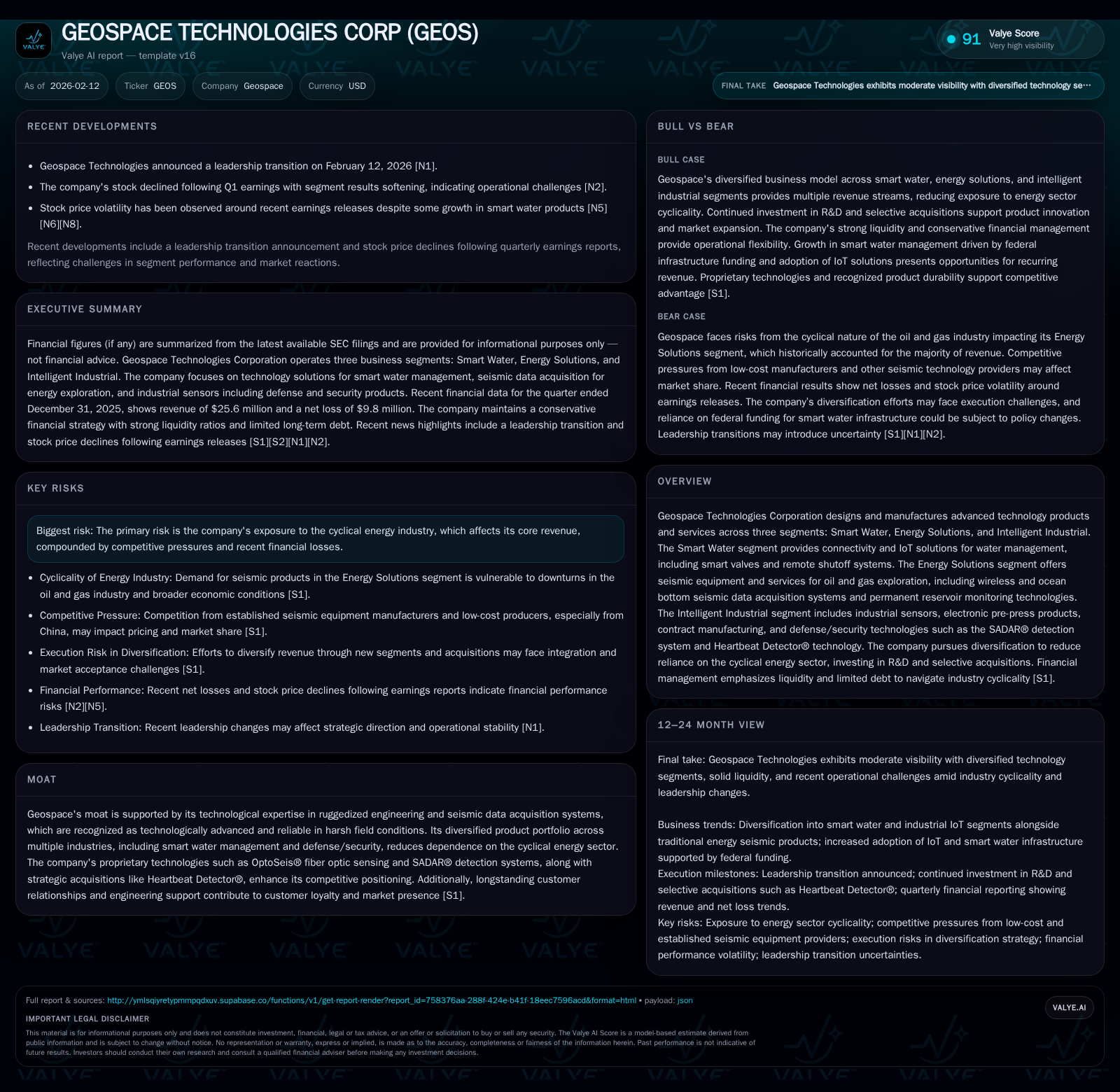
Geospace Technologies Corporation is an advanced technology company operating three main business segments: Smart Water, Energy Solutions, and Intelligent Industrial. While historically reliant on oil and gas seismic equipment—a cyclical and volatile market—the company has strategically diversified into smart water management and defense/security technologies to stabilize revenue streams. Its technological moat stems from ruggedized engineering capabilities and proprietary sensing systems like OptoSeis® fiber optics and SADAR® detection. Despite recent financial pressures including a Q1 earnings miss and net losses, Geospace continues investing in R&D and acquisitions to bolster its competitive positioning.
Company Overview and Market Positioning
Geospace Technologies Corporation designs and manufactures ruggedized technology solutions that serve diverse markets including smart water management, energy exploration, industrial IoT, and defense/security. The company is organized into three segments:
- Smart Water: Provides IoT-enabled connectivity solutions such as smart valves, remote shutoff systems, and Hydroconn® connector cables critical for water utility modernization.
- Energy Solutions: Develops seismic equipment and services used in hydrocarbon reservoir location and monitoring; includes innovative wireless seismic data acquisition systems and fiber optic sensing technologies.
- Intelligent Industrial: Supplies industrial sensors, electronic pre-press products, contract manufacturing services, and detection/security systems like SADAR®.
This segmentation reflects a deliberate diversification strategy designed to mitigate the inherent cyclicality in energy-related products through expanding into sectors driven by infrastructure modernization and industrial automation [S1].
Segment Analysis
Smart Water Segment
The Smart Water segment has become increasingly prominent, approaching nearly half of total revenue in recent years. Geospace’s growth here is bolstered by the widespread push from U.S. municipalities to modernize aging water infrastructure, backed by significant federal funding—such as the Water Infrastructure Finance Act's $7.5 billion allocation.
Products like Hydroconn® cables enable Advanced Metering Infrastructure (AMI), facilitating automated meter reading (AMR) that drives operational efficiencies for utilities. The segment's focus on durable, field-ready connectivity solutions leverages Geospace’s core engineering strengths honed in harsh environments [S1].
Energy Solutions Segment
This segment remains anchored in seismic data acquisition equipment primarily serving oil & gas exploration companies. Demand here correlates closely with upstream capital expenditures dictated by prevailing crude oil prices. Consequently, downturns in global energy markets manifest directly in diminished seismic project activity.
The company’s proprietary sensors—including OptoSeis® fiber optic systems—are positioned at the technological frontier of permanent reservoir monitoring. However, external factors such as geopolitical unrest (notably the Russia-Ukraine conflict) have complicated operations; notably, Geospace divested its Russian manufacturing subsidiary in August 2024 while maintaining supplier relationships.[S1]
Despite innovation advantages, the segment struggles amid ongoing commodity price volatility impacting overall financial returns.
Intelligent Industrial Segment
Encompassing applications from industrial sensor technologies to contract manufacturing and defense-related detection systems like SADAR®, this segment illustrates Geospace’s push beyond traditional energy markets. The inclusion of security-focused technologies provides a gateway to government-funded contracts less correlated with macroeconomic cycles.
Heartbeat Detector® technology acquired via recent strategic acquisitions complements these efforts by enhancing the company's portfolio in high-reliability detection solutions [S1].
Financial Performance Snapshot
For the quarter ended December 31, 2025, Geospace reported revenues of approximately $25.6 million but suffered a net loss of about $9.8 million [F1][S2]. The Q1 2026 earnings release noted softening results across all segments precipitating a notable stock price decline [N1].
The company's liquidity profile remains solid with roughly $10.6 million cash on hand and a current ratio above 3x reflecting prudent working capital management amidst operational challenges [F1]. However, sustained net losses highlight the urgency of balancing investment in new market verticals against legacy sector headwinds.
Competitive Moat and Innovation Edge
Geospace’s distinct competitive advantages revolve around its mastery of ruggedized engineering required for reliable operation in extreme environments—be it subterranean seismic fields or remote water infrastructure sites. Proprietary technologies such as OptoSeis® enable real-time fiber optic sensing that vastly improves reservoir monitoring precision compared to traditional geophones.
Similarly, defense-oriented SADAR® systems provide dynamic detection solutions enhancing perimeter security capabilities often leveraged by governmental agencies.
Longstanding customer relationships buttress these technological assets by fostering loyalty anchored in superior engineering support—a critical factor for mission-critical applications where failures carry significant operational risk [S1].
Strategic Challenges and Risks
The most salient risk facing Geospace remains its residual dependence on the volatile energy sector’s capital spending patterns. Declining oil & gas prices can swiftly shrink seismic exploration budgets, hurting product demand and margins.
Moreover, the geopolitical landscape introduces supply chain uncertainties—exemplified by regulatory complications surrounding Russian operations which were partially mitigated through divestiture but still pose logistical challenges if sourcing restrictions tighten further [S1].
Competitive pressures across all segments necessitate continuous innovation investment; yet recent reported losses may constrain free cash flow availability for R&D or acquisitions needed to maintain pace [N1][S2].
Recent Developments
In early February 2026, Geospace announced leadership transitions aimed at sharpening strategic focus during this critical inflection period [N2]. This move likely reflects management’s recognition of shifting market dynamics requiring agile response.
Analyst commentary earlier this year underscored mixed prospects amidst macroeconomic uncertainties but acknowledged the promise embedded in non-energy businesses underpinned by robust technology pipelines [N3][N4].
Industry Contextualization (Analysis)
The convergence of infrastructure modernization policies globally creates substantial growth potential for IoT-enabled utility management products—a segment where Geospace has established early leadership.
Conversely, broader seismic markets are challenged by decarbonization trends pressuring fossil fuel demand long-term; thus companies relying purely on conventional energy exploration technologies face structural headwinds.
Security technologies within Intelligent Industrial benefit from persistent global concerns over border protection and surveillance requirements—a growth niche less sensitive to commodity cycles yet highly competitive and subject to regulatory complexities.
Outlook Considerations (Analysis)
Going forward, Geospace’s ability to recover profitability hinges on accelerating Smart Water adoption momentum while expanding Intelligent Industrial opportunities sufficiently to offset Energy Solutions volatility. Strategic investments in R&D concurrent with selective acquisitions—such as those enhancing detection capabilities—can diversify revenue streams further.
Maintaining operational discipline amid external uncertainties (including commodity price swings and geopolitical risks) will be equally vital to sustaining liquidity sufficient for innovation cycles.
In summation, Geospace presents a nuanced case study of an engineering-driven firm striving to balance legacy exposure with emerging technologies amid a complex macro environment.
Disclaimer: This report is for informational purposes only and does not constitute investment advice or recommendations. It reflects analysis based solely on publicly available information as of February 12, 2026.
Disclaimer: This is research-only, informational analysis and not investment advice. It may include AI-generated interpretation and general industry context. Always verify important details using primary sources.

Comments