Arteris, Inc.: Navigating Complexity in Semiconductor System IP with NoC Innovation
A deep dive into Arteris’ strategic positioning, technological leadership, and the competitive semiconductor IP landscape.
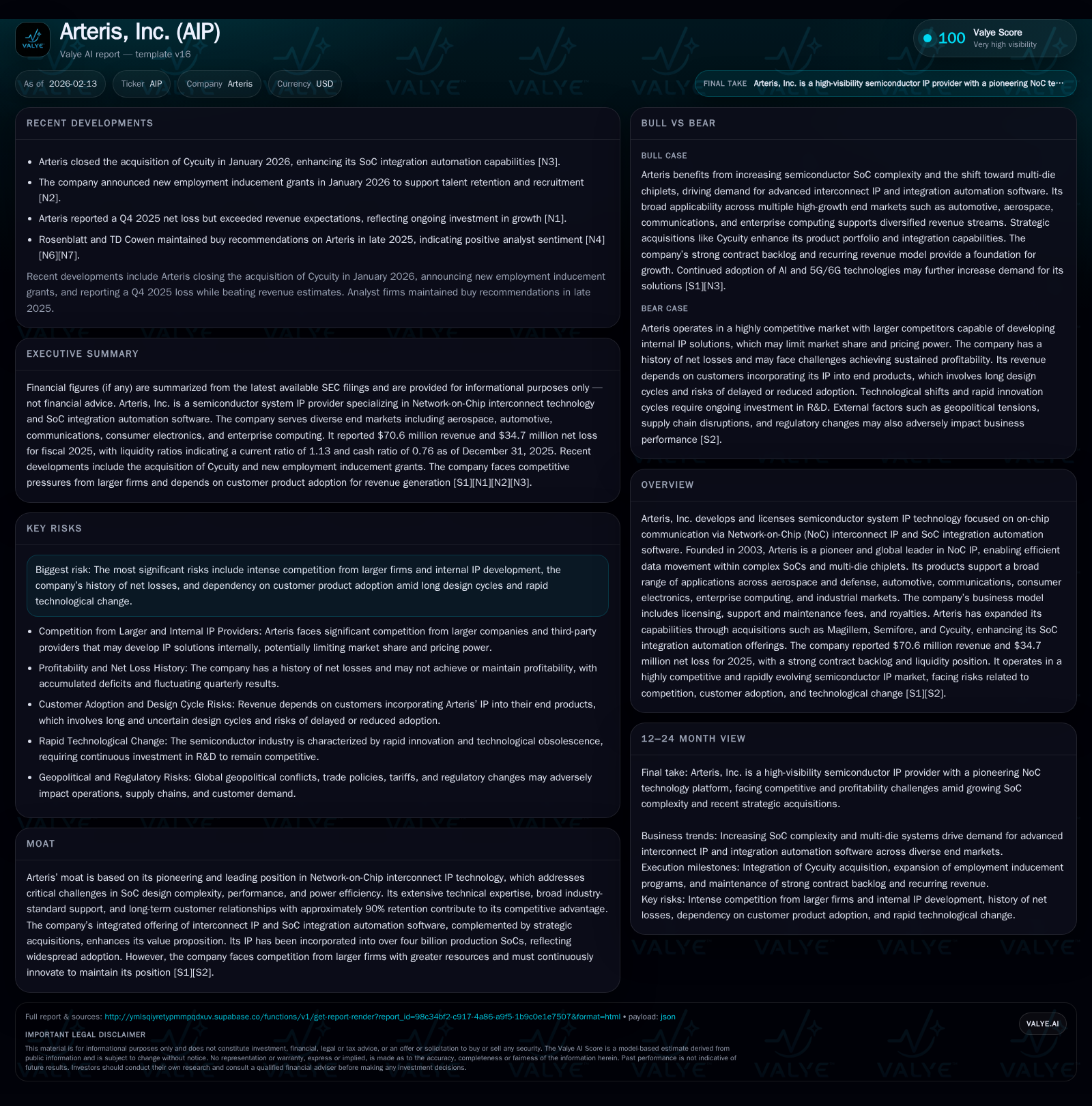
Arteris, Inc. stands as a pioneer and global leader in Network-on-Chip (NoC) interconnect IP technology, serving a broad spectrum of industries including aerospace, automotive, and computing. The company’s integrated approach—combining interconnect IP with SoC integration automation software—has been bolstered by strategic acquisitions such as Cycuity in 2026. Despite achieving $70.6 million in revenues for 2025, Arteris continues to face challenges from larger competitors and a history of net losses. Maintaining innovation pace while managing competitive dynamics remains critical for sustaining its strong market presence.
Company Overview
Arteris, Inc., founded in 2003, is recognized as a trailblazer in Network-on-Chip (NoC) interconnect intellectual property (IP) technology that enables efficient data movement inside today’s highly complex System-on-Chip (SoC) semiconductors as well as multi-die chiplet assemblies [S1]. The company's offerings address fundamental challenges in SoC design: improving performance while managing power consumption, handling increased transistor density, navigating routing congestion, and reducing overall chip cost.
Its core value proposition lies in providing semiconductor designers with scalable NoC IP solutions integrated with SoC integration automation software that streamlines the configuration and deployment of these interconnects within customer-specific system designs. Arteris licenses this technology under a combined model of upfront licensing fees, recurring maintenance/support contracts, and volume-based royalties.
Industry Context and Technological Landscape
The semiconductor IP space is intensely competitive and fast-evolving. Traditional on-chip communication architectures based on buses or crossbars struggle to meet the demands of modern heterogeneous SoCs which incorporate dozens or even hundreds of functional blocks including CPUs, GPUs, memory controllers, AI accelerators, and others [S1]. NoCs offer a modular approach enabling scalable data transport within chips as well as across disaggregated chiplets connected via advanced interconnect standards.
Arteris’ early investment in NoC technology positioned it favorably as demand for sophisticated communication fabric grew with trends such as AI workloads acceleration, automotive electrification requiring advanced sensors and controllers, aerospace systems integration, and high-performance computing deployments.
However, the company competes against formidable players like Arm and Cadence whose extensive financial reserves facilitate aggressive R&D programs alongside comprehensive product suites bundling multiple IP blocks together [S1]. Additionally, some customers develop their own proprietary interconnect solutions internally or turn to government-sponsored alternatives.
Strategic Growth Through Acquisitions
To strengthen its footprint beyond standalone NoCs, Arteris pursued targeted acquisitions aimed at improving SoC integration automation workflows:
- Magillem (2020): Expanded capabilities in design data management enhancing hardware-software co-design.
- Semifore (2022): Added advanced configuration management tools simplifying customer integration complexity.
- Cycuity (2026): Most recent acquisition contributing specialized verification IP enabling silicon-proven interfaces aligned with emerging standards like Universal Chiplet Interconnect Express (UCIe) [N3].
These moves demonstrate Arteris’ strategy to provide end-to-end solutions addressing both hardware interconnects themselves and the accompanying software tooling that accelerates customer time-to-market.
Financial Performance Overview
For fiscal year 2025 ended December 31st, Arteris reported revenues totaling $70.6 million but recorded a net loss of approximately $34.7 million [F1][S1]. The current ratio stood close to 1.13 with cash & equivalents around $33.9 million indicating reasonable short-term liquidity but continued pressure to manage expenses prudently.
Quarterly reports reveal consistent revenue generation stemming from licensing deals complemented by maintenance fees yet weighed down by substantial operating costs related primarily to R&D investments necessary for sustained innovation [N1][N2]. While losses persist historically reflecting growth phase dynamics inherent to emerging technology companies in semiconductor IP sectors [S2], the sizable contract backlog signals ongoing commercial momentum.
Competitive Moat & Customer Dynamics
Arteris commands a meaningful moat anchored in proprietary NoC architecture designs supported by decades of specialized expertise and broad compatibility with industry-standard instruction sets such as Arm’s cores, RISC-V processors, x86 platforms along with embedded memory controllers from partners like CEVA and Synopsys ARC [S1].
Of particular note:
- Its IP has been adopted in over four billion production chips illustrating widespread trust and versatility.
- Customer retention approximates 90%, underscoring long-term relationships fostered through technical support excellence.
- The combination of IP plus accompanying design automation tools differentiates Arteris from entities offering only raw IP blocks or basic configuration utilities.
Nonetheless, the threatening presence of incumbents capable of bundling integrated packages at volume discounts remains an ongoing challenge [S1]. To remain competitive amid industry consolidations where rivals unite component offerings for turnkey solutions will require Arteris to either expand its ecosystem partnerships further or advance unique product capabilities not easily replicable.
Risks and Challenges Ahead
Key risks detailed by management include:
- Intense competition from companies with superior resources who can internalize IP development or undercut pricing structures.
- The historically unprofitable trajectory necessitating sustained capital deployment without guaranteed returns.
- Dependence on successful integration into customers’ end products spanning automotive electronics to enterprise computing hardware where lengthy design cycles can delay revenue realization.
- Constant vulnerability to shifts in semiconductor design paradigms demanding rapid adaptation lest product offerings become obsolete [S1][S2].
Additionally, global regulatory uncertainties around export controls or geopolitical tensions affecting semiconductor supply chains present external variables outside direct control impacting expansion strategies particularly given Arteris’ international operations footprint.
Outlook & Strategic Imperatives
Looking ahead into 2026 and beyond:
- The recent acquisition of Cycuity adds crucial verification IP assets supportive of advanced chiplet-based designs referencing open industry standards such as UCIe—an area gaining traction amid growing disaggregation trends in high-end SoCs [N3].
- Pursuit of employment inducement grants signals sustained investment in talent acquisition crucial for innovation velocity [N4].
- Continuation of robust support services combined with evolving product features tailored for emerging applications across aerospace-defense systems to consumer electronics remains vital to defend market share.
Arteris sits at an inflection point where nurturing its historical leadership while scaling integrated SoC automation software alongside evolving interconnect architectures could define longer-term sustainability. Successfully capitalizing on megatrends like chiplet modularization requires not only technological sophistication but strategic agility accommodating fluctuating design priorities among ecosystem partners.
Conclusion
Arteris has carved out a distinctive niche dominated by highly specialized NoC system IP leveraged through expanding software automation capabilities reinforced by several targeted acquisitions. Despite facing persistent competitive headwinds from industry giants armed with deep pockets and bundled solutions prowess, it maintains compelling differentiation via proven interoperability span across diverse architectures paired with a reputation for close customer collaboration.
Financially challenged yet resilient thanks to steady revenue traction and contract backlog visibility entering 2026; the company’s path forward hinges on balancing continuous innovation against cost discipline while exploiting increasing demands for scalable chip communication fabrics amidst growing SoC complexity. Investors should weigh Arteris’ pioneering technology foundation against risks inherent within fiercely contested semiconductor IP markets characterized by rapid evolution and consolidation movements.
This analysis is intended solely for informational purposes reflecting publicly available data as of early 2026. It does not constitute investment advice or recommendations regarding any securities mentioned herein. Readers should conduct their own due diligence before making any related decisions.
Disclaimer: This is research-only, informational analysis and not investment advice. It may include AI-generated interpretation and general industry context. Always verify important details using primary sources.

Comments