
Bridgeline Digital’s AI-Driven Martech Platform Navigates Financial Headwinds
Exploring how Bridgeline’s customizable AI marketing suite positions it uniquely amid fiscal challenges and fierce industry competition.
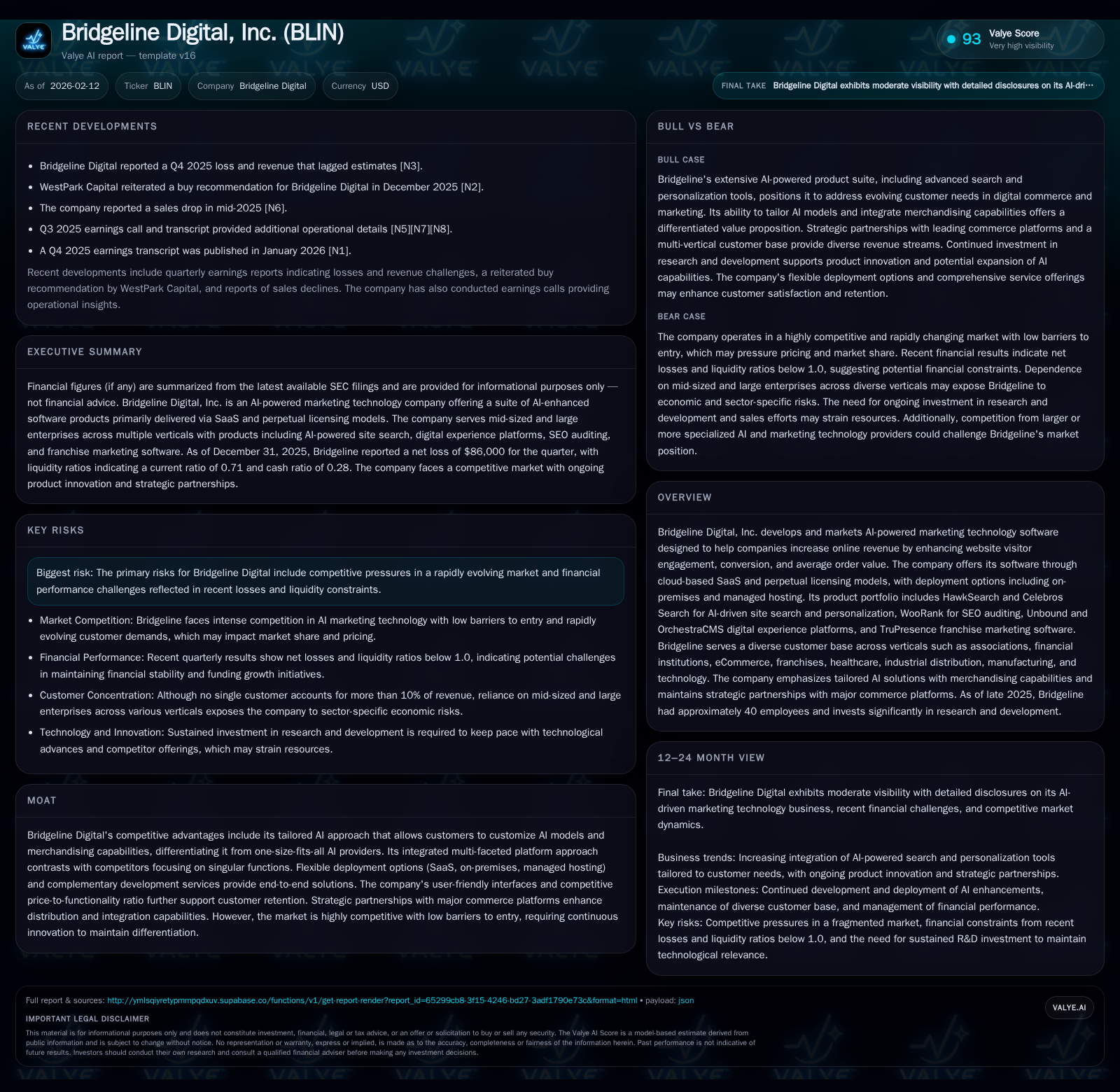
Bridgeline Digital, Inc. distinguishes itself in the marketing technology space through a tailored, modular AI approach embedded across a diverse product portfolio serving multiple industries. While its HawkSearch AI suite and flexible deployment options constitute competitive strengths, the company faces persistent financial losses, liquidity pressures, and risks stemming from customer concentration and license renewal variability. Its multi-faceted platform contrasts with narrower competitors but demands continuous innovation and operational discipline to stabilize revenue streams and sustain growth. Bridgeline’s future hinges on balancing the promise of advanced AI capabilities with prudent financial management in a rapidly evolving martech landscape.
Bridgeline’s AI Suite: Customization as a Competitive Edge
In today’s digital commerce environment where online shoppers expect personalized, intuitive experiences, Bridgeline Digital seeks to bridge that gap using advanced AI technology tailored to distinct client needs rather than one-size-fits-all solutions. At the heart of its offering is the HawkSearch platform—a leading software product ranked #1 in Gartner’s 2025 Critical Capabilities Report specifically for the B2B search use case [S1]. Bridgeline's approach leverages a multifaceted AI toolkit that includes Smart Search powered by Large Language Models (LLMs) coupled with Retrieval Augmented Generation (RAG), along with Concept Search enabling goal-oriented queries in any language.
This modular architecture extends into Smart Response features such as Generative AI-powered Smart Answer and Smart Summary tools that distill complex product data into shopper-friendly formats. Moreover, Smart Facets dynamically categorize products based on real-time queries, while Agentic AI components like Merchandising Assistants enable retailers to collaboratively optimize offerings and boost conversion rates [S1]. This high level of customization—not merely at the front-end shopper interface but also on backend merchandising algorithms—distinguishes Bridgeline from competitors reliant on fixed AI models.
What emerges is an ecosystem where clients can select preferred foundational AI models for different segments of their eCommerce sites. The capacity for fine-tuning and switching between different AI engines reflects a strategic investment in flexibility rather than monolithic design. As noted during the recent earnings call, this tailored model reduces operational overhead for customers by automating tasks through intelligent agents while driving online revenue growth [N1]. This depth of customization addresses a broad spectrum of business requirements—from large manufacturers to niche service providers—underscoring Bridgeline’s commitment to adapting AI precisely to client goals.
A Diverse Product Ecosystem Serving Multiple Verticals
Bridgeline does not rest on HawkSearch alone; it offers a comprehensive portfolio that caters across verticals such as healthcare, manufacturing, financial institutions, associations, industrial distributors, franchises, and ecommerce platforms [S1]. Products like Celebros Search complement HawkSearch to expand site search personalization capabilities, while WooRank serves as an SEO auditing tool enhancing organic traffic strategies.
Digital experience platforms Unbound and OrchestraCMS provide broader content management solutions that integrate seamlessly with core AI functionalities. Further diversifying its reach is TruPresence franchise marketing software designed to meet specific needs of franchise operators aiming to unify brand messaging while empowering local units [S1].
Such an extensive product ecosystem deployed via multiple models—including cloud-based SaaS subscriptions, perpetual licenses for onsite installation, or Bridgeline-managed hosting—materially increases adoption flexibility. Clients constrained by regulatory or IT policies can opt for on-premises versions without sacrificing advanced features. This multiplicity bolsters Bridgeline's ability to serve disparate customer profiles effectively.
However, managing this diverse suite requires continuous coordination of development resources across distinct technologies — a complex endeavor given current fiscal pressures.
Financial Health Check: Navigating Losses and Liquidity Concerns
Turning to its financial footing reveals challenges that temper enthusiasm about its technological prowess. Historically operating at net losses—with an accumulated deficit nearing $94 million—the company reported another net loss of approximately $86 thousand during fiscal 2025 year-end [F1][S1]. Although this particular figure appears modest relative to prior years’ losses (notably a $2.5 million deficit reported in FY2025 per the Annual Report [S1]), consistent profitability remains elusive.
Liquidity metrics reinforce these concerns: current assets stood at about $3.69 million against current liabilities of $5.23 million at 2025 fiscal close [F1]. A resultant current ratio near 0.71 signals a stretched short-term cash position raising questions about operational runway absent fresh capital injections.
Management openly acknowledges potential needs for additional financing either through debt or equity to fund operations or accelerate growth plans. However, access may be constrained under Nasdaq Capital Market rules or adverse market conditions posing material risk if timely funding cannot be secured [S1]. This structural vulnerability juxtaposes the necessity for sustained R&D investments vital to retain competitive edge in fast-moving martech sectors.
Market Positioning in a Rapidly Evolving Martech Landscape
Within the broader marketing technology space characterized by low entry barriers yet intense competition from both startups and established players, Bridgeline positions itself through integration breadth combined with AI configurability [S1][N1]. Unlike competitors targeting narrowly defined functionalities such as stand-alone search widgets or basic personalization tools, Bridgeline offers integrated solutions incorporating site search, merchandising automation, analytics assistants, and content management.
The company’s recent enhancements incorporating generative AI and agentic systems reflect responsiveness to evolving demand for conversational commerce experiences powered by cutting-edge large language models (LLMs) [S1]. Recognition such as Gartner’s top ranking endorses credibility among enterprise buyers seeking robust B2B search capabilities.
Nonetheless, technology alone does not assure success—continuous innovation cycles are imperative given competitor moves deploying simpler turnkey SaaS solutions appealing due to ease of implementation and lower upfront costs [N1]. The balance lies in maintaining sufficient product sophistication to justify premium pricing while avoiding excessive complexity that prolongs sales cycles or undermines user engagement.
Risks Embedded in Customer Concentration and License Renewal
Significant risk exposures derive from client dependency patterns concentrated among a limited number of large accounts whose contract renewals heavily influence revenue visibility [S1]. According to disclosures, some customers have elected not to renew licenses previously; absence of contractual obligations means renewal rates are inherently uncertain.
Fluctuations can stem from factors including dissatisfaction with product evolution pace, imposed budget constraints on client side, or increased competition capturing attention post-implementation delays [S1]. Additionally, sales cycles are protracted due to complex implementation demands requiring coordination across multiple customer departments adding unpredictability around revenue timing.
Delays reverberate into quarterly results producing lumpy financial performance which complicates internal resource planning as well as external investor confidence [S1]. Management must juggle aggressive growth targets versus prudently aligning expenses amid these unpredictable license behaviors.
Deployment Flexibility and Strategic Partnerships as Moats
Against pure-play SaaS vendors lacking adaptable delivery options, Bridgeline's diverse deployment methods act as practical competitive moats enhancing customer stickiness [S1]. The ability for clients either to run licensed software behind firewalls or entrust hosting duties back to Bridgeline through managed services mitigates adoption resistance rooted in data security concerns or legacy system constraints.
Moreover, strategic partnerships with leading commerce platform providers amplify distribution channels enabling smoother integrations thereby shortening sales lead times [S1]. These collaborations also help tap into partner ecosystems expanding market reach beyond traditional direct sales efforts.
This integrated 'end-to-end' offering encompassing software products plus professional development services resonates particularly well with mid-market enterprises requiring comprehensive solutions matched with ongoing advisory support [N1]. The holistic nature of service provisioning feeds into effective customer retention frameworks critical amidst fierce competition.
The Sales Cycle: Growth Opportunities vs. Revenue Recognition Lags
While the wide-ranging product portfolio presents opportunities for cross-selling upselling within existing accounts—as highlighted during latest earnings commentary—the intrinsic complexity of deployment extends sales pipelines noticeably [N1][S1]. Customers tend to engage cautiously given substantial investments required both financially and operationally when introducing sophisticated AI-driven marketing platforms.
Consequently, recognition of license revenues often lags actual contract signings due to protracted integration phases spanning months or quarters according to internal process disclosures [S1]. This time lag generates quarter-to-quarter revenue volatility challenging forecasting accuracy and necessitating disciplined cost management ensuring expenses remain aligned irrespective of delayed cash inflows.
As articulated publicly by management: "significant commitment of resources" by both clients and Bridgeline prolong realization horizons but once implemented unlocks scalable growth potential through automation benefits driven by agentic AIs embedded within HawkSearch modules [N1]. Thus managing this trade-off between near-term financial predictability versus long-term value creation remains central strategic focus going forward.
Looking Ahead: Balancing Innovation with Sustainable Operations
Looking into the near future, Bridgeline Digital stands at a crossroads where its advanced technological foundation offers compelling differentiation yet must be harmonized with rigorous financial stewardship [S1][N1][F1]. Maintaining momentum in generative AI applications—integrating Large Language Models alongside customized agentic assistants—provides avenues for expanded feature sets attuned precisely to client priorities.
However, recurring operating losses coupled with tight liquidity underscore an urgent need for balancing R&D intensity alongside realistic commercialization timelines. Licensing renewals represent crucial cash flow stabilizers; hence maximizing customer satisfaction through ongoing platform enhancements remains indispensable.
Risk mitigation efforts include diversification across industries reducing dependency concentrations somewhat although not eliminating them fully; at-scale deployments compressed within managed service frameworks offer incremental recurring revenue resilience compared with lumpier perpetual licensing alone [S1]. Yet externally sourced capital may still be required depending on market conditions impacting availability especially under Nasdaq listing constraints.
In sum, Bridgeline's trajectory will likely hinge upon executing a measured strategy combining:
- Continued refinement of customizable AI suites unique enough to withstand commoditization,
- Pragmatic cost controls attuned tightly to staged revenue recognition,
- Enhancement of partnership ecosystems fortifying distribution,
- Aggressive stewardship over customer retention dynamics,
- And agile adaptation amid evolving martech trends accelerating toward conversational commerce paradigms supported by next-generation artificial intelligence.
Disclaimer: This analysis is based solely on publicly available information as cited without providing investment advice or recommendations.
Disclaimer: This is research-only, informational analysis and not investment advice. It may include AI-generated interpretation and general industry context. Always verify important details using primary sources.

Comments