Tamboran Resources Corp at a Strategic Crossroads: Navigating Acquisition and Leadership Shifts Amid Financial Challenges
Tamboran Resources pursues a transformative acquisition under new leadership, balancing risks with solid liquidity.
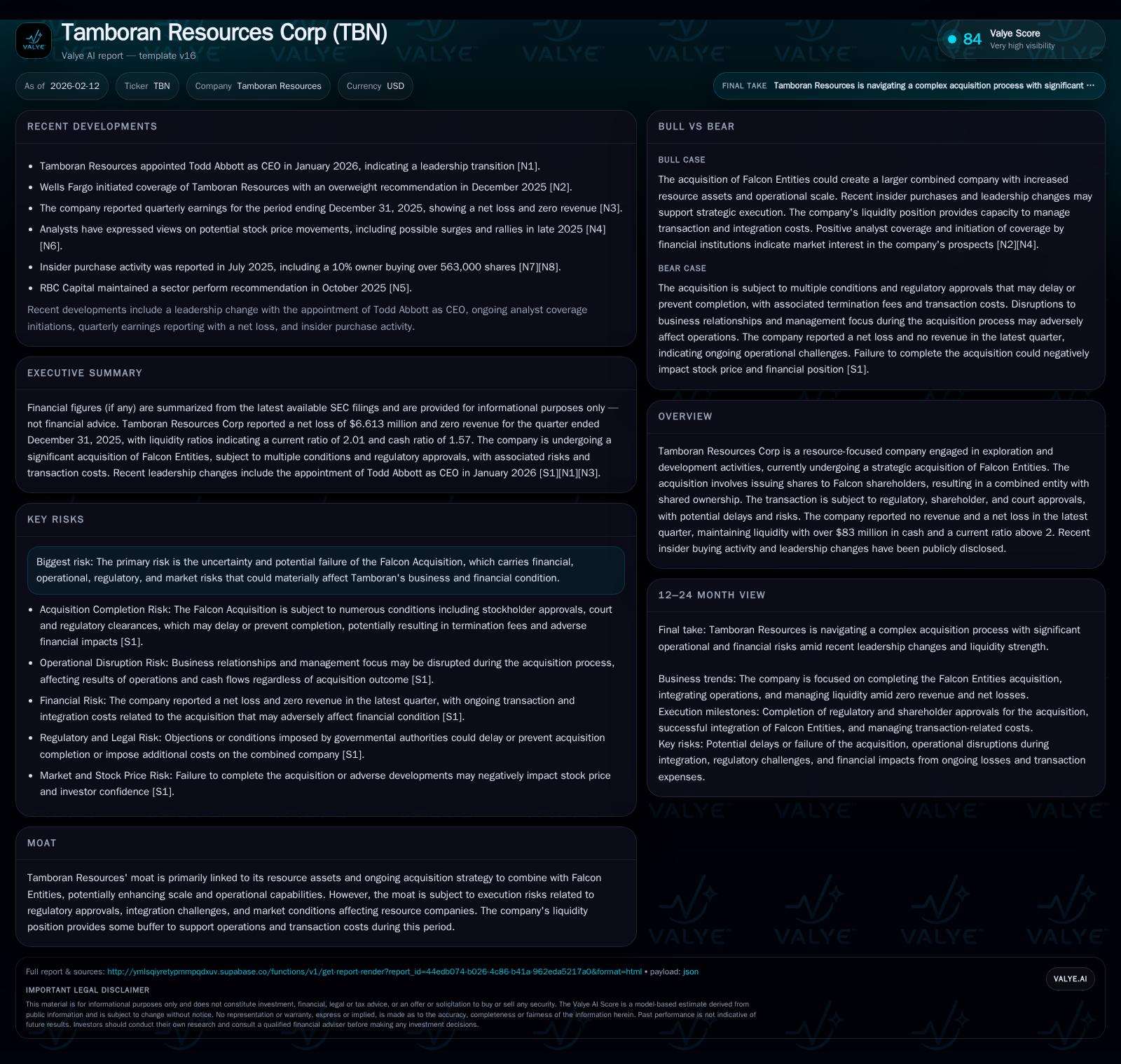
Tamboran Resources faces a critical juncture as it seeks to complete its strategic yet complex acquisition of Falcon Entities. The appointment of Todd Abbott as CEO injects fresh leadership energy, while the company grapples with ongoing losses and zero revenue. Financially, Tamboran maintains a healthy liquidity buffer that supports day-to-day operations and acquisition-related costs despite operational headwinds. However, completion risks loom large given regulatory, shareholder, and market uncertainties that could redefine ownership and operational control.
A New Helm: Arrival of CEO Todd Abbott
In January 2026, Tamboran Resources announced Todd Abbott’s appointment as Chief Executive Officer[ N1 ]. This leadership change arrives at a critical crossroads where the company is navigating not only a bold acquisition move but also continuing financial pressures marked by operational losses and zero revenue from recent periods. Abbott’s track record and approach will be vital in steering the organization through both integration complexities and executing growth strategies. Leadership transitions in resource-focused companies often portend shifts in strategic orientation; thus, his early tenure will be scrutinized for decisiveness amid this transformation.
Abbott inherits an organization poised between maintaining operational stability and leaping into an expanded combined entity via the Falcon acquisition. The timing of his appointment suggests deliberate intent to instill steadiness without losing momentum on corporate ambitions. Maintaining stakeholder confidence through this uncertain phase will require transparent communication paired with visible progress on strategic milestones.
Dissecting the Falcon Acquisition: Opportunity and Uncertainty
The centerpiece of Tamboran’s near-term outlook is its pending acquisition of Falcon Entities, structured around issuing approximately 6.54 million shares of Tamboran common stock to Falcon shareholders[ S2 ]. This exchange is fixed; importantly, the stock consideration will not adjust for fluctuations in either company’s share prices prior to closing—introducing intrinsic valuation risk given market volatility.
Upon consummation, existing Tamboran shareholders' influence will diminish from full control to approximately 77.6% ownership of the merged enterprise while Falcon shareholders will hold roughly 22.4%[ S2 ]. This ownership dilution transforms previously straightforward governance into a more complex balancing act among legacy stakeholders whose voting power and policy sway weaken proportionally.
Several conditions precedent must be met before closing can occur, including obtaining regulatory clearances, shareholder approvals across both parties, and critical court sanctioning of the arrangement[ S2 ]. These elements introduce timing uncertainties and potential delays which can exacerbate costs or undermine anticipated synergy realization.
From an analytical standpoint, the fixed share issuance amidst volatile stock pricing implies that market-driven valuation swings could affect perceived fairness or acceptance among stakeholders. Intraday price movements—from approximately $147 million to $199 million in implied transaction value since announcement—underscore how fluid valuation perception remains[ S2 ].
Financial Foundations: Navigating Losses with Strong Liquidity
Tamboran reported no operating revenue for the quarter ending December 31, 2025[ F1 ], continuing its profile as a development-stage resource explorer without commercial production income streams. This absence of revenue underscores reliance on capital markets and cash reserves for ongoing operations.
The company posted a net loss exceeding $6.6 million in the same period[ F1 ], reflecting typical pre-production expenses such as exploration costs, administrative overhead, and transaction-related expenditures tied to the acquisition process.
Yet despite these losses, Tamboran’s liquidity footprint appears resilient — cash and equivalents totaled approximately $83.4 million complemented by current assets surpassing liabilities twofold for a current ratio above 2 (2.01)[ F1 ]. This financial cushion affords operational flexibility during protracted deal negotiations or unexpected procedural delays.
Maintaining robust liquidity eases pressure on management to raise immediate capital under suboptimal conditions; however, it does not alleviate underlying business model risks around transitioning from explorer status to value-generating producer post-acquisition.
Shareholder Dynamics and Ownership Transformation
The ownership recalibration post-Falcon merger reshapes the control landscape significantly. Existing Tamboran investors see their proportional stake curtailed from near-total dominance toward marginally less than four-fifths of combined equity[ S2 ].
This dilution impacts decision-making dynamics: voting influence dilutes accordingly, adjusting the company's policy trajectory potential as new stakeholder voices enter governance forums more assertively.
Furthermore, Falcon shareholders transitioning into Tamboran equity holders assume co-responsibility for future corporate strategy execution—integrating different legacy cultures and interests within one boardroom environment introduces complexity rarely trivial to manage.
Such structural realignments may compel modified engagement strategies from management to harmonize diverse shareholder expectations while advancing common objectives.
Risk Radar: Regulatory and Market Headwinds
Perhaps most prominently among Tamboran’s challenges are the external forces imperiling deal closure — regulators must grant approvals; courts must sanction agreements; shareholders must endorse terms[ S2 ], all against fluctuating market moods that influence stock prices and sentiment.
Given that many variables lie outside direct corporate control — including geopolitical shifts influencing natural resource sectors, evolving environmental legislation affecting exploratory licensing frameworks, or macroeconomic inflationary pressures — these risks compound transactional fragility.[ valye_report_excerpt ]
Non-approval or delays could precipitate deal termination costs or force strategic pivots with attendant disruptions costing time and budget overruns.[ S2 ]
Moreover, potential integration pitfalls post-close could erode envisioned synergy advantages — merging distinct organizational workstreams demands sound planning underpinned by cohesive leadership aligning disparate assets effectively.
For investors analyzing Tamboran’s trajectory at this inflection point, understanding these multi-dimensional risk factors is essential for framing realistic scenarios regarding outcome variability.
Strategic Moat: Assets and Potential Scale Advantages
Tamboran’s competitive edge largely derives from its resource asset holdings combined with scale gains envisaged by combining with Falcon Entities.[ valye_report_excerpt ] This asset-based moat reflects natural barriers associated with geographic lease positions, exploration rights exclusivity, or established stakeholder relationships in target regions.
The planned merger promises enhanced operational capability through shared infrastructure deployment efficiencies and consolidated management resources potentially lowering unit development costs over time.
However, this advantage hinges critically on effective execution—the pathway from consolidation announcements to value generation is littered with integration missteps across industries.[ valye_report_excerpt ]
While materializing longer-term returns relies on navigating technical exploration successes coupled with favorable commodity market conditions favoring development economics.
How well Tamboran leverages combined assets against peers will ultimately determine whether this moat can translate into sustainable competitive differentiation amidst industry cyclical fluctuations.
Tracking Insider Movements and Confidence Signals
Despite pervasive uncertainties linked to operational results and acquisition contingencies,[ valye_report_excerpt ] notable insider buying activity has emerged recently signaling internal endorsement of company prospects under new stewardship.
Such transactions often reflect management’s belief that the current stock price undervalues future intrinsic worth or overlook underlying fundamentals supporting potential upside post-deal execution.[ valye_report_excerpt ]
This nuanced signal deserves recognition when evaluating both executive alignment incentives designed to retain talent during transition periods as well as overall market confidence calibration amid sector-wide turbulence.
Insider participation arguably lends credibility amidst otherwise opaque future outlook debates surrounding exploration companies embarking on transformative mergers.
Broader Market Sentiment and Industry Positioning
Finally, it is important to situate Tamboran’s developments within wider resource exploration sector dynamics heavily influenced by commodity price volatility,[ S2 ][ valye_report_excerpt ] investor risk appetites shifting cyclically based on macroeconomic indicators such as inflation trends or interest rate trajectories affecting capital availability.
Legislative frameworks globally impose evolving compliance costs impacting operability timelines — especially salient for companies engaged in environmentally sensitive activities or jurisdictionally complex resource domains.[ S2 ]
Market reactions reflected in increasing share price volatility attest to investor ambivalence balancing optimism over strategic deals against caution due to uncertain earnings visibility during pre-production phases.[ S2 ]
The interplay between these forces shapes Tamboran’s valuation narrative as it maneuvers toward redefining its scale through acquisition-driven growth initiatives amid demanding industry headwinds.
Disclaimer: This is research-only, informational analysis and not investment advice. It may include AI-generated interpretation and general industry context. Always verify important details using primary sources.

Comments