
RF Acquisition Corp II's Transition from SPAC Shell to Asian Deep Tech Innovator
An in-depth look at RF Acquisition Corp II's strategic pivot into Asian deep technology via its merger with Nanyang Biologics.
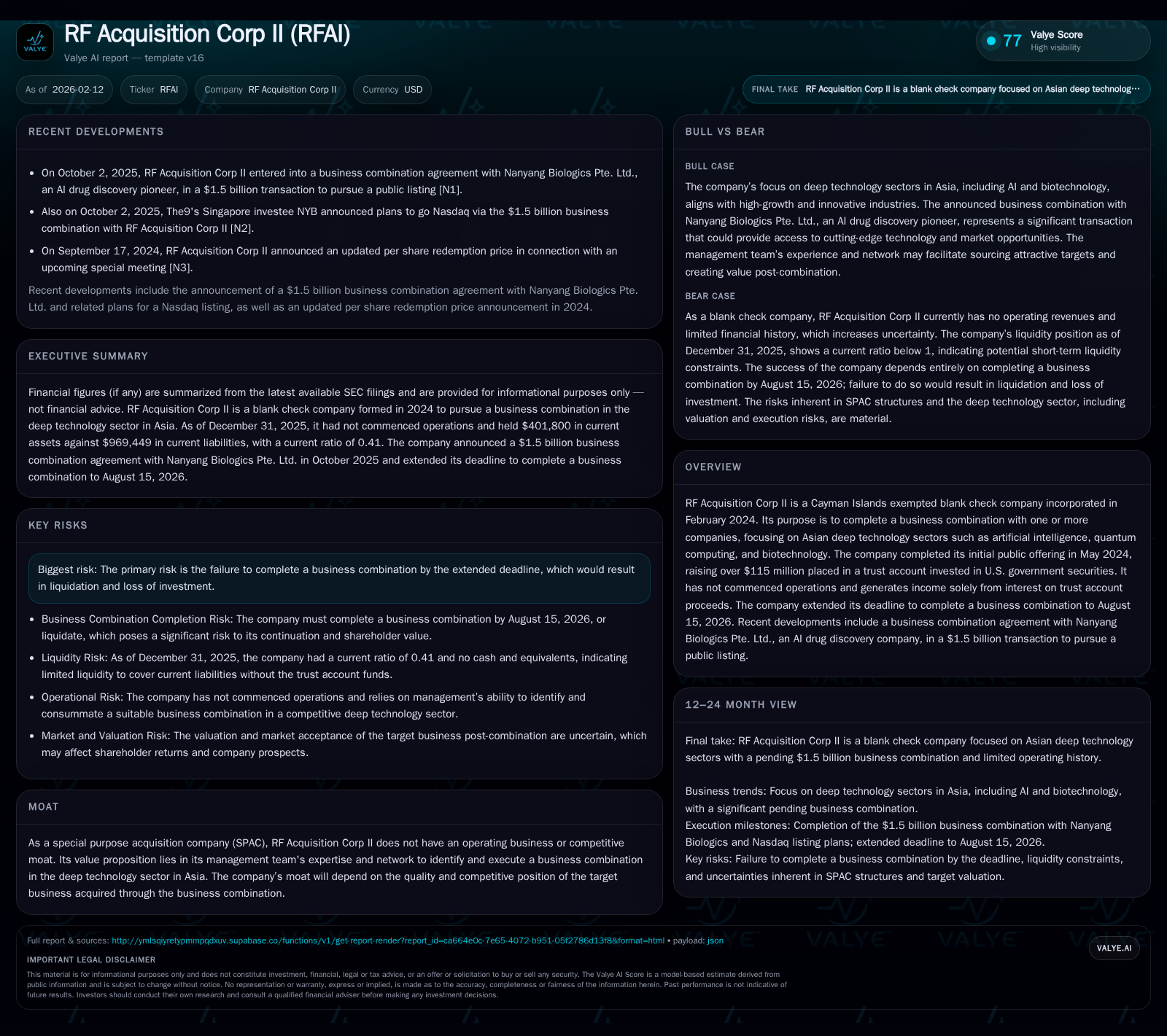
RF Acquisition Corp II (RFAI), a Cayman Islands-incorporated SPAC launched in early 2024, has carved out a focused niche targeting Asian deep technology sectors—particularly AI, quantum computing, and biotechnology. After raising more than $115 million in its IPO and placing proceeds in secure trust investments, the company’s value proposition centers on its proposed $1.5 billion business combination with Nanyang Biologics Pte. Ltd., an AI-driven drug discovery firm based in Singapore. This merger represents RFAI’s shift from a blank check entity to an operating company poised to ride Asia’s technology innovation wave, though it faces classic SPAC risks including looming deadlines and execution uncertainties.
From Blank Check to Deep Tech: RF Acquisition's Strategic Focus
RF Acquisition Corp II was established on February 5, 2024, as a Cayman Islands exempted company structured as a special purpose acquisition company (SPAC) focusing on sourcing potential business combinations in Asia's burgeoning deep technology space [S1]. Unlike many generic SPACs with undifferentiated mandates, RFAI defines its investment scope narrowly around fields such as artificial intelligence (AI), quantum computing, and biotechnology—domains experiencing accelerated innovation and capital inflow within Asia. This sector-specific and regional focus imbues the blank check vehicle with both strategic discipline and thematic relevance rare among SPAC peers.
The Company does not conduct operations pre-combination; rather, its capital—raised during the May 2024 IPO—resides securely in trust accounts invested solely in U.S. government securities to preserve principal while earning nominal interest [S1][F1]. Operating income is effectively limited to this interest income until closing of an acquisition deal, underscoring that value creation hinges entirely on identifying and consummating a suitable business combination.
The Management Edge: Drivers Behind the Pursuit of Asian Innovation
With zero operational moat intrinsic to any blank check company structure, RF Acquisition Corp II relies heavily on its management team's acumen and connections to navigate competitive deal flow in Asia's deep tech sectors [valye_report_excerpt][S1]. This human capital resource is critical given the complex technical assessment required for targets specializing in emergent technologies like AI-based drug discovery or quantum computing platforms.
The management team's experience enables them not only to vet target companies effectively but also to structure bespoke transactions that leverage Asia’s accelerating technological ecosystem. Consequently, while RFAI as an entity holds no direct competitive advantage until after the business combination closes, its potential rests squarely on execution capacity and the relative strengths of the identified target—a typical dynamic for SPAC sponsors focusing on high-innovation sectors.
Structuring the Deal: Inside the Merger with Nanyang Biologics
In a pivotal step towards operational transformation, RFAI entered into a definitive Business Combination Agreement on October 2, 2025, with Nanyang Biologics Pte. Ltd., a Singapore private company focused on AI-driven drug discovery technologies [S1]. Valued approximately at $1.5 billion, this transaction contemplates (i) merging RF Acquisition Corp II into NYB Holdings Limited (PubCo), creating PubCo as the surviving parent entity; (ii) amalgamating PubCo’s subsidiary with Nanyang so that the biologics firm emerges as a wholly-owned subsidiary post-transaction.
Post-merger share conversions are carefully delineated: each outstanding Nanyang ordinary share converts into newly issued PubCo shares per agreed ratios; analogous conversions apply for Amalgamation Sub shares and RF Acquisition ordinary shares [S1]. Rights attached to RFAI shares convert proportionally into fractional PubCo shares rounded down. This structural consolidation creates an integrated corporate configuration positioning Nanyang within public markets under PubCo’s umbrella.
Financial Snapshot: Navigating Early-Stage Fundamentals and Capital Structure
As of December 31, 2025, RF Acquisition Corp II remains pre-operational without generated revenues; all cash inflows derive from interest earned on IPO proceeds invested prudently [S1][F1]. The initial public offering raised gross proceeds of approximately $115 million including exercise of over-allotment options [S1]. Approximately $100 million was raised initially with an additional $15 million following full exercise of underwriting options.
The Company’s balance sheet reveals current assets totaling around $401,800 against current liabilities near $969,449 at year-end 2025 resulting in a constrained current ratio estimated at 0.41 [F1]. This tight liquidity snapshot reflects ongoing administrative costs partially offset by interest income totaling roughly $3.37 million net income for fiscal year-end [F1], highlighting the financial fragility typical of SPAC shells pending business combinations. No significant operating activity or core expenses beyond offering-related costs have been reported.
Risks and Deadlines: Understanding the Countdown to Business Combination
Intrinsic to RFAI's evolution is the looming August 15, 2026 deadline—the extended date by which it must finalize its business combination or face mandatory liquidation and return of IPO proceeds minus allowed fees [S1][valye_report_excerpt]. Shareholders authorized up to nine one-month extensions beyond initial termination terms at an extraordinary general meeting held November 10, 2025 [S1].
Failure to consummate by this Extended Date carries material risk for investors given potential value erosion or total loss due to liquidation protocols common among blank check companies. The company's emerging growth status further amplifies uncertainties tied to execution capabilities amid competition for quality deep tech targets in Asia [S2]. Although management has publicly committed resources towards transaction completion with Nanyang Biologics—a positive signal—the inherent operational risks and timing constraints remain pivotal variables.
Post-Merger Outlook: Projecting Value Creation in AI-Driven Drug Discovery
While quantifiable forecasts are premature given incomplete post-close disclosure, qualitative indicators posit that integrating Nanyang Biologics—operating at AI-biotech convergence—aligns RFAI with high-growth technology frontiers favored across Asia’s innovation landscape [valye_report_excerpt][S1]. The drug discovery application harnessing artificial intelligence promises scalability benefits leveraged by increasingly sophisticated computational models and growing industry partnerships regionally.
This merger positions PubCo as an early mover benefiting from rising demand for efficient biopharmaceutical development tools within Asia-Pacific hubs such as Singapore strategically fostering biotech startups through supportive ecosystems. In addition to technological differentiation from legacy biotech firms dependent on conventional pipelines, Nanyang's AI-centric focus may unlock novel research avenues minimizing time-to-market bottlenecks. These qualitative growth drivers underpin management’s rationale for selecting this target within their specialized mandate.
Regulatory and Geopolitical Boundaries: Why No China VIEs?
A deliberately cautious approach surfaces regarding geographic exposures; notably RFAI excludes potential acquisitions utilizing variable interest entity (VIE) structures associated primarily with Chinese operations consolidated through complex offshore arrangements [S1].
This limitation reflects heightened regulatory scrutiny post-China’s ramped enforcement actions targeting VIE entities amid geopolitical tensions and investor concerns surrounding governance transparency and compliance risk profiles. The choice avoids complications related to U.S.-China regulatory conflicts or disclosure ambiguities that commonly plague cross-border SPAC deals involving mainland Chinese technology firms using VIE architectures.
By confining investment scope principally within other Asian jurisdictions like Singapore—well regarded for regulatory stability—RFAI demonstrates risk mitigation aligned with international investor interests navigating evolving compliance landscapes while preserving access to deep tech innovation clusters.
SPAC Valuation Challenges and RFAI’s Unique Positioning
SPACs as investment vehicles historically encounter valuation hurdles arising from their inherent shell status pre-business combination alongside binary outcome risks centered on deal success or liquidation outcomes [valye_report_excerpt][S2]. Market skepticism often tempers valuations especially if identification of quality targets or crystallization of synergies appears uncertain.
In RFAI’s case, however, emphasis on a clearly defined sectoral thesis centered around Asian deep tech firms offers distinctive positioning compared with broadly scoped peers lacking granular specialization. This niche focus combined with commitments evidenced through sizable transactions like the proposed Nanyang Biologics merger may attenuate traditional volatility associated with SPAC launches dominated by generic acquisition pursuits.
Nonetheless, structural risks remain nontrivial—with milestone deadlines tightening capital deployment windows—and ultimate valuation uplift contingent upon successful integration and execution post-merger rather than purely speculative thematic appeal alone.
Disclaimer: This analysis is based solely on publicly available information and SEC filings without any forward-looking projections or investment recommendations. Readers should consider inherent risks detailed herein when evaluating RF Acquisition Corp II.
Disclaimer: This is research-only, informational analysis and not investment advice. It may include AI-generated interpretation and general industry context. Always verify important details using primary sources.

Comments