Kelly Services’ Strategic Shift to Specialty Staffing Amid Financial Headwinds
A detailed exploration of Kelly Services’ legacy, specialty focus, financial challenges, and technological evolution within a fragmented staffing industry.
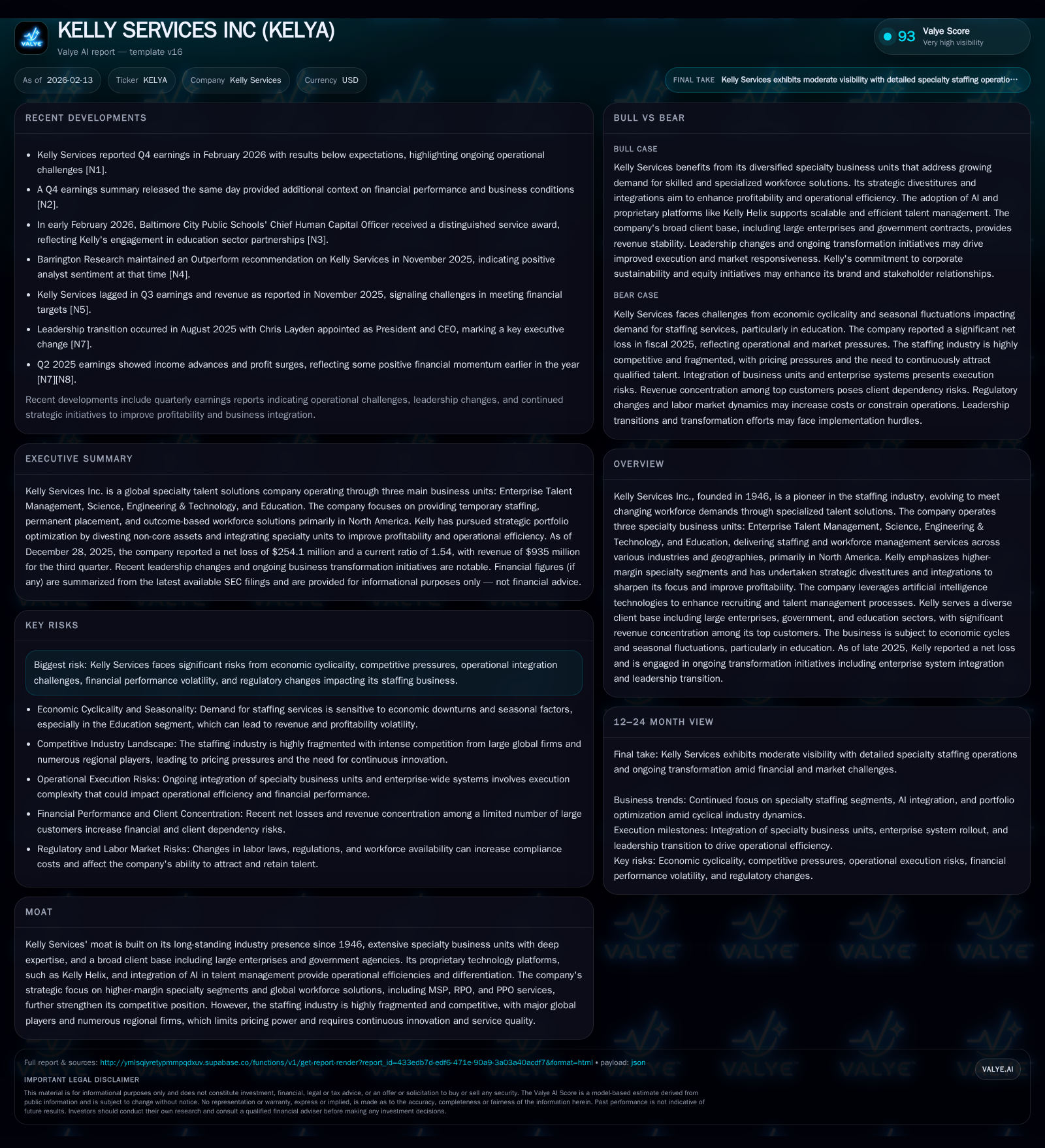
Kelly Services has leveraged its storied history since 1946 to pivot towards specialty staffing sectors, aiming to capture higher-margin markets through strategic restructuring and acquisitions. Despite this clear strategic focus, the company reported a surprising Q4 earnings miss and a substantial full-year net loss, underscoring ongoing profitability challenges. Operational efficiencies from integrating specialty units and investments in proprietary AI-driven platforms like Kelly Helix offer differentiation but are counterbalanced by significant economic cyclicality and competitive pressures. The company’s rigorous cybersecurity governance and client diversification illustrate disciplined risk management amid complex industry dynamics.
Legacy of Innovation: From Kelly's Founding to Specialty Focus
Kelly Services Inc. traces its origins back to 1946 when William Russell Kelly pioneered what would become an entire staffing industry. Emerging as a critical workforce facilitator during World War II—a period that notably expanded opportunities for women—the company built its foundation on innovation and adaptability. Bridging decades of labor market transformations, Kelly consistently refined its offerings. Landmark initiatives included the launch of the industry's first Managed Service Provider (MSP) program in 1996 and specialized divisions in engineering, information technology, and education by 1999 [S1].
Fast forward to 2020, reflecting deeper shifts in demand and margin profiles across staffing categories, Kelly strategically restructured into five specialty business units: Professional & Industrial (P&I), Science, Engineering & Technology (SET), Education, KellyOCG (Outsourcing & Consulting Group), and Kelly International. This transition marks more than a rebranding; it underlines a fundamental pivot towards outcome-oriented services in higher-margin niches—a response to intensifying competition in commoditized staffing segments [S1].
Specialty Business Units: Engines of Future Growth or Margin Pressure?
Today’s enduring pillars of Kelly's operations rest on three primary specialty units: Enterprise Talent Management (a consolidation of P&I with OCG completed in 2025), Science, Engineering & Technology (SET), and Education. These units underpin differentiated service models ranging from temporary staffing to complex recruitment process outsourcing (RPO) and payroll process outsourcing (PPO).
Kelly's strategic emphasis on higher-margin specialties is deliberate. By channeling capital into acquisitions such as Teachers On Call (Education), Global Technology Associates (SET), and various niche consultancies, the company aims to offset traditional staffing revenue pressures tied to price competition and commoditization [S1]. Yet, integration of these diverse specialty lines remains a working challenge. The 2025 merger of P&I with OCG illustrates management's acknowledgment that clients prefer integrated workforce solutions over siloed offerings in large enterprise contexts—a necessity driving operational complexity alongside potential margin improvement.
However, specialty-focused growth isn't without friction. Segments like Education may face budget constraints stemming from public sector funding volatility, while highly technical disciplines within SET require ongoing investment in talent development and technology adoption—all factors weighing on near-term margin expansion.
Navigating the Financial Rapids: Analyzing Recent Performance and Challenges
Despite the strategic realignment towards specialties, Kelly encountered notable financial turbulence during fiscal year-end 2025. Q4 revenue totaled $935 million but fell short of analyst estimates, triggering scrutiny over the company’s growth sustainability [N1][N2][F1]. The headline figure masking these dynamics is a reported full-year net loss exceeding $254 million—a stark contrast against previous profit snapshots.
Multiple elements converge here: first, operational expenses linked to business transformation initiatives—namely enterprise system integrations—likely exerted pressure on margins. Second, the lingering effects of economic cyclicality dampened demand elasticity for temporary labor solutions amidst macroeconomic uncertainty. Thirdly, costs associated with divesting non-core assets such as EMEA operations may have contributed to transient charges impacting bottom-line results [S1].
Liquidity metrics provide nuanced reassurance; current assets stood at approximately $1.27 billion relative to current liabilities near $822 million yielding a current ratio around 1.54 [F1]. This balance sheet robustness offers breathing room for ongoing transformation spending but reflects no immunity against persistent market headwinds.
Strategic Divestitures and Acquisitions: Refining the Portfolio
A cornerstone of Kelly’s recent corporate strategy involves shedding lower-margin or geographically peripheral businesses while reinforcing presence in specialty verticals most aligned with long-term profitability goals. The divestiture of European staffing operations in 2024 epitomizes this shift away from geographically dispersed commodity staffing toward concentrated North American specialties integrated with global RPO/MSP capabilities [S1].
Concurrently, targeted acquisitions bolster expertise within SET (e.g., Global Technology Associates), Education (Teachers On Call), and consulting services through KellyOCG—threading specialized talent pools with client demands for end-to-end workforce solutions. Such moves signal management’s commitment to portfolio discipline over scale for scale's sake.
This recalibration also reduces exposure to volatile markets less conducive to margin capture while positioning Kelly as a partner adept at fulfilling complex employer requirements across technology-enabled recruitment workflows.
Technology Integration: AI and Kelly Helix’s Role in Differentiation
In an industry marked by fragmentation—comprising both multinational players and numerous regional agencies—operational efficiency via technology is paramount. Kelly leverages proprietary platforms such as Kelly Helix alongside cutting-edge artificial intelligence tools to drive recruiting workflows more effectively [S1][valye_report_excerpt].
These technologies automate candidate sourcing pipelines, optimize skill matching accuracy, enhance compliance tracking, and improve client reporting transparency—critical differentiators where human capital outsourcing commoditization pressures margins severely otherwise. The integration of AI aims not only for cost-effective processes but also enriches talent pool analytics offering predictive insights on skills demand trends.
Such tech-stack investments exemplify how Kelly endeavors to convert its nearly eight decades of domain expertise into scalable digital assets that help maintain competitive edges amidst technological disruption rocking legacy staffing models.
Risk Governance: Cybersecurity and Operational Risk Amid Industry Complexity
Kelly’s dependence on vast volumes of sensitive employee data—including personally identifiable information across multiple client industries—necessitates stringent cybersecurity governance frameworks. Oversight starts at the board level with defined roles assigned comprehensive risk responsibility including surveillance of cyber threats, privacy regulation compliance updates, and incident response protocols [S1].
A multi-layered defense strategy encompasses the Chief Information Security Officer (CISO)—who boasts over two decades overseeing security domains—and senior cross-functional teams regularly convening to assess evolving threats. Notably, an empowered emergency management team can rapidly enact mitigation plans during security breaches ensuring containment while maintaining regulatory transparency.
This institutionalized approach extends beyond typical protocols; independent internal audits evaluate risk identification rigor continually reporting effectiveness directly to the Audit Committee enhancing checks-and-balances within cyber risk posture.
Client and Industry Exposure: Concentrations, Cyclicality, and Market Position
Kelly's client roster spans large enterprises across private sectors along with government agencies and educational institutions—a mix providing some diversification benefits yet also concentration risks given top customers generate substantial revenue portions [valye_report_excerpt]. Additionally, cyclical rhythms inherent in labor demand create fluctuating utilization rates for temporary placements affecting topline stability.
The fragmented beneficiaries landscape constrains pricing power considerably; widespread availability of competing staffing suppliers forces aggressive bids eroding margins even amid differentiated service offerings. Consequently, sustained revenue growth demands constant innovation paired with superior quality controls; any lapse invites client attrition toward competitors with comparable capabilities but leaner cost bases.
Moreover, cyclical downturns typically coincide with budget cuts particularly impacting public sector Education segments posing additional performance uncertainties.
Outlook and Transformation Initiatives: Path to Sustainable Profitability
Looking ahead, Kelly’s multi-year transformation blueprint prioritizes unifying disparate specialty units onto integrated enterprise resource planning systems—phase one completed early 2026 focused on SET segment signaling momentum toward operational synergies [S1]. Streamlined processes aim at rationalizing overhead structures while enhancing cross-selling potential among business units coordinated under one IT architecture.
While heavy investments have suppressed near-term profits evidenced by recent losses, these structural reforms combined with continued emphasis on AI-driven efficiency enhancements outline a potential path toward renewing margin expansion absent sacrificing growth aspirations.
Nonetheless, execution risks persist given volatile macroeconomic contexts combined with intense competitive dynamics requiring vigilant adaptation entailing proactive risk mitigation frameworks embedded organization-wide.
This analysis synthesizes public filings alongside recent market developments providing an integrated view without extending investment advice or speculative forecasts. Readers should consider these findings as part of broader due diligence encompassing qualitative judgment regarding evolving labor market conditions and regulatory environments impacting staffing providers broadly.
Disclaimer: This is research-only, informational analysis and not investment advice. It may include AI-generated interpretation and general industry context. Always verify important details using primary sources.

Comments