
NMI Holdings: Leveraging Comprehensive Licensing and Proprietary Pricing Amid Mortgage Insurance Risks
NMI Holdings capitalizes on full U.S. licensing, GSE approvals, and a diversified lender base to sustain growth within the evolving private mortgage insurance landscape.
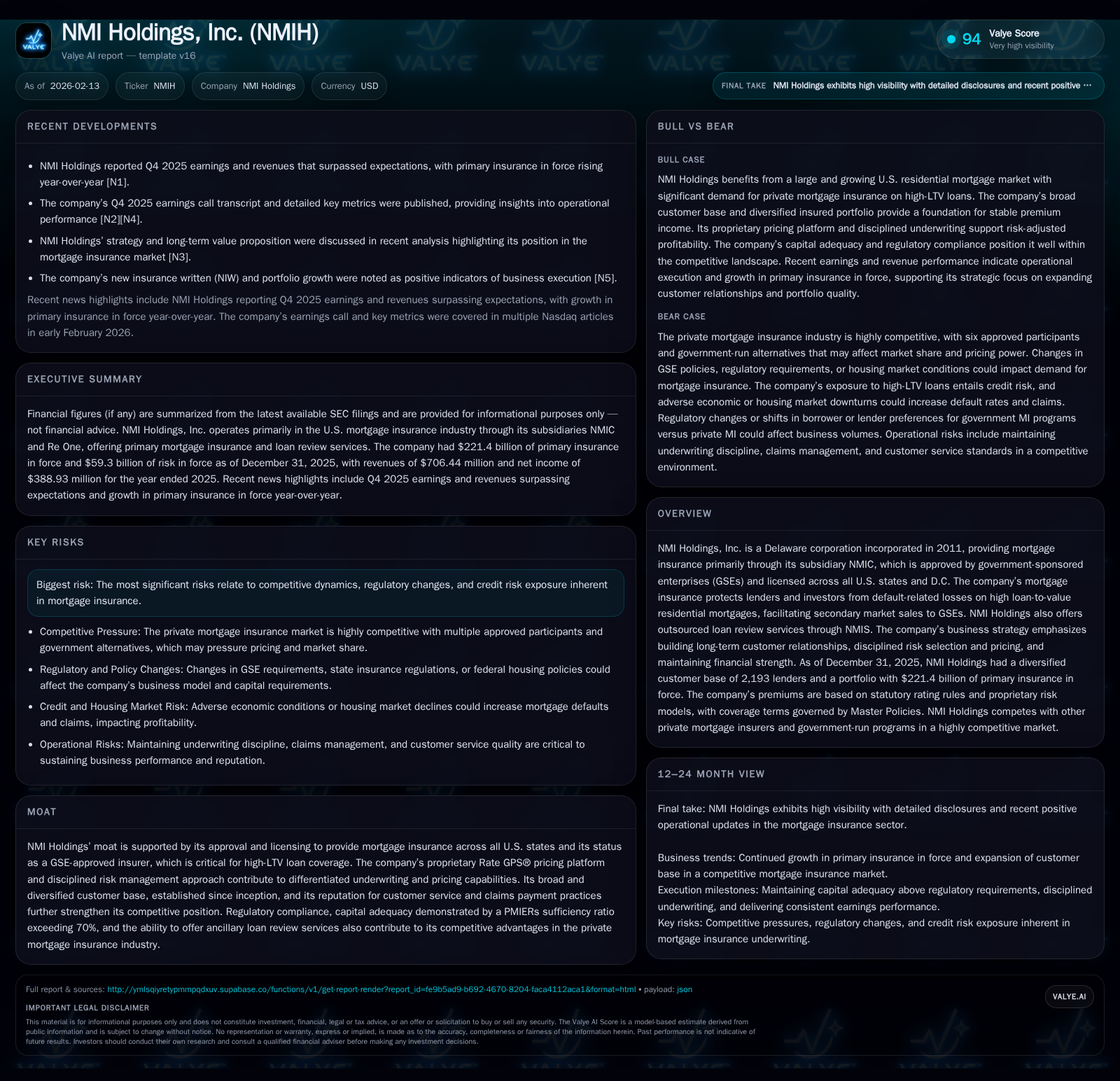
NMI Holdings, founded in 2011 and operating primarily through its subsidiary NMIC, stands as a significant participant in the U.S. private mortgage insurance sector. Its competitive strengths center on comprehensive all-state licensing, GSE approval, and proprietary Rate GPS® pricing platform that underpin disciplined underwriting and risk management. The sizeable and diversified portfolio—with $221.4 billion primary insurance in force as of year-end 2025—and broad customer relationships contribute to operational resilience amid rising challenges from regulatory shifts, credit risks, and intensifying competition. Ancillary loan review services further differentiate NMI’s value proposition while risks such as borrower defaults and market volatility remain critical areas of focus.
NMI Holdings at a Glance: Company Evolution and Market Role
Incorporated in Delaware in May 2011, NMI Holdings, Inc. began operations in 2012 and issued its first mortgage insurance policy in 2013 [S1]. It primarily delivers mortgage insurance via NMIC, its Wisconsin-domiciled insurance subsidiary licensed across all U.S. states and the District of Columbia—a credential critical for nationwide market reach. NMIC's approval by key government-sponsored enterprises (GSEs), namely Fannie Mae and Freddie Mac, enables the underwriting of high loan-to-value (LTV) residential mortgages that would otherwise face purchase restrictions by these entities.
Mortgage insurance mitigates loss exposure for lenders and investors when borrowers default on loans exceeding an 80% LTV ratio. By transferring this credit risk through MI policies secured with firms like NMIH, lenders bolster their capacity to issue more loans while expanding homeownership access [S1]. By December 31, 2025, the company had amassed $221.4 billion in primary insurance in force (IIF) with $59.3 billion of primary risk in force (RIF), servicing a sizable client base of 2,193 lenders that includes banks large and small, credit unions, builder-affiliated lenders, internet-originators, and other non-bank entities [S1], [F1]. This foundational positioning defines NMI’s role as an enabler within the broader U.S. residential mortgage ecosystem.
Decoding the Moat: Licensing, GSE Approval, and Rate GPS® Pricing
NMI Holdings’ competitive moat is anchored in several strategic assets woven tightly into its business model. Foremost is its all-state MI licensing combined with GSE approval status—a regulatory duality that reigns essential for offering coverage on loans destined for secondary market sales to government-backed agencies [S1]. This geographic breadth eliminates fragmentation concerns encountered by insurers without full-state licenses.
Equally pivotal is the proprietary Rate GPS® platform developed internally to dynamically price mortgage insurance policies [valye_report_excerpt]. This system leverages both statutory rating rules mandated by regulators and proprietary risk modeling techniques to calibrate premium levels finely tuned to individual loan characteristics. Such precision enhances underwriting discipline by aligning pricing tightly with anticipated loss exposures. In a sector where underwriting margins can be thin and claims volatility impactful, this capability distinguishes NMI from peers reliant on more static or less sophisticated models.
The company’s adherence to stringent capital requirements—demonstrated by maintaining a PMIERs sufficiency ratio well above the required 70% threshold—further underscores operational strength under regulatory oversight conducted principally by Wisconsin's Office of Commissioner of Insurance (OCI) [valye_report_excerpt], [S1]. This capital adequacy not only ensures claim-paying ability but supports market confidence amid cyclical mortgage origination environments.
Portfolio Growth and Customer Diversification: Engines of Resilience
The scale and diversity of NMI's customer relationships constitute another pillar of its resilience. With over two thousand active lender customers spanning multiple institution types—including national money center banks alongside community lenders—the portfolio benefits from diffusion across geographic regions and lending strategies [S1]. This spread tempers concentration risks often observed when insurers rely heavily on limited partners or single large originators.
Growth metrics further validate this diversification approach; new insurance written (NIW) reached $48.9 billion for 2025 amid general mortgage market fluctuations [N1], [F1]. The mature IIF inflates steadily as previously insured loans remain active or repay slowly given evolving housing markets. Such growth trajectory signals successful customer acquisition balanced with prudent retention efforts emphasized by NMI's customer service ethos.
Navigating Competitive Dynamics in Private Mortgage Insurance
Despite these strengths, competition within the private MI industry remains intense. As disclosed explicitly in the company’s risk disclosures, NMI faces challenges from other MI providers competing aggressively for originator mandates as well as alternative credit risk mitigation tools potentially supplanting the need for traditional private MI coverage [S1]. These alternatives might include lender-funded loss-sharing arrangements or portfolio insurance.
This rivalry places pressure on new insurance written volumes (NIW) as customers weigh cost-benefit profiles alongside service experience factors. Maintaining differentiation via underwriting accuracy powered by Rate GPS® alongside responsiveness becomes crucial to sustaining long-term customer loyalty within this competitive framework.
Regulatory Landscape and Risk Management Framework
Regulatory constraints uniquely shape MI operations given their systemic relevance to housing finance stability. NMI’s primary regulator—Wisconsin OCI—monitors its solvency closely under frameworks linked to PMI Eligibility Requirements (PMIERs), which detail minimum capital adequacy thresholds correlated with portfolio risk profiles [S1]. Exceeding these minima reflects NMI’s proactive capital management strategy mitigating risk from adverse claim cycles.
Complementing capital strength is NMI’s disciplined underwriting philosophy designed to identify emergent risks early via robust analytics complemented by proprietary pricing models [valye_report_excerpt]. The firm explicitly acknowledges scenarios that could challenge this posture including inaccurate reserve estimations leading to insufficient claims hedging or unexpected default spikes tied to economic downturns or localized geographic deteriorations [S1].
Moreover, external shocks like natural disasters or climate-related events impose additional latent risks potentially impacting current insured pools—risks increasingly acknowledged in MI sector disclosures worldwide [S1]. By maintaining conservative reserving policies combined with nimble monitoring systems focused on borrower creditworthiness trends, NMI endeavors to balance growth against these inherent exposure vectors.
Earnings Performance and Financial Health: Latest Insights
Recently reported earnings showcase how these operational principles translate into financial outcomes. For full-year 2025 ending December 31st, NMI recorded net income just shy of $389 million on revenues exceeding $706 million—metrics that represent not only profitability but also growth derived from an expanding insured book [F1], [N1], [N4].
Quarterly earnings releases have consistently exceeded analyst expectations across key line items including premiums earned driven by incremental increases in primary IIF [N1], reinforcing investor confidence during periods subject to broader financial market volatility.
Loan Review Ancillary Services: Complement or Growth Catalyst?
A less heralded but strategically relevant element arises from NMIS—the outsourced loan review segment operated as a separate subsidiary within NMI’s corporate family [S1]. Though constituting a smaller revenue stream relative to core mortgage insurance premiums, NMIS contributes positively by deepening relationships with lender clients.
By auditing loans outside of direct MI policies or providing quality controls reflective of underwriting best practices, NMIS enhances perceived value propositions offered by NMIH beyond pure risk transfer functions. This diversification not only provides margins insulated slightly from cyclical mortgage production shifts but strengthens client ‘stickiness’ due to integrated service offerings.
Challenges Ahead: Credit Risk, Market Shifts, and Operational Risks
Risk disclosures paint a cautiously vigilant portrait of ongoing challenges confronting NMI Holdings moving forward. Central among these are:
- Unexpected borrower default rate spikes that exceed modeled expectations due to macroeconomic shocks or sector-specific downturns;
- Increasing competition reducing market share or compressing pricing power;
- Regulatory changes potentially increasing capital burdens or altering permissible business practices;
- Complexities inherent in outsourcing core underwriting functions which may lead to elevated claims if third-party performance weakens;
- Operational risks tied to fraud or technological infrastructure failures impacting claims processing accuracy;
- Exposure related to reinsurance counterparties whose credit downgrades could impair expected recovery profiles;
- Natural disasters or pandemic events exacerbating loss incidence beyond typical actuarial assumptions;
- Longer policy tenure dynamics affecting premium flow timing versus claim payout liabilities.
These categories demonstrate why an acute focus on analytics-driven risk management backed by disciplined capital strategy remains paramount for survival within this complex niche market segment [S1].
Investor Takeaways: Valuation Context and Long-Term Perspectives
Recent commentary identifies NMI Holdings as positioned among top value names within specialty finance sectors owing largely to durable competitive moats forged through regulatory licensing breadth combined with advanced pricing technologies [N6], [N12]. Its outperformance relative to peers throughout volatile periods places it favorably when evaluated against fundamental metrics drawn from SEC filings capturing solid revenue expansion and earnings quality [F1].
However, prudent consideration involves balancing these strengths against inherent cyclicality tied closely to mortgage origination cycles influenced by interest rate regimes and housing demand fundamentals—factors prone to external economic variables outside company control.
Overall, fabricating an analytical lens through which NMIH’s story unfolds reveals an enterprise thoughtfully building structural defenses around scalable underwriting capabilities supported by regulatory compliance while navigating evolving credit landscapes. Sustainability depends as much on maintaining these pillars as adapting proactively should market conditions deviate sharply from historical norms.
Disclaimer: This analysis is based solely on information available as of February 13th, 2026 and does not constitute investment advice or recommendations.
Disclaimer: This is research-only, informational analysis and not investment advice. It may include AI-generated interpretation and general industry context. Always verify important details using primary sources.

Comments