
Digital Asset Acquisition Corp.: Transition from SPAC to Banking Entity in Crypto Finance
DAAQ’s planned merger with Old Glory Bank marks its shift from a pure SPAC into a hybrid crypto-banking platform, presenting unique strategic opportunities and regulatory challenges.
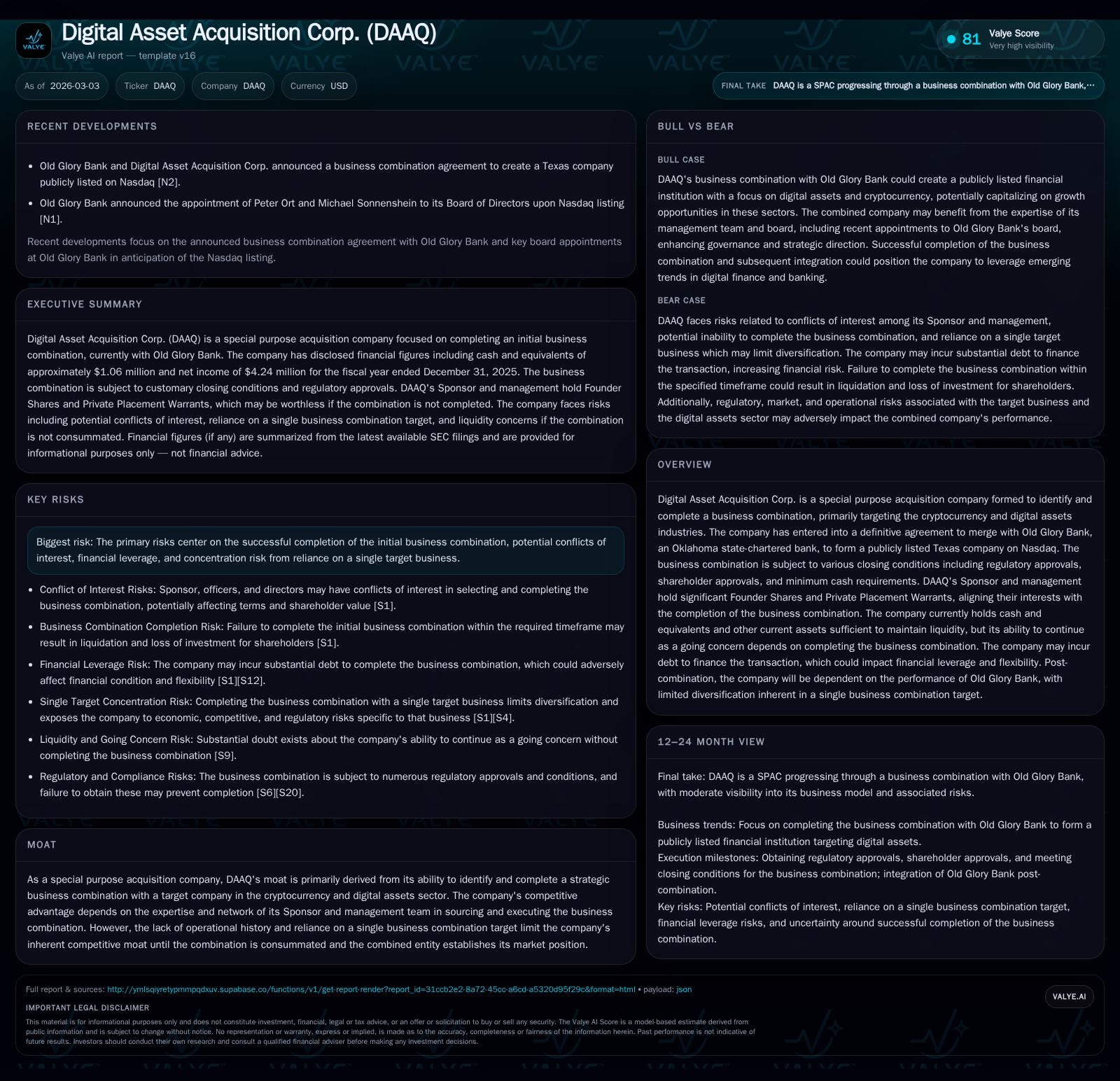
Digital Asset Acquisition Corp. (DAAQ) began as a special purpose acquisition company focused on the cryptocurrency and digital assets industry. It is poised to merge with Old Glory Bank, transforming into a Nasdaq-listed Texas-based financial institution. The success of this transition hinges on navigating shareholder vote dynamics, regulatory approvals, and execution risks intrinsic to the SPAC structure and banking sector compliance. DAAQ maintains a strong liquidity position but faces concentration and governance-related risks until consummation of its business combination. Investors should monitor key milestones including shareholder votes and regulatory gating events for final execution clarity.
Historical Performance: SPAC Formation, Capital Structure, and Operating Results
Digital Asset Acquisition Corp. launched as a special purpose acquisition company (SPAC) designed specifically to identify and complete a business combination in the cryptocurrency and digital assets sector. As typical for SPACs, DAAQ itself holds no operating revenue streams or business operations before consummation of a business combination. Its financials for fiscal year ending 2025 reflect this profile: an operating loss of $379K contrasted with net income of roughly $4.24M arising largely from accounting treatments linked to equity interests rather than generated operating cash flow [F1].
Liquidity remains robust with over $1 million in cash and equivalents supported by a current ratio exceeding 10 times, suggesting a comfortable cushion against short-term liabilities [F1]. However, the company carries an approximate negative return on equity around -72.7%, underscoring that capital has been largely deployed towards preparatory expenses rather than profits or cash-generating operations [F1].
A critical facet shaping DAAQ’s capital structure is its "Founder Shares," accounting for 25% of total shares post-IPO. These shares were issued at nominal cost ($0.004 per share) to the Sponsor and allocated partly to independent directors and advisors [S1]. Founder Shares grant disproportionate voting power in approving the impending business combination, representing both alignment incentives and governance risk.
Historical performance (annual)
| FY |
|---|
| 2025 |
Source: SEC companyfacts cache [F1].
All data sourced from most recent 10-K filing [F1]. Year-over-year comparisons are not available due to DAAQ's nature as a newly formed SPAC.
Strategic Rationale Behind the Merger with Old Glory Bank
DAAQ’s definitive agreement to merge with Old Glory Bank marks a notable pivot from its initial remit solely focused on cryptocurrency companies towards becoming an operational hybrid entity blending regulated banking services with digital asset finance capabilities [N1][S3]. This convergence reflects broader fintech trends where traditional banks seek exposure to—and infrastructure enabling—the burgeoning crypto economy.
Old Glory Bank provides DAAQ entry into the regulated banking world via an Oklahoma state-chartered institution now slated to be domiciled in Texas following merger completion under Nasdaq listing rules [S3][N1]. Recent appointments of industry veterans Peter Ort and Michael Sonnenshein to Old Glory’s board enhance governance expertise aligned with scale growth ambitions [N1]. These moves position the combined entity uniquely at the intersection of traditional finance compliance frameworks and evolving cryptocurrency products.
The strategy aims to capitalize on synergies between legacy deposit franchises, lending operations, and digital asset client demands that require banking-grade custody, payments infrastructure, and regulatory compliance—domains for which standalone crypto firms often lack licenses or scale.
Operational Risks and Regulatory Hurdles Post-Business Combination
Substantial risks shadow DAAQ’s path ahead centered principally on executing shareholder vote mechanics amid rigorous regulatory gating events.
Under Cayman Islands corporate law where DAAQ is incorporated, founder shareholders wield significant influence over approval outcomes—they hold about one quarter of ordinary shares plus associated voting rights on Founder Shares [S1]. This could lead to completion even if majority public investors oppose the merger (the so-called prevalence of sponsor voting power). Additionally, DAAQ reserves discretion whether or not to seek public shareholder approval depending on timing or legal requirements, underscoring governance complexities inherent in SPAC structures [S1].
Regulatory approvals span multiple U.S. banking authorities tasked with reviewing fitness for operating a state bank merged into a publicly traded firm—a process entailing scrutiny over capital adequacy, management experience, anti-money laundering controls, and cybersecurity readiness [S5][S6]. Delay or non-approval could materially impact timelines or feasibility.
Moreover, evolving federal proxy rules require detailed historic financial disclosures on target entities which may limit alternate potential targets due to reporting burdens [S7]. Compliance costs post-merger may rise given Sarbanes-Oxley obligations including internal controls reporting beginning after initial filings as a listed entity [S7][S8].
Financial Positioning: Liquidity, Capital Allocation, and Sponsor Alignment
DAAQ carries approximately $1.06 million in cash & equivalents as of end-2025 against current liabilities near $110K resulting in an enviable current ratio exceeding 10x—an ample liquidity cushion through merger execution phases [F1]. This liquidity supports transaction-related expenses incurred before generating operating revenues.
Capital allocation focuses squarely on fulfilling business combination conditions including minimum cash thresholds for payment consideration to Old Glory Bank shareholders as well as working capital requisites post-merger [S20][S21]. No dividends or share repurchases have been executed given the absence of positive operational free cash flow characteristic of early-stage SPACs transitioning toward operational entities [F1][S12][S18].
Sponsor alignment is reinforced through ownership of Founder Shares (approximately 25% post-IPO) plus Private Placement Warrants exercisable upon deal closure or shareholder redemption scenarios [S1][S12]. This structure ties sponsor equity upside directly to successful combination completion.
While net income appears positive due to non-cash items related to equity interests rather than recurring earnings—operating loss near $379K illustrates ongoing investment outlays during pre-combination phase [F1]. The approximate -72.7% ROE evidences capital deployment ahead of return generation but will reset as post-business-combination operations commence integrating Old Glory Bank results [F1].
Market Outlook: Prospects, Constraints, and Critical Milestones Ahead
Market potential lies at the nexus of expanding demand for crypto-friendly banking services that comply fully with regulatory frameworks—a sector attracting growing institutional adoption yet fraught with policy uncertainties nationwide.
Successful closing remains contingent on complex multistage conditions: securing both sets of shareholder approvals (DAAQ’s public shareholders plus Old Glory Bank’s majority), satisfying minimum cash conditions stipulated in agreements, obtaining banking regulator licenses and clearances requisite for Texas domiciling status on Nasdaq listing completion [N1][S8]. Failure at any step may trigger deal collapse or necessitate renegotiation disrupting plans.
Concentration risk is material as DAAQ moves away from being purely an acquisition shell dependent on identifying profitable crypto targets toward sole reliance on one merged bank operation initially—limiting diversity until potential future acquisitions or organic growth materialize.
Watchpoints include final vote results amid potentially conflicted sponsor voting blocks; turnaround timing from merger announcement date through regulatory reviews; ability for new management teams drawn from Old Glory Bank staff to assimilate SEC reporting requirements; capitalization adequacy during ramp-up phases; competitive responses from incumbent banks or neobanks targeting similar crypto clientele.
Governance and Shareholder Vote Dynamics Impacting Business Combination Approval
DAAQ's governance framework assigns outsized influence over merger decisions to Sponsor-controlled Founder Shares which represent roughly 25% ownership but full voting rights alongside public shareholders’ Class A ordinary shares under Cayman Islands corporate law provisions [S1]. Key points:
- The Sponsor has contractually agreed to vote Founder Shares in favor of any proposed combination ensuring control over outcome regardless of broader public sentiment.
- Public shareholders' approval threshold requires only about one-third favorable votes among outstanding Public Shares assuming quorum—potentially allowing deal passage without majority investor endorsement if participation skews low [S1].
- The company retains discretion whether to hold binding shareholder votes depending on transaction structure or applicable regulations further centralizing decision-making authority within Sponsor ranks.
This dynamic underscores classic SPAC agency conflicts where founders may prioritize deal closure over maximizing diluted public investor value raising governance oversight concerns particularly during volatile or transitional market regimes typical for crypto-linked entities.
Public shareholders retain redemption rights enabling exit before combo closes but face limited influence over terms once Founder Share voting blocs lock-in outcomes—a structural tension common across many modern SPACs warranting continuous investor attention.
Disclaimer
This memorandum summarizes publicly available filings through March 3, 2026 including SEC submissions and recent press disclosures regarding Digital Asset Acquisition Corp. No investment advice or recommendations are intended or implied herein. Readers should conduct their own evaluation considering all relevant risk factors associated with SPAC structures transitioning into regulated bank holding entities within evolving digital asset markets before forming conclusions.
Disclaimer: This is research-only, informational analysis and not investment advice. It may include AI-generated interpretation and general industry context. Always verify important details using primary sources.

Comments