
Dollar General Reports Q1 2026 Earnings Amid Value Retailing Resilience
Strong Q1 results and dividend reaffirmation underscore Dollar General’s solid execution of its value-based discount retail strategy.
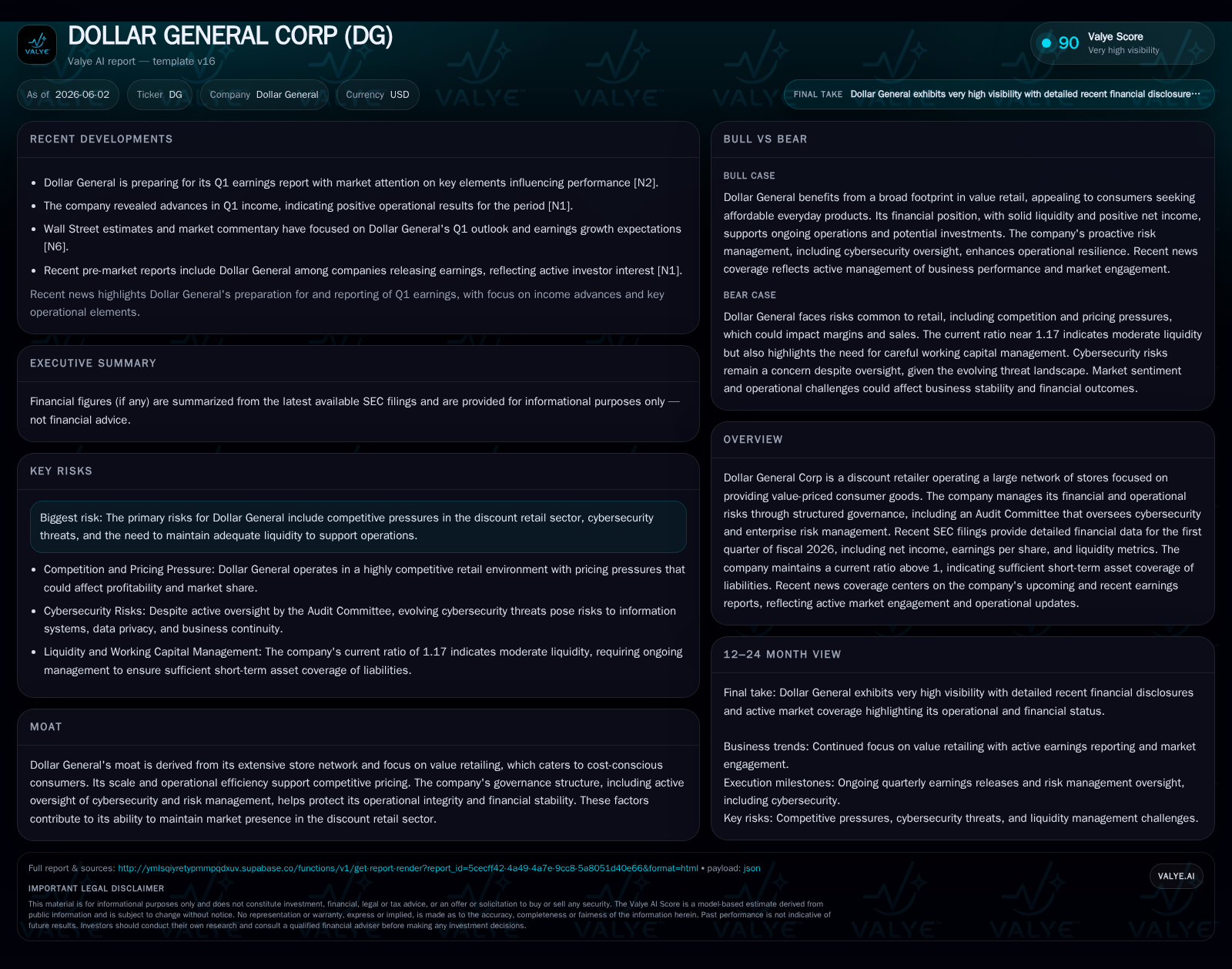
Dollar General’s fiscal first quarter ended May 1, 2026, showcased continued operational resilience with steady income and earnings per share reflecting stable consumer demand in the discount retail segment. The Board declared a quarterly dividend consistent with prior payouts, evidencing confidence in cash flow stability. Robust liquidity metrics support operational flexibility amid competitive and macro pressures. The company’s extensive store network and focused product assortment remain key moats, while governance oversight of cybersecurity and enterprise risk reinforces operational integrity. Key risks include sector competition and evolving consumer dynamics, but solid growth drivers persist in store-level execution and product mix optimization.
Q1 Operating Performance and Fiscal Outlook Update
Dollar General's fiscal first quarter ended May 1, 2026, demonstrated resilient operating performance marked by a net income near $1.5 billion, sustaining profitability during an inflation-impacted retail environment [F1], [S2]. Earnings per share remained consistent with recent quarters, reflecting effective cost controls and stable consumer engagement at its stores. Significantly, the Board approved a quarterly cash dividend of $0.59 per share payable in July 2026, underscoring confidence in cash flow sustainability even as retail conditions balance between cautious consumer spending and value-seeking behavior [S3]. The reported current ratio stands at a healthy 1.17, indicating that current assets sufficiently cover short-term liabilities — a key liquidity measure supporting operational flexibility and supplier relations [F1]. Management’s outlook for fiscal year 2026 remains broadly unchanged from annual guidance, signaling steady execution continuity.
Dollar General’s Value Retail Business Model at Scale
Dollar General operates a densely distributed network of small-box stores targeting price-sensitive shoppers with a focus on essential consumer products — an approach optimized for convenience shopping in underserved or rural markets [S1]. Revenue is generated primarily through sales volume driven by foot traffic into these stores, supplemented by product assortment emphasizing everyday low prices bolstered by private-label brands which enhance margin control while fostering brand loyalty. This value-centric model benefits from scale economies in procurement and logistics, enabling Dollar General to negotiate favorable vendor terms that contribute to competitive pricing advantages over regional or niche discounters.
An important component is the company’s governance structure which integrates rigorous oversight of operational risks including cybersecurity — an increasingly critical factor as digital systems underpin supply chain management and customer data security. The Audit Committee’s quarterly review process involves detailed tracking of cyber threats and risk mitigation protocols with CIO and CISO reports forming an internal dashboard that guides proactive responses to IT vulnerabilities [S1]. This layered risk management apparatus complements Dollar General’s operational efficiency moat by protecting revenue streams against disruption.
Competitive Positioning within the Discount Retail Sector
Within the highly competitive discount retail sector, Dollar General distinguishes itself through its unparalleled store density across many U.S. regions relative to peers like Dollar Tree or Family Dollar. Its broad product assortment balances staples with consumables tailored to meet everyday needs at low price points — facilitating higher basket sizes than more narrowly focused dollar stores [N12], [S1]. While price perception closely competes with other value retailers, Dollar General leverages its scale to optimize inventory turns and markdown cadence for fresh stock availability without excessive shrink.
Unlike club-based retailers such as Costco or Kroger’s membership models, Dollar General operates without membership fees which lowers adoption friction among cost-conscious consumers seeking quick trips rather than bulk-shopping events. This positions it well amid economic segments prone to budget constraints. However, it contends with grocers expanding small-format stores and eCommerce players encroaching into essentials distribution — challenges demanding continuous assortments adaptation and omnichannel exploration.
Execution Drivers Behind Growth Momentum
Dollar General's latest quarterly results suggest that same-store sales growth is principally supported by stable traffic levels rather than ticket size inflation — a pattern consistent with discretionary budgeting trends common among discount consumers heading into mid-2026 [S2], [N2]. The company's ability to maintain shopper frequency despite broader economic uncertainties speaks to product mix relevance and targeted promotions enhancing perceived value.
Private-label penetration continues contributing positively by driving margin expansion through cost-effective offerings distinct from national brands. Inventory management strategies maintain fluidity through efficient markdown cadence reducing aged stock risks while supporting fresh availability—a critical factor given consumer preference shifts towards fresher consumables alongside household staples.
Risk Management and Corporate Governance Frameworks
Dollar General's corporate governance features robust monitoring of enterprise risks led by an active Audit Committee embedding cybersecurity risk within broader operational oversight strategies. The committee engages regularly with senior IT leadership, reviewing incident reports as well as long-term disaster recovery plans ensuring readiness against evolving threats to technology infrastructure integrity [S1]. This focus signals an organizational acknowledgement that mitigating cyber attacks is integral not only for data protection but also for preserving supply chain continuity—critical in retail operations reliant on secure vendor communications and payment systems.
Additionally, governance includes ongoing assessments of financial risk exposures ensuring balance-sheet strength aligns with strategic investments in store growth or digital enhancements.
Key Risks and Operational Watchpoints for Investors
Key risks identified in SEC disclosures remain centered on discount sector competition intensification driven by rivals deploying aggressive pricing or expanding physical footprints—pressuring margin preservation and market share retention [S2], [S1]. Cybersecurity threats also pose material risk given the sensitive customer data handled alongside complex supply chains vulnerable to disruption.
Liquidity management continues as a watchpoint amid fluctuations in working capital requirements stemming from inventory stocking cycles or vendor payment terms adjustments.
Inflation-impacted input costs could compress margins if not offset adequately by pricing power or efficiency gains.
Upcoming Milestones and What to Monitor Next
Investors should monitor the upcoming fiscal year 2026 conference call scheduled shortly after this filing for further color on comparable store sales trajectory through Q2 and beyond as well as any revision to full-year guidance responsive to marketplace dynamics [S3], [N10]. Dividend policy consistency will also be indicative of underlying cash flow confidence.
Additional indicators of customer sentiment such as traffic data or basket composition updates can provide early signs on demand elasticity. Technological investments relating to omnichannel capability expansion or supply chain optimization may emerge as focal areas for sustaining competitive differentiation.
Brief Financial Snapshot from Latest Filing
As of May 2026 quarter-end, Dollar General reported cash and equivalents totaling roughly $1.35 billion complementing total debt near $4.65 billion resulting in net debt around $3.3 billion—a leverage level aligned with industry standards for large-scale discount retailers [F1]. Operating income remains robust just above $2.2 billion reflecting effective cost structure control supporting net income over $1.5 billion reported last fiscal year-end period [F1]. The current ratio at 1.17 underscores adequate liquidity buffers grounding the company’s operational ambitions amidst competitive headwinds [F1]. This financial profile supports ongoing dividend payments while enabling selective reinvestment into store growth initiatives or digital capabilities supporting long-term market presence.
This analysis leverages Dollar General's latest SEC filings alongside relevant sector insights without extending into speculative territory or providing investment advice.
Disclaimer: This is research-only, informational analysis and not investment advice. It may include AI-generated interpretation and general industry context. Always verify important details using primary sources.

Comments