
DPC Holdings: Precision Casting Scale, Aerospace and IGT Tailwinds, and the Stakes of Capital Allocation
DPC Holdings PLC’s latest financials reveal a profitable, cash-rich manufacturer positioned in structurally growing aerospace and industrial gas turbine markets. The company’s recent acquisition and strategic partnerships point to ambitions for deeper integration and technological differentiation, but margin resilience, capital deployment, and exposure to cyclical risks will define its next phase.
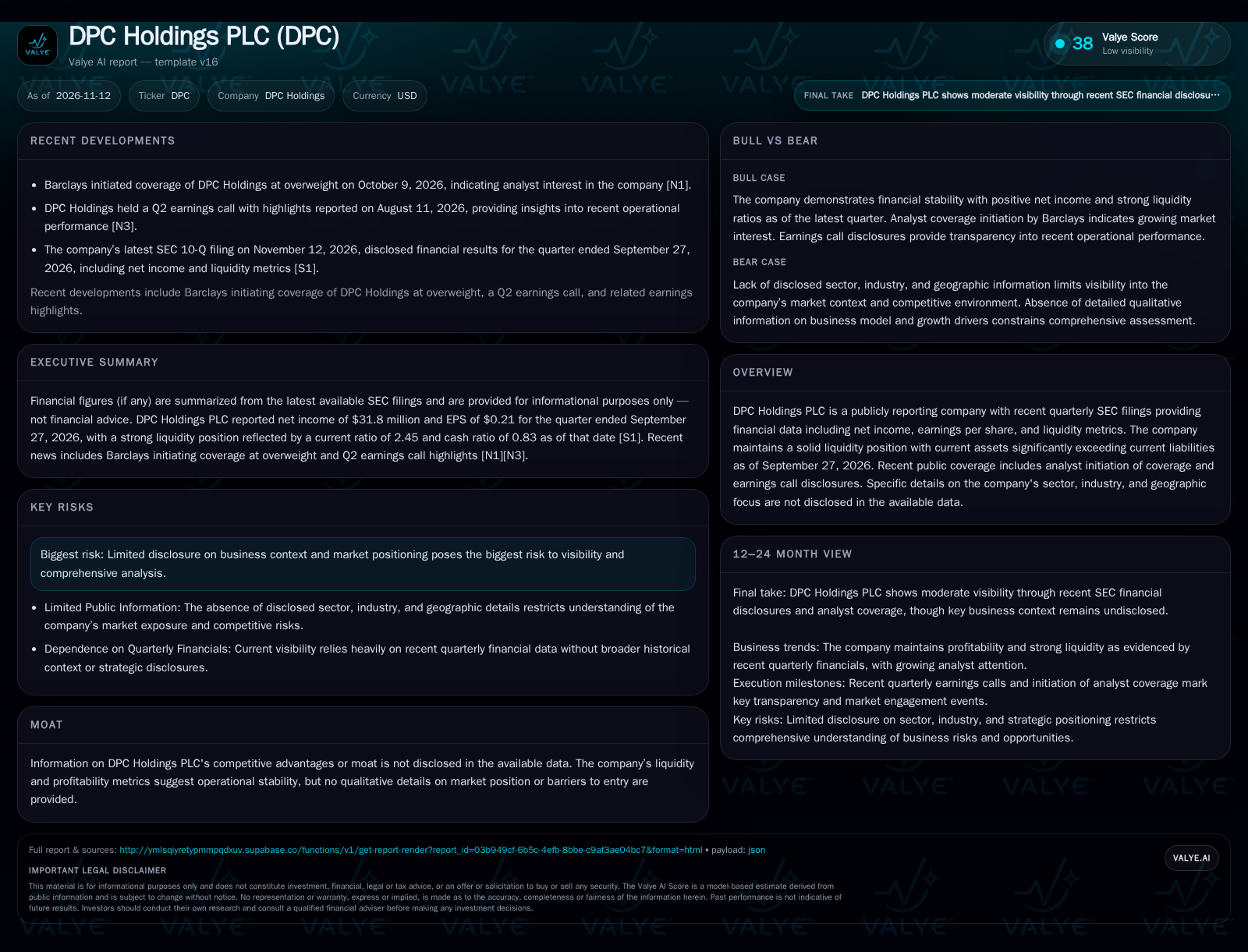
DPC Holdings PLC reported $31.8 million in net income and an 18.9% adjusted EBITDA margin for the quarter ending September 27, 2026, with $275.5 million in cash and a current ratio of 2.45. The business is concentrated in precision castings for aerospace and industrial gas turbine (IGT) markets, both of which are experiencing strong secular demand. Recent moves include the acquisition of a 50% stake in Montana Precision Products (MPP) and the signing of strategic partnership agreements, suggesting a push for scale and technical depth. However, margin sustainability, capital intensity, and exposure to macro or OEM cycles remain material questions for long-term value creation. [S1]
DPC Holdings PLC has emerged as a significant independent manufacturer of precision cast components and superalloys, with its financial disclosures for Q3 2026 underscoring both operational momentum and strategic ambition. Anchored in the structurally robust aerospace and industrial gas turbine sectors, DPC’s recent moves—including the acquisition of a major joint venture stake and a series of partnership agreements—suggest a bid for technical leadership and deeper OEM integration. However, as the company deploys capital into growth and navigates margin pressures from input costs and macro cycles, investors must weigh the durability of its competitive position against the capital demands and risks inherent in these complex markets. [S1]
Recent Results and Strategic Moves Define Near-Term Trajectory
DPC Holdings reported $308.1 million in revenue and $31.8 million in net income for Q3 2026, with an adjusted EBITDA margin of 18.9% and $275.5 million in cash on the balance sheet as of September 27, 2026. The company reported cash and liquidity metrics for the period; these figures do not by themselves establish operating runway, investment capacity, financial flexibility, or financing capacity. Notably, DPC completed the acquisition of a 50% stake in Montana Precision Products (MPP)—an aerospace manufacturing joint venture with GE Aerospace’s Unison Industries—expected to be earnings accretive within the first year. The company also signed its fifth strategic partnership agreement during the quarter, signaling an ongoing effort to deepen OEM relationships. Analyst coverage has expanded, with Barclays initiating at overweight in October 2026, suggesting increased market scrutiny and potential for re-rating. [S1] [N1]
How DPC Earns: Precision Scale, Fixed Cost Leverage, and Capital Intensity
DPC’s core economics rest on the manufacture of highly engineered precision castings and superalloys, serving primarily aerospace and IGT OEMs. These components are mission-critical, requiring advanced metallurgy, tight tolerances, and compliance with stringent certifications. Revenue mix is dominated by aerospace (35–39%) and IGT (42–47%), both end markets with high barriers to entry due to technical and regulatory requirements. Pricing power in these segments is often a function of qualification status, long-term supply relationships, and the limited number of global peers with comparable capabilities.
Gross margins in precision casting tend to be sensitive to input costs (notably metals), plant utilization, and contract structures. Adjusted EBITDA margins near 19% suggest some degree of operating leverage, but recent disclosures also mention margin dilution from metal cost inflation pass-through—implying that not all input cost increases can be immediately or fully offset via pricing. Capital expenditures were $13.8 million for the quarter and $33.6 million year-to-date, reflecting ongoing investment in manufacturing assets and a new greenfield superalloy facility. The acquisition of MPP further underscores a capital-intensive growth strategy. These dynamics suggest that while DPC can capture value through technical scale and OEM integration, returns on capital will hinge on margin discipline, asset utilization, and the ability to sustain volume growth without overextending the balance sheet. [S1]
Technical Barriers and Industry Consolidation: DPC’s Place in the Value Chain
DPC operates in a sector with significant technical barriers and a narrow field of global competitors—particularly after GE Aerospace’s acquisition of Consolidated Precision Products, one of DPC’s three most prominent direct peers. The company’s competitive position is anchored in its decades of engineering expertise, proprietary processes, and large-scale specialized casting equipment. These attributes enable DPC to meet demanding customer specifications and participate in OEM supply chains for both new-build and aftermarket components.
However, industry consolidation among OEMs and tier-1 suppliers can shift bargaining power and potentially compress margins for independent players. Strategic partnerships and the MPP joint venture may help DPC secure preferred supplier status and deeper integration into next-generation engine platforms, but dependence on a concentrated set of large OEM customers could also amplify exposure to production cycle swings and renegotiation risk. Substitution risk is relatively low given the certification hurdles and mission-critical nature of the products, but margin compression from input cost volatility and OEM consolidation represents a persistent counterforce.
OEM Integration and Platform Wins Drive Margin Expansion
A favorable scenario for DPC would involve successfully leveraging its technical capabilities and new partnerships to become a preferred supplier on high-volume, next-generation aerospace and IGT platforms. If the MPP acquisition achieves the projected accretive impact and facilitates access to new engine programs, DPC could realize higher utilization rates, improved pricing leverage, and incremental share of wallet with key OEMs. Sustained secular tailwinds—rising air travel, aging fleets, grid modernization—would provide underlying volume growth.
Evidence confirming this scenario would include: further expansion of long-term supply agreements, visible backlog growth into the 2030s, margin improvement despite input cost volatility, and positive commentary from OEM customers or partners. Accelerated revenue growth and return on invested capital (ROIC) above the cost of capital would further validate the upside. Conversely, signs of flat or declining margin, slow integration of MPP, or lack of new platform wins would challenge this thesis.
Steady Demand, Margin Pressures, and Disciplined Capital Deployment
The most plausible scenario is that DPC continues to benefit from secular demand in aerospace and IGT—driven by aircraft replacement cycles, grid reliability needs, and regulatory pressure for efficiency—but faces ongoing margin pressure from input cost inflation and periodic OEM production schedule changes. Revenue growth remains linked to the health of these end markets, with incremental gains from MPP and new partnerships offset by capital expenditures and integration costs.
Confirmation would come from stable or modestly growing revenue, EBITDA margins holding in the high teens, and prudent capital allocation that avoids overleveraging the balance sheet or overinvesting ahead of demand. Falsifying signals would include significant negative leverage (declining profitability despite revenue growth), evidence of impaired returns from new investments, or a material deterioration in customer concentration risk.
Cyclical Shocks and Cost Overruns Erode Profitability
A negative scenario would be triggered by a downturn in global air travel or energy infrastructure investment, leading to OEM production cuts, order deferrals, or renegotiations. If DPC cannot pass through input cost increases or faces underutilization of expanded capacity (for example, if the greenfield superalloy facility or MPP integration lags), margins could compress sharply. Capital intensity could become a liability if cash flow generation fails to keep pace with investment outlays, potentially forcing balance-sheet retrenchment or asset sales.
Evidence supporting this downside would include: sequential declines in revenue and EBITDA, rising working capital or debt levels, negative free cash flow, or the need to restructure supply arrangements. Early warning signs could also come from negative revisions to OEM production forecasts or broader macro shocks affecting demand for mission-critical castings.
Milestones That Will Test DPC Holdings’ Strategic Ambitions
Quarterly and annual trends in adjusted EBITDA margin, especially in relation to input cost volatility and capacity utilization.
Progress on integration and financial contribution from the Montana Precision Products (MPP) joint venture (e.g., accretion to earnings, new program wins, and operational synergies).
Capital expenditure levels and the pace of greenfield superalloy facility development, relative to revenue and cash flow generation.
Changes in revenue concentration by end market (aerospace vs. IGT) and by major OEM customer, if disclosed.
The number and scope of new or renewed long-term supply agreements with OEMs, and any disclosed backlog figures.
Any evidence of margin compression or cost overruns linked to metal price volatility or underutilization of new capacity.
Commentary on industry consolidation and DPC’s response to changes in customer or competitor structure, if addressed in future filings or calls.
Free cash flow trends and changes in net cash or leverage position, particularly following significant capital outlays or acquisitions.
Disclaimer: This is research-only, informational analysis and not investment advice. It may include AI-generated interpretation and general industry context. Always verify important details using primary sources.

Comments