
Range Capital Acquisition Corp II: SPAC Pathways, Execution Risk, and the Stakes of Capital Deployment
With $230 million in trust and no operating business yet, Range Capital Acquisition Corp II’s future depends entirely on its ability to execute a successful business combination amid a shifting SPAC landscape. The company’s experienced leadership and ample capital provide option value, but execution, target quality, and shareholder redemptions will ultimately determine investor outcomes.
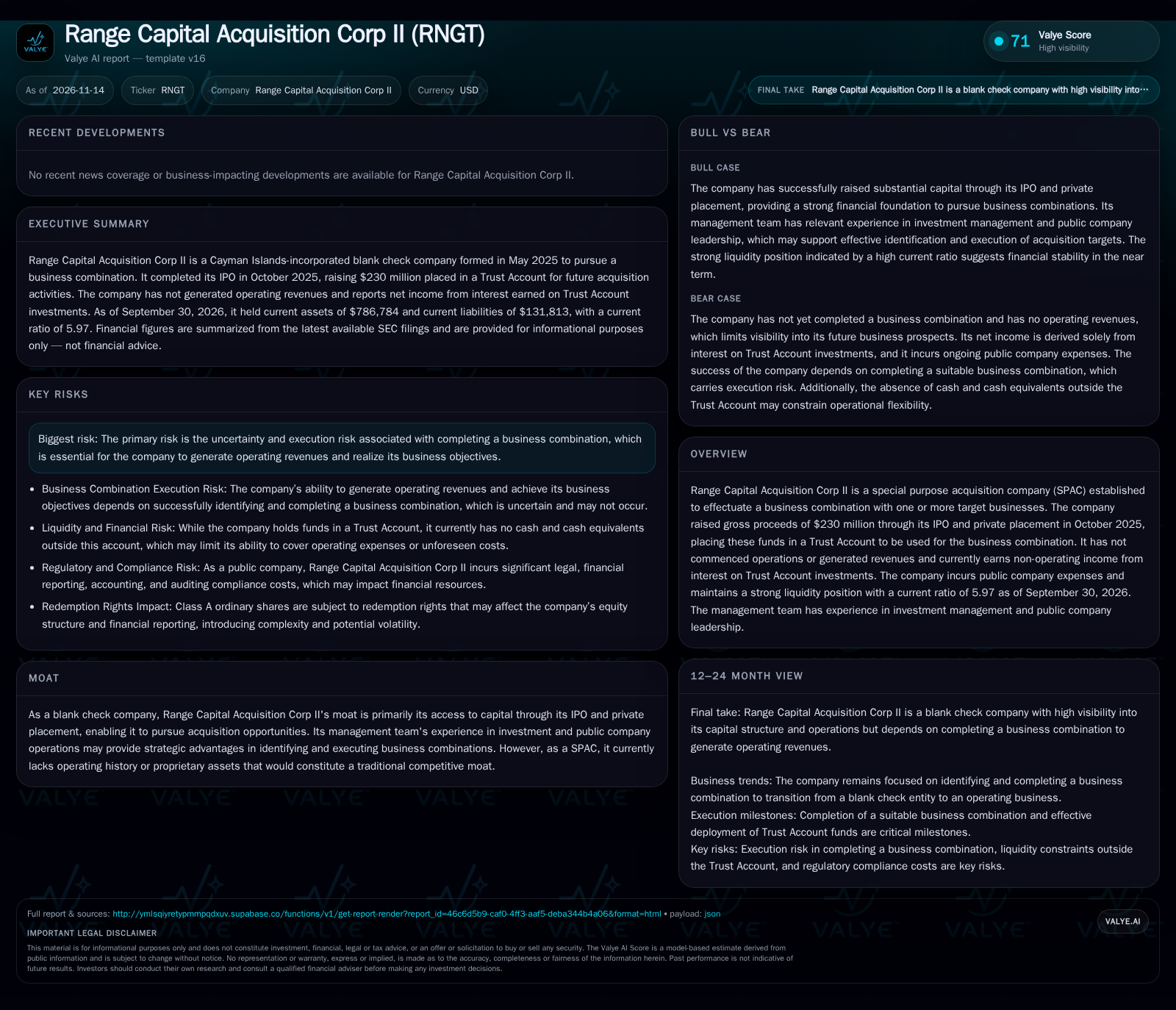
Range Capital Acquisition Corp II (RNGT) is a recently listed SPAC with $230 million in trust and no operating business as of September 30, 2026. Its future hinges on sourcing, negotiating, and executing a business combination. Management’s investment background and public company experience may help, but the company faces the same risks as all SPACs: deal execution, target quality, and the impact of potential redemptions. Until a deal is announced, RNGT’s value is almost entirely option-like, and investors must weigh the possibility of a value-creating transaction against the risk of no combination or a suboptimal deal. [S2]
Range Capital Acquisition Corp II (RNGT) exemplifies the modern SPAC: flush with IPO capital but lacking a defined business until it completes a merger or acquisition. As of September 30, 2026, RNGT has $230 million in trust, no operations, and no revenue beyond interest income. The company’s experienced leadership could be a differentiator, but execution risk looms large, given the competitive and regulatory headwinds facing blank check companies. For investors, RNGT is a pure play on the outcome of a yet-to-be-identified business combination, with significant uncertainty about both timing and value creation. [S2]
IPO Proceeds in Trust and the Absence of an Operating Business
Range Capital Acquisition Corp II completed its IPO on October 6, 2025, raising $230 million by issuing 23 million units at $10.00 per unit. An additional $6.6 million was raised via a private placement, with all proceeds held in a trust account designated for a future business combination. As of September 30, 2026, the company had not commenced operations, reported no operating revenues, and its only income was $2,028,953 in net interest from trust account investments. Current assets outside the trust are limited ($786,784), and there is no cash available for operations beyond the trust account. The current ratio of 5.97 reflects these restricted assets, not operational liquidity. Until a business combination is completed, RNGT’s equity value and future prospects remain entirely contingent on deal execution. [S2]
SPAC Economics: Option Value, Incentives, and Dilution Dynamics
A SPAC like RNGT generates no operating revenue until it completes a merger or acquisition. Its current earnings are solely from interest on the trust account, which is temporary and non-core. The company incurs ongoing public company expenses—legal, financial reporting, accounting, and compliance costs—which will gradually erode the value available to shareholders if no deal is closed within the SPAC’s permitted timeframe (typically 18–24 months post-IPO).
Upon a successful business combination, the economics shift dramatically: the trust account is used to fund the acquisition, and RNGT becomes an operating company with the acquired business’s revenue and cash flows. The value for shareholders then depends on the quality of the target, the price paid, and the integration and growth prospects post-merger.
SPAC structures also introduce dilution through sponsor shares, warrants, and potential PIPE (private investment in public equity) deals. If redemptions are high—meaning many shareholders opt to redeem their shares for trust value instead of staying invested in the combined company—the resulting capital and float may be much smaller than the headline IPO proceeds. The net result is that pre-deal, RNGT’s shares are essentially a financial option on management’s ability to find and execute an attractive transaction.
SPAC Market Saturation and the Role of Management Track Record
RNGT competes in a crowded SPAC market, where dozens of blank check companies vie for a limited pool of attractive private targets. Success is heavily influenced by the management team’s network, negotiation skill, and reputation. RNGT’s leadership, with experience in investment management, ETF asset management, and public company operations, may help differentiate it in the eyes of potential targets who value post-merger public company stewardship.
However, the competitive landscape is not just other SPACs—direct listings, venture capital exits, and traditional IPOs all represent alternative paths for private companies. The recent tightening of regulatory oversight and investor skepticism toward SPACs post-2021 boom further raises the bar for deal quality and post-merger performance. Without a unique sourcing advantage or deal structure, RNGT must compete primarily on its ability to offer certainty, speed, and favorable terms to potential targets.
Value Creation Through a High-Quality Business Combination
The most favorable outcome for RNGT investors is a timely merger with a high-growth, scalable private company at a reasonable valuation. If the management team leverages its investment acumen and network to identify a target with strong fundamentals, the resulting operating company could justify a significant re-rating of RNGT shares post-deal. Confirmation of this scenario would include the announcement of a definitive business combination agreement with a credible, well-understood target, limited shareholder redemptions, and the ability to attract additional PIPE financing or strategic partners.
Further signals would be a clear, compelling investor presentation outlining the target’s growth trajectory, margins, and competitive advantages, as well as favorable market reaction to the deal announcement. Evidence against this scenario would be delays, failure to secure a target, or a deal announcement met with high redemptions and negative investor sentiment.
The Probable Path: Deal Uncertainty and Option-Like Equity
Absent a standout target, the most likely scenario is that RNGT continues to search for a business combination, incurring public company costs while earning modest interest on trust assets. The equity remains a time-decaying option: if a deal is announced, shareholders must assess its quality and redemption risk; if not, trust value minus expenses is eventually returned to investors upon SPAC liquidation.
This middle path is confirmed by continued lack of business combination announcements, steady erosion of trust value due to operating expenses, and little movement in share price above net asset value. Falsification would come from an unexpectedly attractive deal or from rapid deterioration in SPAC market conditions that force early liquidation.
Failure to Close a Deal or Destructive Dilution
The primary risk is that RNGT fails to identify or close a business combination within the required timeframe. In this scenario, the company would liquidate and return trust proceeds to shareholders, less expenses. This outcome caps upside and exposes investors to opportunity cost and the erosion of trust value from ongoing costs.
A secondary risk is a 'bad deal': management, facing time pressure, merges with a lower-quality target or overpays, resulting in post-merger underperformance. If redemptions are high, the effective cash delivered to the target is minimal and the resulting public float is thin, potentially increasing volatility and limiting value creation. Confirming evidence would include multiple deadline extensions, lack of credible target announcements, or a deal announcement followed by high redemptions and negative post-close returns.
Milestones That Will Define RNGT’s Trajectory
Announcement of a definitive business combination agreement, including the identity and financial profile of the target.
Level of shareholder redemptions upon deal announcement and prior to merger close—a high redemption rate could undermine deal economics.
Ability to attract PIPE financing or strategic partners alongside the business combination, if disclosed.
Ongoing trust account value and the pace of expense accrual, which directly affect net asset value per share.
Deadlines for deal completion and any requests for extensions, which signal execution risk or time pressure.
Management’s public communication regarding deal pipeline, target sectors, or acquisition criteria, if disclosed.
Regulatory or market shifts that could impact SPAC dealmaking or redemption mechanics, such as changes in SEC rules or prevailing investor sentiment.
Disclaimer: This is research-only, informational analysis and not investment advice. It may include AI-generated interpretation and general industry context. Always verify important details using primary sources.

Comments